


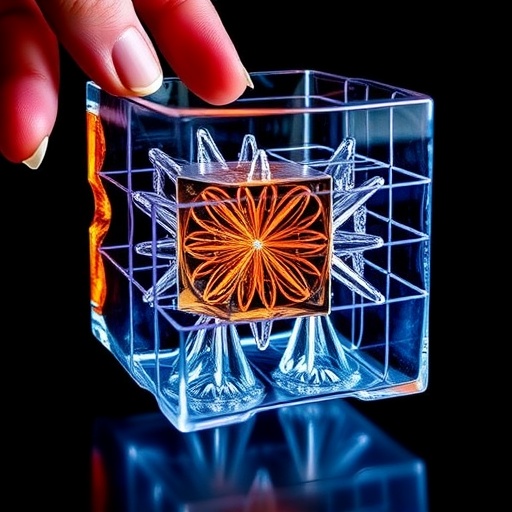
Scientists have unveiled a groundbreaking advancement in the field of metal–organic framework (MOF) glasses, applying age-old chemical principles to tailor the properties of these innovative materials. MOFs—constructed from metal ions linked by organic molecules—have surged to the forefront of materials science due to their remarkable porosity, capable of sieving gases such as carbon dioxide and hydrogen, or even capturing and storing water molecules. The researchers’ pioneering work demonstrates an unprecedented degree of control over MOF glasses, enabling their behavior and structural characteristics to be finely tuned much like traditional silicate glasses.
This pioneering study, recently published in the prestigious journal Nature Chemistry, marks a pivotal milestone in the evolution of MOF glasses. Conducted by an international collaboration including scientists from TU Dortmund and the University of Birmingham, the research reveals how introducing alkali ions—specifically sodium and lithium—can fundamentally alter the thermal and mechanical properties of MOF glasses. The modification lowers the melting and softening temperatures of these hybrid materials, a critical factor that has historically hampered large-scale industrial processing due to their requisite high softening point near 300 °C.
In conventional silicate glasses, the inclusion of small amounts of chemical modifiers has long been known to disrupt the glass network, consequently adjusting melting behavior and flow characteristics. Translating this foundational concept to MOF glasses is a remarkable leap, given the entirely different chemical nature and hybrid organic-inorganic lattice of MOFs. Prior to this work, MOF glasses such as ZIF-62, which exhibit intrinsic porosity even in their amorphous glassy state, could only be processed at temperatures perilously close to their decomposition point, significantly limiting practical applications in areas like gas separation membranes, catalysis, and chemical storage.
Through sophisticated experimentation, the team devised a method to embed sodium ions into the MOF glass network, producing a glass with a softened structure and improved thermal workability. State-of-the-art solid-state nuclear magnetic resonance (NMR) spectroscopy, performed at the UK High-Field Solid-State NMR Facility, provided atomic-level insights into how these sodium ions interact within the glass matrix. Far from simply occupying void spaces, sodium substitutes some of the metal centers—zinc atoms in this case—thereby delicately perturbing the connectivity of the metal-organic framework and loosening its overall network.
The researchers employed cutting-edge computational modeling supported by artificial intelligence to unravel the complex experimental data and gain a more profound understanding of the glass’s altered atomic arrangement. Machine-learning-assisted simulations verified that sodium ions integrate in a way that partially disrupts the network without compromising key structural features necessary to retain porosity. This synergy of experimental and computational tools exemplifies the future of materials research, where AI bridges gaps in deciphering intricate molecular architectures.
An essential implication of this discovery is its potential to catalyze the development of bespoke MOF glasses with tailored physical and chemical attributes optimized for specific industrial applications. By controlling alkali-ion incorporation, manufacturers could fabricate MOF glasses that combine ease of processing with essential functionality, such as selective gas adsorption or catalytic activity. The lowered softening temperature allows for processing well below degradation thresholds, vastly enhancing material lifespan and sustainability.
Historically, MOF glasses have been overshadowed by traditional glasses due to challenges in manufacturing and stability. However, this development paves the way for MOF glasses to transcend laboratory curiosities and emerge as candidate materials in sectors that demand sophisticated molecular sieves or selective barrier layers. Beyond membranes, these tunable glasses hold promise for advanced coatings that require both porosity and mechanical resilience, expanding their technological footprint.
Moreover, this research underscores the universality of chemical principles across material classes, demonstrating that strategies successful in silicate glass modification can be adapted to hybrid organic-inorganic frameworks. This cross-pollination of ideas is fueling innovation at an unprecedented pace, and it opens exciting avenues for interdisciplinary collaborations among chemists, materials scientists, and engineers.
Despite these breakthroughs, the authors caution that further study is essential to comprehensively map stability parameters, refine prediction capabilities, and rigorously test these alkali-ion-modified MOF glasses in application settings. Understanding long-term thermal, chemical, and mechanical durability remains critical before deployment in real-world technologies.
Central to the project was the synergy between experimentalists and theoreticians, showcasing how advanced characterization paired with AI-driven molecular simulations can unravel complexities inherent in novel glassy materials. This combined approach sets a new standard for how future materials with intricate atomic architectures should be studied and optimized.
In conclusion, the discovery that alkali ions can serve as effective network modifiers within MOF glasses heralds a new era for these hybrid materials. Lowering the operational softening temperature without sacrificing internal porosity enables scalable manufacturing routes, opening a vast landscape of technological applications awaiting exploration in environmental, energy, and chemical sectors. As scientific understanding deepens, alkali-ion-modified MOF glasses stand poised to become indispensable tools in the quest for sustainable and high-performance materials.
News Publication Date: 4-May-2026
Keywords
Materials, Glass, Metallic glasses, Physical sciences, Chemistry, Organic chemistry, Molecular chemistry
Cite Scienmag News
Bethany Barker. (May 4, 2026). Researchers Pioneer Innovative Technique to Design Next-Generation Glass. Scienmag. https://scienmag.com/researchers-pioneer-innovative-technique-to-design-next-generation-glass/
Bethany Barker. "Researchers Pioneer Innovative Technique to Design Next-Generation Glass." Scienmag, 4 May 2026, https://scienmag.com/researchers-pioneer-innovative-technique-to-design-next-generation-glass/. Accessed 4 September 2026.
Bethany Barker. "Researchers Pioneer Innovative Technique to Design Next-Generation Glass." Scienmag. May 4, 2026. https://scienmag.com/researchers-pioneer-innovative-technique-to-design-next-generation-glass/


