


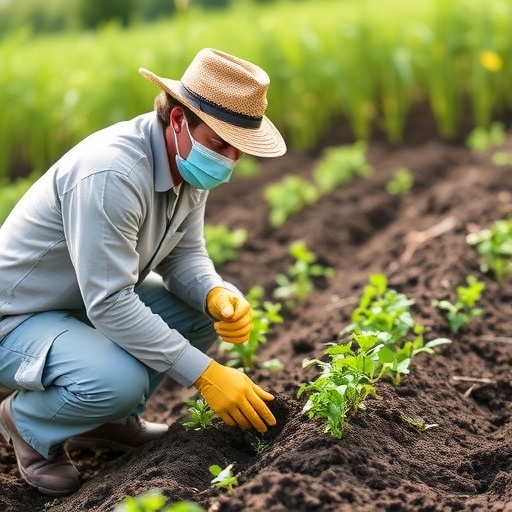
In a groundbreaking advancement at the intersection of environmental science and occupational health, researchers have unveiled a sophisticated exposure scenario tailored specifically for farmworkers, aiming to quantify and mitigate their contact with per- and polyfluoroalkyl substances (PFAS) through soil contamination. This novel framework, detailed in a recent study led by Lupolt, Simones, and Gillooly, addresses a critical gap in risk assessment methodologies by contextualizing the unique exposure patterns characteristic of agricultural laborers, a group historically underrepresented in environmental health research.
Farmworkers often engage directly with soil over prolonged periods, and this direct contact raises significant concerns given the persistence and bioaccumulation potential of PFAS compounds, often dubbed “forever chemicals.” These substances, prevalent due to widespread industrial use, have been detected in soils globally, raising alarms about their inadvertent transfer to humans through dermal contact, ingestion, and inhalation of soil particles. Yet, the lack of tailored models to evaluate these exposure routes has hindered regulatory bodies from establishing effective soil screening levels—that is, thresholds under which soil PFAS concentrations are deemed safe for human activity.
The research team took a comprehensive and methodical approach to developing this farmworker soil exposure scenario. By integrating detailed behavioral data, environmental measurements, and bioavailability metrics, they have crafted a nuanced model that captures the frequency, duration, and intensity of soil contact events typical of farmwork. This includes data on hand-to-mouth activity, the use of personal protective equipment, variations in soil moisture and texture influencing PFAS adherence, and day-to-day work patterns that alter exposure profiles seasonally and geographically.
Crucially, the study emphasizes the importance of considering farmworkers’ unique occupational setting rather than applying generic exposure assumptions often derived from residential or recreational scenarios. For instance, typical exposure assessments often underestimate soil ingestion and dermal absorption for populations engaging in agricultural labor, failing to account for factors such as continuous handling of soil, mixing tasks that disturb subsurface soil layers where PFAS concentration might be higher, and limited opportunities for hand hygiene during the workday. This tailored scenario represents a significant evolution beyond one-size-fits-all models, fostering more accurate risk characterizations.
The development process was underpinned by extensive fieldwork, reflecting on-the-ground realities faced by farmworkers. The team employed direct observations, surveys, and biomonitoring data to ascertain the typical pathways through which PFAS might enter the body. Such multidimensional data collection helped calibrate the exposure assumptions to real-world actions and eventual biological uptake. Moreover, the inclusion of variability factors, accounting for differences in farming practices and regional environmental PFAS levels, lends strong adaptability to the model, ensuring broad applicability across diverse agricultural settings.
One of the study’s central contributions is to enhance the scientific basis for deriving soil screening levels specific to PFAS. Soil screening levels are pivotal in guiding regulatory decisions—they delineate soil contamination criteria that trigger remediation or restrict land use. Without realistic exposure models, these levels risk either overestimating the danger, leading to unnecessary economic burden, or underestimating risks, compromising worker health. By equipping regulators with data reflecting actual farmworker interactions with PFAS-contaminated soils, policy can stride towards protection priorities that are both scientifically sound and socially responsible.
The challenge of PFAS is multifaceted. These compounds are notable for their chemical stability, resistance to degradation, and widespread industrial utilization, ranging from firefighting foams to food packaging. Consequently, PFAS contamination has intricately woven into environmental compartments including water, air, and soil. However, soil as an exposure medium, particularly for specific populations like farmworkers, demands nuanced understanding due to complex sorption-desorption dynamics, soil type heterogeneity, and interplay with other agricultural chemicals, which can influence bioavailability and toxicity.
Advancing the dialogue, this research sets a precedent for future exposure science methodologies concerning emerging contaminants. It underscores the imperative of population-specific scenarios that integrate occupational and environmental data streams to render exposure assessments representative of real-world contexts. This paradigm shift fosters more targeted public health interventions, ensuring vulnerable groups receive protection calibrated to their specific exposure circumstances.
The mathematical underpinnings of the developed scenario are grounded in mechanistic exposure equations that incorporate parameters such as soil adherence factors, transfer efficiencies, particle ingestion rates, and absorption coefficients. By parameterizing these inputs with empirical data, the model can generate probabilistic exposure distributions rather than deterministic point estimates, thus embracing uncertainty and variability inherent in environmental health sciences.
Furthermore, the model’s flexibility allows incorporation of emerging knowledge on PFAS toxicity, enabling dynamic updates as toxicological benchmarks evolve. This integration ensures that soil screening levels remain both protective and adaptive, enhancing long-term policy resilience amid shifting scientific landscapes. Equally important is the model’s potential role in epidemiological studies, where refined exposure metrics can elucidate dose-response relationships with greater precision.
The societal implications of this work extend beyond regulatory frameworks. By illuminating the pathways and magnitudes of PFAS exposure for farmworkers, it reinforces the need for occupational health protections, including personal protective equipment guidelines, hygiene interventions, and exposure reduction strategies on farms. Concurrently, it draws attention to broader environmental justice concerns, given that farmworkers often belong to marginalized and underserved communities, disproportionately facing environmental health risks.
As regulatory agencies worldwide grapple with PFAS contamination, this study contributes a vital piece to the complex puzzle of risk assessment, moving towards comprehensive, realistic, and equitable exposure characterization. The collaborative, interdisciplinary approach evidenced by Lupolt and colleagues exemplifies how environmental science can inform practical solutions to emerging chemical threats—transforming abstract risk concepts into actionable policy and worker protections.
Looking ahead, the research team envisions expanding this model to encompass cumulative exposures from multiple PFAS compounds and synergistic effects with other environmental contaminants common in agricultural settings. Advancements in biosensing technologies and real-time exposure monitoring may soon offer opportunities to validate and refine the scenario further, bridging model predictions with observed biomarker levels. Such innovations promise an era of precision exposure assessment that transcends the current paradigms.
In conclusion, the development of a dedicated farmworker soil exposure scenario for PFAS represents a landmark achievement with profound implications for environmental health sciences, occupational safety, and regulatory policy. It redefines the standards of exposure assessment for persistent environmental contaminants in agricultural contexts, advocating a future where science-driven protections safeguard the well-being of those who nourish the world.
Cite Scienmag News
Ophelia Keating. (April 27, 2026). Farmworker Soil Exposure Aids PFAS Screening Levels. Scienmag. https://scienmag.com/farmworker-soil-exposure-aids-pfas-screening-levels/
Ophelia Keating. "Farmworker Soil Exposure Aids PFAS Screening Levels." Scienmag, 27 April 2026, https://scienmag.com/farmworker-soil-exposure-aids-pfas-screening-levels/. Accessed 5 September 2026.
Ophelia Keating. "Farmworker Soil Exposure Aids PFAS Screening Levels." Scienmag. April 27, 2026. https://scienmag.com/farmworker-soil-exposure-aids-pfas-screening-levels/


