


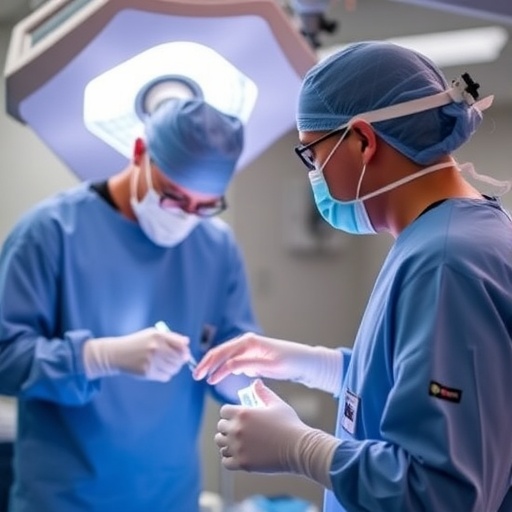
In a groundbreaking advancement for surgical care, UC San Diego Health has become the first health system on the West Coast to perform spine surgery utilizing a cutting-edge robotic platform that integrates advanced imaging and artificial intelligence-guided assistance. This novel technology represents a significant leap forward in precision and safety, ushering in a new era for complex spine surgeries. Leading this transformative initiative is Dr. Joseph Osorio, MD, PhD, a neurosurgeon renowned for his expertise in complex spinal procedures and innovative treatment methodologies.
Dr. Osorio, who also serves as the chief of spine surgery in the Department of Neurological Surgery at the University of California San Diego School of Medicine, emphasizes the revolutionary nature of this platform. He explains that it unifies artificial intelligence, data-driven alignment strategies, patient-specific implant design, robotic navigation, and automated screw placement into one seamless system. Such an integrative approach offers unprecedented precision and coordination during operations, enabling surgeons to work more efficiently while significantly minimizing potential risks to patients.
At the core of this new system is the convergence of smart computer algorithms with tailored implants, real-time imaging, and robotic assistance—all designed to enhance surgical accuracy. The robotic platform generates a comprehensive three-dimensional visualization of each patient’s unique spinal anatomy, providing surgeons with an exceptionally detailed view during surgery. This enhanced visualization capability introduces robust safety protocols that mitigate errors in implant placement, a critical factor when addressing the intricacies of the spinal column.
The technology’s AI-driven planning capability is particularly transformative, allowing the creation of highly personalized surgical strategies optimized for each patient’s specific anatomical and functional needs. According to Dr. Alexander Khalessi, MD, MBA, chief innovation officer at UC San Diego Health and chair of the Department of Neurological Surgery, this precision planning, coupled with intra-operative imaging and robotic workflows, empowers surgeons to execute procedures with an unmatched level of safety and efficiency. Patients can thus anticipate not only meticulous technical execution but also smoother postoperative recoveries.
Spine fusions, a common yet complex surgical intervention, stand to benefit significantly from this platform. By tailoring spinal alignment and implant positioning to individual anatomical nuances, the system boosts the predictability and consistency of outcomes. In addition, streamlining operating room workflows reduces procedure times, which can contribute to lower risks of complications and faster patient rehabilitation.
This advancement is a direct response to the growing need for sophisticated tools that can address the multifaceted challenges presented by spinal disorders. The integration of AI and robotics tackles critical issues such as intraoperative variability, surgeon fatigue, and the high demands of precision required when operating near delicate neural structures. The platform’s ability to harmonize multiple technological components into a single, user-friendly interface is a testament to the progress made in surgical innovation.
More than just a technological enhancement, this system represents a paradigm shift in how neurosurgical teams collaborate during complex procedures. Incorporating robotics and AI into the surgical workflow optimizes communication and coordination among surgeons, anesthesiologists, and specialized technicians, ultimately elevating institutional standards of care. The implementation at UC San Diego Health signals a commitment to advancing academic medicine through the deployment of next-generation tools to the clinical frontlines.
UC San Diego Health’s spine program, acknowledged for excellence by The Joint Commission, has been a leader in neurosurgical modernization for years. This latest technological adoption further strengthens its position as a hub of innovation in treating spinal conditions. The program brings together a multidisciplinary team that includes neurosurgeons, orthopedic experts, rehabilitation clinicians, and pain management professionals, ensuring holistic patient care from conservative interventions through complex surgical reconstructions.
Such innovations have been recognized by top-tier hospital rankings as well. UC San Diego Health’s neurology and neurosurgery department consistently ranks among the nation’s best in the annual U.S. News & World Report “Best Hospitals” listings. This new robotic platform aligns perfectly with the institution’s ongoing dedication to research, technological advancement, and interdisciplinary approaches, reinforcing its reputation as a center of excellence and patient-centric innovation.
Dr. Osorio highlights that the platform not only improves surgical outcomes but also elevates patient confidence. The integration of data-driven planning and intraoperative precision allows patients to be assured that the surgical objectives will be met with the utmost accuracy. This assurance of technical success is pivotal in fostering more positive recovery experiences and long-term functional improvements.
Looking ahead, the adoption of AI-powered robotics in spine surgery heralds a future where surgeries are safer, more efficient, and less prone to human error. UC San Diego Health’s early embrace of this technology serves as a model for institutions nationwide, demonstrating the tangible benefits of combining engineering advances with medical expertise. As this technology continues to evolve, it is poised to redefine standards in neurosurgical practices globally.
In summary, UC San Diego Health’s introduction of this AI-augmented robotic spine surgery system represents a seminal moment in surgical innovation. By combining artificial intelligence, precision robotics, patient-specific implants, and advanced imaging, the institution has set a new benchmark for spine surgery on the West Coast. This pioneering effort exemplifies how technology can elevate patient care, surgical accuracy, and overall healthcare outcomes in the complex realm of spinal procedures.
News Publication Date: Not specified in the provided content
Web References:
https://mediasvc.eurekalert.org/Api/v1/Multimedia/83aaa879-3df3-4cf8-a7dc-a74df6528f9c/Rendition/low-res/Content/Public
Cite Scienmag News
Ophelia Keating. (April 27, 2026). UC San Diego Health Pioneers First AI-Driven Robotic Spine Surgery on the West Coast. Scienmag. https://scienmag.com/uc-san-diego-health-pioneers-first-ai-driven-robotic-spine-surgery-on-the-west-coast/
Ophelia Keating. "UC San Diego Health Pioneers First AI-Driven Robotic Spine Surgery on the West Coast." Scienmag, 27 April 2026, https://scienmag.com/uc-san-diego-health-pioneers-first-ai-driven-robotic-spine-surgery-on-the-west-coast/. Accessed 4 September 2026.
Ophelia Keating. "UC San Diego Health Pioneers First AI-Driven Robotic Spine Surgery on the West Coast." Scienmag. April 27, 2026. https://scienmag.com/uc-san-diego-health-pioneers-first-ai-driven-robotic-spine-surgery-on-the-west-coast/


