


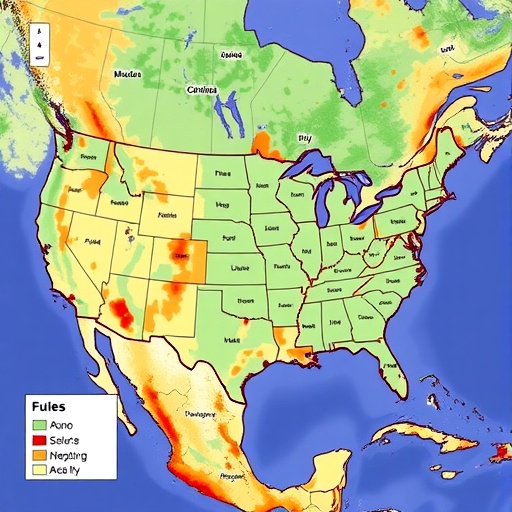
A groundbreaking initiative led by researchers from Weill Cornell Medicine and Boston University School of Public Health has secured over $950,000 in funding from Arnold Ventures to develop an innovative “Medicaid Atlas.” This ambitious national web platform promises to transform how healthcare spending and utilization patterns are analyzed across Medicaid programs, managed care plans, and diverse populations nationwide. By consolidating fragmented data into a comprehensive, user-friendly interface, the project aims to provide actionable insights for policymakers grappling with the complexities of Medicaid financing and delivery.
Medicaid, as one of the largest expenditures in state budgets, remains notoriously difficult to analyze comprehensively due to its decentralized administration across states and reliance on private managed care organizations. The lack of standardized, accessible data has limited the ability of health policy experts and state officials to discern the factors driving spending variability. The Medicaid Atlas endeavors to change this paradigm by offering detailed comparative data that elucidate spending patterns and service utilization across multiple dimensions, including geographic regions, health plans, and enrollee demographics.
Dr. William Schpero, assistant professor of population health sciences at Weill Cornell Medicine and co-leader of the project, emphasizes the critical need for improved data transparency. “Medicaid is a massive program with complex spending variation that remains poorly understood. Our goal is to illuminate these variations by harnessing detailed claims data in a way that empowers rapid, evidence-informed policy decisions,” he explains. The fragmented landscape of Medicaid has thus far hampered efforts to produce timely and comparable analyses, limiting policymakers’ ability to respond adaptively to shifting fiscal pressures.
The impetus for creating the Medicaid Atlas coincides with increasing financial constraints faced by state Medicaid programs, particularly in light of funding reductions associated with recent legislative changes, such as the One Big Beautiful Bill Act. State leaders urgently require dynamic tools capable of providing granular, real-time insights into where spending is concentrated and identifying systemic inefficiencies or inequities. The Medicaid Atlas aims to facilitate such insights with a dashboard that distills millions of claims into interpretable measures, available at the click of a button.
Co-lead Dr. Sarah Gordon, associate professor at Boston University School of Public Health and co-director of the BU Medicaid Policy Lab, highlights the shift toward more accessible, high-quality federal claims data as a foundational enabler for the project. “Recent releases of comprehensive national Medicaid claims datasets allow us to conduct sophisticated, cross-state analyses for the first time,” she remarks. The Medicaid Atlas builds upon this data infrastructure, leveraging advancements in data science and health services research to peel back the layers of spending complexity.
The research team intends to develop an initial battery of 10 to 15 key metrics that capture major drivers of Medicaid spending and utilization. These metrics will be carefully selected in consultation with state Medicaid leaders to ensure relevance and utility for policy development. By aligning the atlas’s focus with stakeholder priorities, the platform endeavors to directly address pressing questions regarding efficiency, care quality, and population health outcomes within state Medicaid programs.
Importantly, the platform goes beyond crude spending comparisons; it integrates detailed information about enrollee populations and plan types, acknowledging how diverse care management approaches and regional factors impact utilization and cost. This nuanced view enables a deeper understanding of which interventions or care delivery models yield the greatest value, informing targeted policy reforms aimed at optimizing Medicaid’s effectiveness.
The conceptual precedent for this initiative is the venerable Dartmouth Atlas of Health Care, a landmark research project that used Medicare claims data to reveal geographic variation in health services utilization and spending. The Dartmouth Atlas’s findings directly informed durable national policy reforms including aspects of the Affordable Care Act. Dr. Schpero hopes that the new Medicaid Atlas will have a similarly transformative impact on state and federal Medicaid policymaking.
The creation of a national Medicaid data resource marks a significant stride in overcoming longstanding barriers posed by siloed and fragmented claims information. Traditionally, obtaining even basic analytics required resource-intensive, custom data requests handled piecemeal by individual states or insurers. The new platform seeks to embed cutting-edge analytics into a single, accessible tool that accelerates evidence generation throughout the policymaking cycle.
As Medicaid grapples with evolving demographic pressures, chronic disease burdens, and disparities in access and outcomes, the availability of timely, actionable data becomes paramount. The atlas will enable not only states but also researchers, journalists, and the public to benchmark Medicaid performance, detect variations, and surface best practices. This democratization of data aims to enhance transparency and accountability across the healthcare system.
In addition to facilitating immediate policymaking needs, the Medicaid Atlas project aligns with a broader vision at Cornell and partner institutions to integrate rigorous data science into health equity advancement and health system improvement. The Medicaid Policy Impact Initiative at Weill Cornell Medicine, directed by Dr. Schpero, exemplifies this approach by synthesizing research, data infrastructure, and stakeholder engagement to translate complex evidence into practical guidance.
By making Medicaid data insights readily accessible, the atlas holds promise not only for efficiency improvements but also for advancing equity and high-quality care delivery. Its capacity to spotlight variation within states as well as across states ensures that subtle inequities and systemic challenges can be identified and addressed. In this way, the Medicaid Atlas is poised to become a cornerstone resource for the next generation of Medicaid reform efforts.
Ultimately, this initiative signals a pivotal evolution in how Medicaid policy research is conducted and utilized. With state budgets strained and demands on Medicaid growing, the ability to harness comprehensive data analytics swiftly and precisely could redefine the scope and impact of health policy interventions. As data-driven decision-making becomes standard practice, the Medicaid Atlas may serve as a prototype for other complex public programs seeking similar transformation.
News Publication Date:
Not specified
Web References:
- Medicaid Policy Impact Initiative: https://www.medicaidpolicyimpact.org/
- Boston University School of Public Health: https://www.bu.edu/sph/
- Arnold Ventures: https://www.arnoldventures.org/
- Medicaid Data Learning Network: https://academyhealth.org/about/programs/medicaid-data-learning-network
- Dartmouth Atlas of Health Care: https://www.dartmouthatlas.org/
- Cornell Health Policy Center: https://healthpolicycenter.cornell.edu/chpc/
- BU Medicaid Policy Lab: https://www.bu.edu/sph/departments/health-law-policy-and-management/medicaid-policy-lab/
Cite Scienmag News
Courtney Benton. (April 27, 2026). Grant Fuels Development of Comprehensive Atlas Mapping Medicaid Expenditures. Scienmag. https://scienmag.com/grant-fuels-development-of-comprehensive-atlas-mapping-medicaid-expenditures/
Courtney Benton. "Grant Fuels Development of Comprehensive Atlas Mapping Medicaid Expenditures." Scienmag, 27 April 2026, https://scienmag.com/grant-fuels-development-of-comprehensive-atlas-mapping-medicaid-expenditures/. Accessed 5 September 2026.
Courtney Benton. "Grant Fuels Development of Comprehensive Atlas Mapping Medicaid Expenditures." Scienmag. April 27, 2026. https://scienmag.com/grant-fuels-development-of-comprehensive-atlas-mapping-medicaid-expenditures/


