


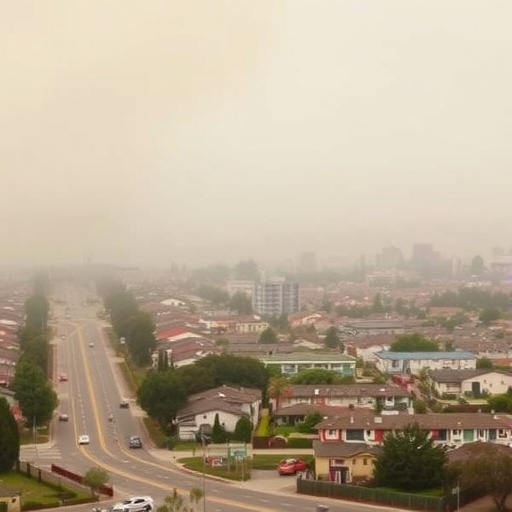
In a groundbreaking peer-reviewed study published in Urban Forestry & Urban Greening, scientists from California Polytechnic State University have reshaped our understanding of urban wildfire dynamics. Their comprehensive analysis of the 2025 Southern California firestorms—specifically the Eaton and Palisades fires—reveals that building density, not urban tree canopy, plays the pivotal role in determining home destruction during extreme fire events. By meticulously studying over 15,000 structures and nearly 53,000 tree canopies within the affected fire scars, the research offers critical insights into the fire’s behavior amid densely populated urban landscapes.
The study leveraged an integrative methodology, combining high-resolution LiDAR mapping, satellite imagery, and detailed CAL FIRE damage inspections with robust wind modeling. This interdisciplinary approach enabled precise evaluations of how structural proximity and vegetation influenced fire spread and structural loss. Contrary to prevailing assumptions that urban trees significantly exacerbate fire risks, the findings show that the spatial arrangement and density of buildings dictate the primary pathways for fire propagation. This nuance challenges existing wildfire mitigation frameworks that disproportionately emphasize vegetation removal around homes.
“Our research demonstrates that houses themselves become the main fuel sources during these extreme urban firestorms,” explained Dr. Reed Kenny, the study’s lead author and a biological sciences lecturer at Cal Poly. “Once the fire penetrates a neighborhood, the way flames leap from building to building essentially determines the extent of destruction—not the presence or absence of trees.” This assertion shifts the paradigm towards viewing built environments as critical fire vectors rather than natural elements like urban canopy.
Delving into the granular results, each additional structure per hectare markedly increased the probability of home loss. This effect was observed consistently across both the Palisades and Eaton fire zones. Interestingly, tree canopy influences were not only minor but also inconsistent—in some cases, tree presence correlated with reduced structural damage. Simulated scenarios eliminating tree canopy within a two-meter radius around homes resulted in minimal reduction of fire losses, indicating that aggressive vegetation removal in immediate proximity to buildings holds limited efficacy in mitigating damage under these fire conditions.
The implications of these findings are especially relevant against the backdrop of California’s new “Zone Zero” defensible space policies, which mandate ember-resistant zones requiring removal of vegetation within five feet of structures. The study urges caution in implementing such measures enthusiastically without more definitive evidence linking tree canopy directly to property loss. Urban forests contribute critical ecosystem services, including shade, ambient cooling, stormwater management, and air purification, with tangible benefits for public health and urban sustainability. Large-scale canopy removal may therefore impose unintended environmental and social costs far outweighing marginal fire safety gains.
Instead, the research advocates for a redirection of wildfire mitigation efforts toward addressing the built environment. Strategies such as integrating fire-resistant construction materials, installing ember-resistant vents and roofing, and optimizing spacing between structures where feasible could substantially reduce fire spread. Enhancing neighborhood-scale fire planning and adopting rigorous maintenance practices—like targeted pruning and leaf litter clearance—provide additional layers of defense that leverage the unique vulnerabilities of urban fire scenarios highlighted by the study.
This research also underscores a fundamental shift in wildfire policy and preparedness, as wildfires increasingly transition from wildland boundaries into densely populated suburban and urban contexts. It challenges the prevailing narrative presuming natural vegetation as the primary hazard and emphasizes the need for urban design and home hardening as critical components of future fire resilience frameworks. Notably, the investigation acknowledges that trees are not the problem per se; rather, vulnerable structural features are the predominant drivers of loss in these conflagrations.
The catastrophic fires examined collectively claimed 30 lives while destroying over 16,000 buildings, with economic losses estimated between $76 billion and $131 billion. These events starkly illustrate the urgency of evidence-based interventions that balance environmental conservation with life and property protection. The multidimensional dataset and statistical analyses developed during the study set a new benchmark in urban wildfire research, offering policymakers an empirically grounded foundation to revisit and refine fire mitigation regulations.
By reframing the question from “Are trees to blame?” to “How do urban form and construction influence risk?” the study catalyzes important discourse on sustainable urban wildfire management. It suggests that maintaining healthy urban tree populations while aggressively reducing structural vulnerabilities could yield a more resilient coexistence between communities and wildfire-prone landscapes. As climate change continues to amplify fire frequency and intensity, such insights are indispensable for shaping adaptive and nuanced fire safety policies.
In summary, the research reveals an urgent need to recalibrate wildfire mitigation strategies focusing on the built environment’s role in fire spread and destruction. While trees offer manifold benefits that enhance urban life and environmental health, their role as a threat during dense urban firestorms is significantly less than previously assumed. Investing in fire-resistant building techniques, thoughtful neighborhood planning, and appropriate maintenance represent promising pathways toward reducing urban wildfire devastation while preserving the vital urban canopy.
Cite Scienmag News
Courtney Benton. (May 14, 2026). New Cal Poly Study Finds Building Density, Not Trees, Is the Key Predictor of Home Loss in Los Angeles Firestorms. Scienmag. https://scienmag.com/new-cal-poly-study-finds-building-density-not-trees-is-the-key-predictor-of-home-loss-in-los-angeles-firestorms/
Courtney Benton. "New Cal Poly Study Finds Building Density, Not Trees, Is the Key Predictor of Home Loss in Los Angeles Firestorms." Scienmag, 14 May 2026, https://scienmag.com/new-cal-poly-study-finds-building-density-not-trees-is-the-key-predictor-of-home-loss-in-los-angeles-firestorms/. Accessed 4 September 2026.
Courtney Benton. "New Cal Poly Study Finds Building Density, Not Trees, Is the Key Predictor of Home Loss in Los Angeles Firestorms." Scienmag. May 14, 2026. https://scienmag.com/new-cal-poly-study-finds-building-density-not-trees-is-the-key-predictor-of-home-loss-in-los-angeles-firestorms/


