


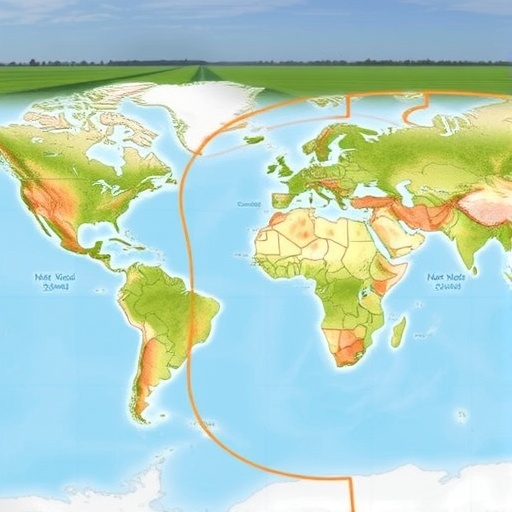
In the unfolding narrative of global climate change, the role of coastal ecosystems has increasingly come into the spotlight. Among these, salt marshes stand out as vital blue carbon sinks, capable of sequestering significant amounts of carbon dioxide from the atmosphere. Yet, a groundbreaking study recently published in Nature Communications reveals a stark reality: despite ongoing restoration efforts, the global losses of blue carbon from salt marshes currently surpass the carbon gains achieved through these interventions. This new research by Zheng, Jiang, He, and colleagues sheds critical light on the complex dynamics governing carbon storage in these fragile ecosystems and underscores the urgent need for more effective preservation strategies.
Salt marshes, coastal wetlands found in the intertidal zones of estuaries and bays, play a crucial role in the carbon cycle. These ecosystems are characterized by their dense vegetation and waterlogged soils, conditions that slow down the decomposition of organic matter and allow for significant carbon storage in the form of what scientists refer to as “blue carbon.” Blue carbon is carbon captured by oceanic and coastal ecosystems, including salt marshes, mangroves, and seagrass beds. The potential of these ecosystems to mitigate climate change by locking away atmospheric carbon dioxide has been touted as a natural climate solution. However, as the study highlights, this potential is under serious threat.
The researchers employed a comprehensive global dataset combining satellite imagery, field measurements, and carbon flux modeling to quantify carbon emissions and sequestration rates in salt marshes worldwide. By integrating these diverse data sources over recent decades, the study provides an unprecedentedly detailed account of the net carbon balance of salt marshes on a global scale. The key finding is unsettling: anthropogenic pressures and environmental changes have led to blue carbon losses that outpace the gains from restoration projects implemented to date.
One of the most compelling revelations of the study is the scale of salt marsh degradation driving these carbon losses. Factors such as coastal development, land reclamation, pollution, and rising sea levels contribute to the fragmentation and dieback of salt marsh habitats. The study documents that the accelerated destruction of marshlands results in the release of carbon stored for centuries back into the atmosphere, thereby exacerbating the greenhouse effect. This overturns the previously held assumption that restoration efforts have been sufficient to compensate for these losses.
This imbalance between loss and restoration gains challenges policymakers and conservationists alike. Restoration activities typically focus on replanting native vegetation and improving hydrological conditions to mimic natural system functions. While these strategies are essential, the study argues that their scope and scale are currently inadequate against the backdrop of ongoing marsh degradation. Restoration projects, often limited by funding, technological challenges, and local governance issues, have not yet achieved the footprint necessary to reverse net carbon emissions effectively.
Moreover, the study highlights the influence of climate change itself on both the functionality and resilience of salt marshes. Sea level rise, shifting precipitation patterns, and increasing storm frequencies are altering marsh hydrology and sediment budgets, which are critical for marsh accretion and stability. As these physical forcings intensify, they pose profound threats to the ability of marshes to continue acting as carbon sinks. The feedback loops between climate change impacts and marsh degradation may create scenarios where restoration alone cannot keep pace.
Importantly, the authors emphasize the heterogeneity of salt marsh responses globally. Regions vary in their susceptibility to stressors and in the effectiveness of restoration interventions. For instance, marshes in North America show more robust restoration gains compared to those in Asia, where urban expansion and industrial activities are more aggressive. This spatial variability calls for tailored management approaches that match local ecological, social, and economic contexts.
The paper also delves into new methodologies for improving restoration outcomes. The integration of remote sensing technologies with carbon flux measurements allows for finer-scale monitoring and adaptive management. Innovative restoration techniques, such as sediment augmentation and engineered hydrologic reestablishment, are discussed as potential pathways to enhance carbon sequestration capacities. However, the authors caution that despite technological progress, restoration must align with broader environmental policies targeting pollution reduction and coastal zone management.
The global implications of these findings extend beyond academic circles. Blue carbon ecosystems are increasingly incorporated into national carbon accounting frameworks as countries seek to meet their climate targets under international agreements such as the Paris Accord. The revelation that current blue carbon losses overshadow restoration gains signals a need for reevaluation of policy frameworks and investment priorities. It raises urgent questions about the scalability of blue carbon projects and their role as a reliable climate mitigation strategy without addressing root causes of ecosystem degradation.
In this context, the study advocates for integrative coastal zone management that harmonizes conservation, sustainable development, and climate adaptation. Cross-sectoral collaboration involving scientists, local communities, industries, and governments is vital to safeguard salt marsh ecosystems effectively. The authors propose that protecting existing marshes may be more cost-effective and beneficial for carbon storage than relying primarily on restoration after damage occurs.
Furthermore, this research calls attention to the temporal dimensions of carbon cycling in salt marshes. Carbon sequestration is a slow process occurring over decades to centuries, whereas carbon loss from degradation can be abrupt and large-scale. This asymmetry necessitates long-term monitoring and commitment to environmental stewardship beyond short electoral cycles. Only through sustained, evidence-based actions can the global community hope to maintain the blue carbon benefits provided by salt marshes.
The study also contributes to broader ecosystem service valuation by quantifying the carbon costs of salt marsh decline. By translating ecological changes into climate-relevant metrics, it supports the economic case for prioritizing these habitats in climate policy. The authors encourage the incorporation of blue carbon considerations into spatial planning and investment decisions, highlighting the avoided emissions benefits of salt marsh conservation.
Finally, this pioneering investigation by Zheng and colleagues sets a new benchmark for coastal ecosystem research. It bridges knowledge gaps by connecting local-scale observations with global patterns and policy implications. The work urges a paradigm shift from isolated restoration efforts toward integrated climate-smart management of salt marshes and other blue carbon ecosystems. This holistic approach is crucial for harnessing their full potential to combat climate change and for sustaining the biodiversity and livelihoods dependent on these invaluable coastal environments.
As the world confronts the escalating climate crisis, this study serves as a crucial reminder that the path to a sustainable future must include robust protection and thoughtful management of natural carbon sinks like salt marshes. The challenge is formidable but clear—only by securing and expanding these blue carbon reservoirs can we hope to offset the anthropogenic carbon emissions driving planetary warming. This work not only advances scientific understanding but also energizes global action towards preserving nature’s climate solutions before it is too late.
Cite Scienmag News
Hazel L. (April 24, 2026). Global Salt Marsh Carbon Losses Outpace Restoration Gains. Scienmag. https://scienmag.com/global-salt-marsh-carbon-losses-outpace-restoration-gains/
Hazel L. "Global Salt Marsh Carbon Losses Outpace Restoration Gains." Scienmag, 24 April 2026, https://scienmag.com/global-salt-marsh-carbon-losses-outpace-restoration-gains/. Accessed 28 August 2026.
Hazel L. "Global Salt Marsh Carbon Losses Outpace Restoration Gains." Scienmag. April 24, 2026. https://scienmag.com/global-salt-marsh-carbon-losses-outpace-restoration-gains/


