


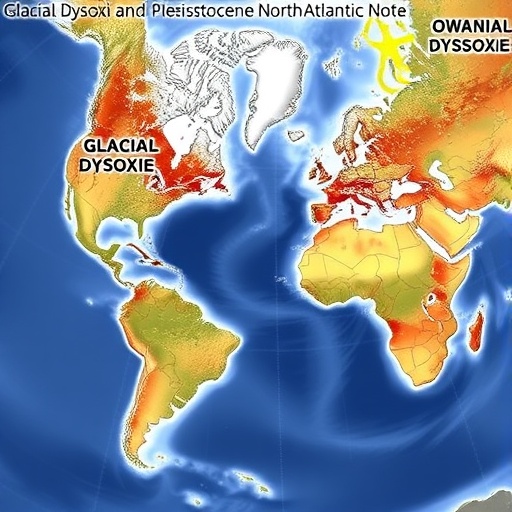
In a groundbreaking study published in Nature Communications, a team of researchers including Hernández-Almeida, Sierro, and Filippelli have unveiled new insights into the history of oxygen levels in the deep subpolar North Atlantic during the Mid-Pleistocene Transition (MPT). This period, occurring roughly between 1.2 million and 700,000 years ago, was a pivotal chapter in Earth’s climatic evolution, marked by a significant shift in the nature of glacial cycles and their intensity. The study sheds light on a phenomenon termed ‘glacial dysoxia’—a state of reduced oxygen availability in deep ocean waters—which has profound implications for our understanding of past oceanic conditions and climate dynamics.
The research focuses on sediment records extracted from the North Atlantic Ocean, a critical region influencing global climate due to its role in thermohaline circulation. This circulation drives the transport of heat and carbon across the globe, and any changes in oxygen levels can impact oceanic carbon storage, marine ecosystems, and feedback mechanisms affecting global temperatures. By reconstructing oxygen conditions during the MPT, the study provides crucial evidence that challenges conventional perspectives on glacial ocean environments, which were traditionally thought to be well-oxygenated.
Employing advanced geochemical proxies, the team analyzed trace metals and isotopic compositions preserved in benthic foraminifera—tiny marine microorganisms whose shells are fossils embedded in ocean sediments. These proxies serve as robust indicators of past oxygen levels, allowing scientists to infer dysoxic (oxygen-poor) conditions that prevailed in the deep ocean basin. The richness of this data uncovers episodes where glacial periods coincided with significant declines in deep water oxygenation, a pattern not previously documented with such clarity or temporal resolution.
One of the remarkable findings of this study is the cyclical nature of oxygen depletion events aligned with glacial maxima, intensified during the MPT. This suggests that the changing climate regime during this interval was not merely about ice volume and temperature fluctuations, but also involved complex alterations in ocean circulation and biogeochemical cycles. The dysoxia observed points to a weakening of deep water ventilation, whereby the cold and dense waters formed in polar regions, essential for oxygen transport, became less effective in replenishing oxygen into the deep ocean depths.
This shift toward glacial dysoxia may have been driven by several interlinked factors. The increased ice sheet volume and altered sea ice dynamics likely disrupted the formation and sinking of North Atlantic Deep Water (NADW). Reduced NADW formation would hamper the conveyor belt system that oxygenates the deep ocean, causing oxygen levels to plummet. Additionally, enhanced stratification—a layering effect in the ocean caused by differences in water density—could have impeded vertical mixing, further isolating deep waters from oxygen-rich surface layers.
The implications of these findings extend beyond paleoclimate reconstructions. Dysoxic deep waters during glacials likely affected nutrient recycling and carbon sequestration in the oceans, influencing atmospheric carbon dioxide concentrations. A decrease in oxygen could have led to the expansion of oxygen minimum zones (OMZs) and altered microbial processes that govern carbon and nutrient cycling. By impacting these processes, dysoxia during the MPT may have contributed to the distinct change in glacial cycles—from the 41,000-year periodicity of ice ages to the more prolonged and intense 100,000-year glacial-interglacial cycles seen afterward.
Moreover, the identification of dysoxic conditions underlines that the ocean’s response to climatic shifts is highly nuanced. It prompts a reevaluation of models that previously assumed deep ocean waters remained well-aerated throughout glacial times. By integrating these new data, climate models can better simulate the feedbacks between ocean oxygenation, carbon cycling, and ice sheet dynamics, producing more accurate projections for both past and future climate scenarios.
The study also underscores the importance of the North Atlantic as a climatic control knob during the Pleistocene. The biogeochemical shifts documented during the MPT reflect how sensitive this region is to climate forcing, with alterations in deep ocean conditions having far-reaching effects on global climate stability. As the ocean is a major reservoir of heat and carbon, understanding past events of ocean dysoxia is vital for predicting the responses of modern oceans amidst ongoing anthropogenic climate change.
Technologically, this research exemplifies the power of high-resolution geochemical analyses combined with paleoceanographic records to decode complex climate transitions. The team’s methodology leveraged cutting-edge mass spectrometry and isotope ratio techniques to construct a precise oxygenation timeline that aligns with known glacial-interglacial fluctuations. Such methodological advancements enable the extraction of detailed environmental signals from minute fossil remains, highlighting the growing capabilities of earth sciences to unravel the planet’s deep past.
Another aspect highlighted by the results is the potential biological impact of glacial dysoxia. Oxygen-poor conditions in deep waters would have imposed stress on marine fauna adapted to well-oxygenated environments, potentially leading to shifts in ecosystem structure and function. This respiratory stress may have affected benthic communities, which play essential roles in sediment biogeochemical processes, thereby altering nutrient cycling and sediment chemistry further compounding climate feedbacks.
The integration of sedimentologic, geochemical, and paleoecological data in this investigation provides a comprehensive perspective on the Mid-Pleistocene oceanographic landscape. Such interdisciplinary approaches are crucial in reconstructing Earth’s climatic and environmental systems, suggesting that future research should continue to combine diverse datasets to enhance our understanding of historical climate dynamics.
This discovery opens avenues for researchers to explore dysoxic events in other ocean basins during similar or distinct periods, improving the global context of glacial oceanography. Comparing North Atlantic data with records from the Pacific and Southern Oceans could reveal if dysoxia was a localized phenomenon or part of a global oceanic reorganization during the MPT.
As climate science gears up to tackle 21st-century challenges, the historical insights offered by studies like this are invaluable. They remind us that ocean oxygenation and circulation can be highly volatile under climate stress, reinforcing concerns that ongoing global warming and deoxygenation trends may ripple through marine systems with unforeseen magnitude. Understanding past episodes of ocean dysoxia enhances predictive models, informing conservation strategies aimed at preserving ocean health amid accelerating human impacts.
In conclusion, the research led by Hernández-Almeida and colleagues represents a significant leap forward in paleoclimatology and oceanography. By illuminating glacial dysoxia in the deep subpolar North Atlantic during the Mid-Pleistocene Transition, it reframes our understanding of ancient ocean states and their climatic significance. This study not only enriches our knowledge of the MPT but also equips the scientific community with critical insights into the intricate links between ocean dynamics, oxygen availability, and climate evolution across geological timescales.
The continued exploration of oceanic oxygenation patterns promises to deepen our grasp of the complex interplay between the Earth’s atmosphere, cryosphere, and hydrosphere. This knowledge is fundamental as society strives to navigate the uncertainties of future climate trajectories, where lessons from the past remain key guides for sustainable planetary stewardship.
Cite Scienmag News
Violet Maxwell. (April 24, 2026). Glacial Dysoxia Shaped Mid-Pleistocene North Atlantic. Scienmag. https://scienmag.com/glacial-dysoxia-shaped-mid-pleistocene-north-atlantic/
Violet Maxwell. "Glacial Dysoxia Shaped Mid-Pleistocene North Atlantic." Scienmag, 24 April 2026, https://scienmag.com/glacial-dysoxia-shaped-mid-pleistocene-north-atlantic/. Accessed 4 September 2026.
Violet Maxwell. "Glacial Dysoxia Shaped Mid-Pleistocene North Atlantic." Scienmag. April 24, 2026. https://scienmag.com/glacial-dysoxia-shaped-mid-pleistocene-north-atlantic/


