


In an era where modern infrastructure and urban life flourish, the environmental footprint of synthetic materials such as rubber has come under intense scrutiny. A new in-depth study focusing on Lake Sihwa in South Korea sheds light on the spatial and temporal distribution of tire- and rubber-related chemicals that permeate sediment layers in aquatic ecosystems. Given the surging global production of synthetic rubber, which reached 16.1 million tons in 2023, understanding the environmental impact of these compounds is more urgent than ever.
South Korea’s transformation over the past half-century has been monumental, with vehicle registrations soaring by over 500 times since 1966. This automotive boom has been accompanied by a corresponding rise in synthetic rubber manufacturing, directly tied to tire production. Tires and various rubber products incorporate a myriad of chemical compounds designed to enhance performance and durability. Yet, many of these chemicals exhibit significant toxicity, particularly to aquatic fauna such as fish, sparking concern among environmental scientists.
The collaborative research effort, published in the esteemed journal Environmental Chemistry and Ecotoxicology, meticulously mapped the concentrations of 17 tire- and rubber-associated chemicals within sediment samples from Lake Sihwa. Located in a region impacted by heavy industrialization and urban runoff, the lake presents a unique case study to understand the pollutant dynamics at play. Researchers employed sediment surface and core analyses to trace the historical deposition and spatial gradients of these chemicals.
One pivotal finding highlighted distinct spatial variation across the lake’s watershed. Concentrations of target chemicals were markedly elevated in sediments collected from inland creeks discharging directly into Lake Sihwa. Intriguingly, the sediment samples from within the lake itself consistently showed higher contaminant levels compared to more distal offshore sites, suggesting localized accumulation and persistent inputs.
Further investigation along creek transects revealed a stark contrast between upstream and downstream sampling points. Downstream locations tended to harbor significantly higher concentrations of tire-related chemicals, implicating proximate industrial facilities and densely populated urban areas as major point sources. These observations underscore the complex interplay between anthropogenic activities and pollutant distribution in freshwater ecosystems.
To assess ecological risks, the team conducted a preliminary screening based on Risk Quotient metrics, which compare detected chemical concentrations against known toxicity thresholds. Results indicated that within certain inland creeks, the levels of specific compounds exceeded benchmarks, potentially threatening aquatic organisms. This finding calls for enhanced monitoring and reevaluation of current pollution management strategies in such vulnerable watersheds.
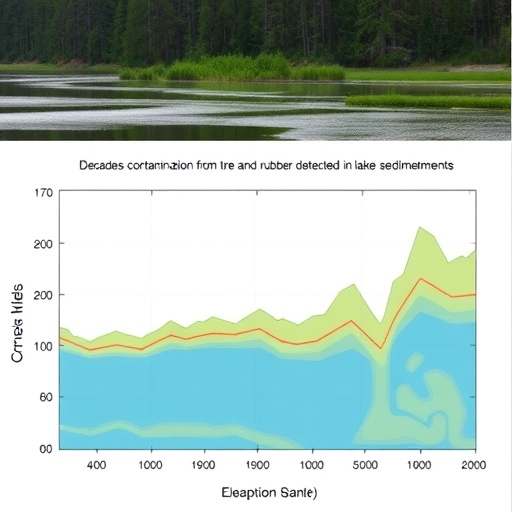
Delving deeper into sediment core profiles, researchers uncovered intriguing temporal patterns. The concentration shifts recorded in these cores likely echo changes in industrial production volumes, regulatory policies, and broader economic fluctuations that have occurred over several decades. Notably, sediments near industrial discharge points encapsulated a chemical signature consistent with historical trends in tire demand and synthetic rubber manufacturing.
These sedimentary archives form an invaluable baseline, enabling scientists and policymakers to track future pollution trajectories in Lake Sihwa and similar environments. Establishing this foundational data is crucial for forecasting the ecological consequences of ongoing industrialization and urban expansion, as well as for guiding targeted remediation efforts.
The study’s lead authors emphasize the importance of integrating chemical data with hydrological flows, industrial expansion records, and environmental regulations to construct a holistic understanding of contaminant behavior. Such multidisciplinary approaches are key to unraveling the complexities of pollutant sources, dispersal mechanisms, and ecological impacts.
This investigation represents one of the most comprehensive attempts to chart the environmental imprint of tire-derived chemicals in a heavily industrialized landscape. As synthetic rubber production and vehicle usage continue to climb globally, the implications extend far beyond South Korea’s borders, highlighting a worldwide challenge in balancing urban development with ecosystem protection.
Ultimately, the research calls for heightened vigilance and proactive management to mitigate the ecological risks posed by tire- and rubber-associated contaminants. By illuminating the intricate pathways through which these substances accumulate and persist, it lays critical groundwork for future environmental policies aimed at safeguarding aquatic biodiversity against anthropogenic pollutants.
Contact with the corresponding author Kurunthachalam Kannan at the Wadsworth Center, New York State Department of Health, offers further insights into ongoing work at the intersection of environmental chemistry and public health. This study exemplifies the growing necessity to scrutinize human-made chemical footprints in freshwater systems, championing scientific inquiry as a cornerstone of sustainable development.
Web References:
http://dx.doi.org/10.1016/j.enceco.2026.03.011
Cite Scienmag News
Violet Maxwell. (April 24, 2026). Decades-Long Contamination from Tire and Rubber Chemicals Detected in Lake Sediments. Scienmag. https://scienmag.com/decades-long-contamination-from-tire-and-rubber-chemicals-detected-in-lake-sediments/
Violet Maxwell. "Decades-Long Contamination from Tire and Rubber Chemicals Detected in Lake Sediments." Scienmag, 24 April 2026, https://scienmag.com/decades-long-contamination-from-tire-and-rubber-chemicals-detected-in-lake-sediments/. Accessed 4 September 2026.
Violet Maxwell. "Decades-Long Contamination from Tire and Rubber Chemicals Detected in Lake Sediments." Scienmag. April 24, 2026. https://scienmag.com/decades-long-contamination-from-tire-and-rubber-chemicals-detected-in-lake-sediments/


