


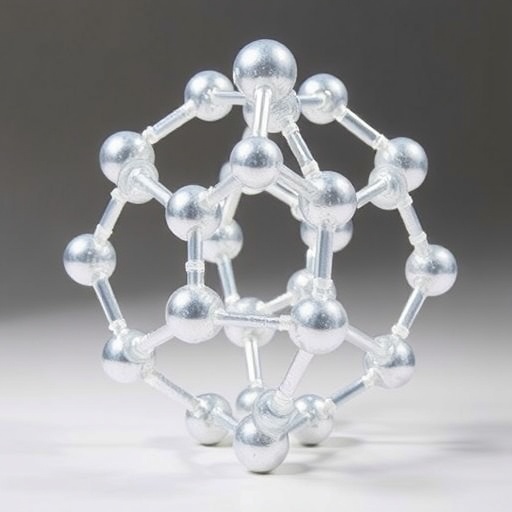
A groundbreaking advance in the chemistry of metal-organic frameworks (MOFs) has been revealed by a team of researchers, introducing a transformative method to modify these complex materials with unprecedented control and precision. Metal-organic frameworks are porous crystalline materials constructed from metal ions coordinated to organic ligands, widely valued for their tunable structures and exceptional capacity for gas storage, separation, and catalysis. Nevertheless, accessing MOFs with desired, wide mesopores or intricate topologies often requires the introduction of auxiliary ligands called centring structure-directing agents (cSDAs). Until now, the deliberate and clean removal of these cSDAs post-synthetically, without compromising the crystallinity or framework integrity of the MOF, posed a significant challenge. The new study outlines a versatile, single-crystal to single-crystal editing strategy that overcomes these obstacles, unlocking new horizons for MOF design and function.
The cornerstone of this innovative approach lies in the ability to selectively excise cSDAs after the MOF has fully formed, a feat akin to molecular surgery conducted with exquisite precision inside a single crystal. Unlike traditional post-synthetic modifications that often result in amorphization or structural collapse, the researchers have demonstrated that it is possible to remove these temporary architectural elements while preserving the ordered framework, essentially editing the MOF’s topology on demand. This advancement signifies a paradigm shift whereby MOF topologies are no longer confined by the limitations imposed during initial synthesis but can be dynamically tailored afterward, offering enhanced porosity and novel functionality.
Two principal routes have been developed to achieve this precise removal of cSDAs. The first approach leverages the well-established Pearson’s hard and soft acids and bases (HSAB) theory, utilizing careful acid treatment protocols to release the cSDAs from robust frameworks. This method entails selecting acid conditions that disrupt the coordination bonds between the cSDAs and the metal centers without damaging the primary framework. The result is a dramatic expansion of accessible pore volume, with chromium-based MOFs exhibiting pore volumes soaring to as high as 3.6 cm³ g⁻¹. Such remarkable porosity not only exceeds prior limits but also enables enhanced molecular diffusion, critical for applications spanning catalysis to gas storage.
Complementing this acid-based technique, the second approach employs imidazole, an organic base that selectively substitutes and displaces cSDAs within mere minutes under mild conditions. This gentler substitution strategy minimizes the risk of framework degradation, making it an attractive option for sensitive MOFs or those with vulnerable topologies. By exploiting the selective binding affinity of imidazole, the cSDAs can be replaced and extracted, facilitating a controllable ‘window opening’ effect. This precise manipulation paves the way toward widely varied structures from a common synthesis platform, underscoring the modular nature of MOFs.
An extraordinary feature of this strategy is its broad applicability across multiple MOF topologies, including sodalite (sod), nia-d, and pop frameworks. The successful removal of cSDAs in these distinct architectures confirms that these ligands indeed act as temporary, auxiliary construction elements, essential during framework assembly but not integral to the final crystalline structure. This transient role challenges the conventional perception that all ligands contribute to the permanent topology, expanding the conceptual toolkit available to materials chemists and reticular chemistry practitioners.
The elegance of maintaining single crystallinity throughout the process allows for direct structural characterization at every step through X-ray diffraction, enabling researchers to capture in exquisite detail the framework evolution during ligand removal. This capacity for real-time observation benefits fundamental understanding of MOF formation and transformation mechanisms, opening possibilities for rational design of frameworks with engineered porosity and feature sets. Such high-fidelity editing might stimulate the development of adaptive materials capable of changing pore architectures under external stimuli.
From a practical standpoint, the enhanced porosity generated through cSDA removal holds profound implications for enhancing the performance of MOFs in applications such as gas separation, catalysis, and drug delivery. Increased pore volumes facilitate higher guest molecule uptake and diffusion rates, while the ability to tailor topology post-synthetically allows optimization unprecedentedly specific to a given application. For example, catalysts requiring large pore windows for bulky substrate access can be prepared through initial synthesis with cSDAs followed by selective removal, bypassing the synthetic complexity traditionally needed.
The study also highlights the synergy between theoretical principles—like Pearson’s HSAB theory—and experimental ingenuity, illustrating how fundamental chemical concepts guide the rational manipulation of complex materials. By harnessing the differential hardness or softness of metal centers and ligands, the researchers achieved selectivity in ligand removal, turning a foundational chemical principle into a powerful design tool. This fusion of conceptual and practical advances is emblematic of the burgeoning era of reticular chemistry and functional material design.
Furthermore, this single-crystal to single-crystal editing paradigm demonstrates an exemplary level of modularity within MOF chemistry. It showcases the potential for dynamic tuning of framework properties post-synthesis—an aspect long pursued but rarely achieved with such precision. The concept that MOFs’ physical and chemical traits can be intentionally and selectively edited expands the scope of reticular design philosophy. It also promises that MOF libraries can be diversified broadly from fewer parental scaffolds through controlled post-synthetic transformations.
This breakthrough will undoubtedly inspire further exploration into dynamic framework engineering, including the possibility of reversible ligand removal and reinsertion, stimuli-responsive porosity modulation, and the creation of complex multi-functional architectures. By harnessing the temporary nature of cSDAs, scientists may develop smart materials capable of adaptive responses, optimized catalysis environments, or switchable separation profiles, propelling MOFs into new realms of material science ingenuity.
Given the increasing importance of clean, scalable, and precise material modification techniques for industrial applications, these methods for single-crystal editing provide a promising pathway toward practical production of high-performance MOFs. Their rapid kinetics, mild conditions, and broad applicability combine to yield adaptable workflows compatible with emerging manufacturing technologies. This opens exciting prospects not only in the laboratory but also in commercial applications where tailored porosity is a critical parameter.
In summary, the meticulous work of Sapianik, Barsukova, Shkurenko, and colleagues presents a profound evolution in the control of metal-organic frameworks. Their ability to perform single-crystal to single-crystal ligand removal without structural degradation redefines the limits of modularity and adaptability in reticular chemistry. By introducing post-synthetic editing strategies that afford deliberate topology transformations and substantial porosity enhancements, they have unlocked new potential for MOFs’ design and function.
This novel approach underscores the extraordinary possibilities offered by integrating targeted chemical principles with sophisticated crystallographic techniques to realize dynamic materials. As MOFs continue to ascend as versatile platforms for energy, environmental, pharmaceutical, and chemical innovations, the ability to fine-tune their pore architectures on demand will become an indispensable asset.
The field of metal-organic frameworks finds itself at a pivotal juncture, equipped now with tools not just to create, but to artfully edit, tailor, and optimize frameworks within single crystals. This innovation signals a future where material properties can be tuned with surgical precision, enabling the next generation of high-performance porous materials engineered at the atomic level and customized for advanced technological applications.
Cite Scienmag News
Bethany Barker. (April 24, 2026). Single-Crystal MOF Editing Through Ligand Removal. Scienmag. https://scienmag.com/single-crystal-mof-editing-through-ligand-removal/
Bethany Barker. "Single-Crystal MOF Editing Through Ligand Removal." Scienmag, 24 April 2026, https://scienmag.com/single-crystal-mof-editing-through-ligand-removal/. Accessed 3 September 2026.
Bethany Barker. "Single-Crystal MOF Editing Through Ligand Removal." Scienmag. April 24, 2026. https://scienmag.com/single-crystal-mof-editing-through-ligand-removal/


