


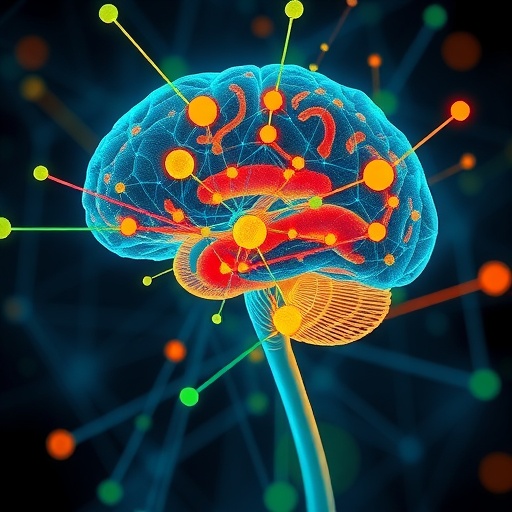
In the enigmatic landscape of depression research, a new beacon has emerged, shedding critical light on the brain’s intricate networks and their malleable nature under targeted intervention. Researchers Henensal, Attali, Aubry, and colleagues have meticulously pieced together evidence in a groundbreaking systematic review that elucidates the functional connectivity of the subcallosal cingulate—a pivotal brain region intricately involved in mood regulation—and its alterations following brain stimulation treatments for depression. This synthesis not only unpacks the neurobiological underpinnings of depressive disorders but also spotlights potential neurophysiological predictors that could revolutionize personalized therapeutic strategies.
The subcallosal cingulate cortex (SCC), nestled deep within the medial prefrontal cortex, plays a central role in emotional processing, making it a prime target for intervention in major depressive disorder (MDD). Traditional treatments have often left clinicians grappling with inconsistent patient responses, highlighting the necessity to dive deeper into neural circuitry to understand why some individuals respond favorably while others do not. The review comprehensively analyzes brain stimulation-induced changes in SCC connectivity, offering profound insights into the dynamic shifts within the depressive brain’s functional architecture.
Advances in neuroimaging techniques, particularly resting-state functional magnetic resonance imaging (rs-fMRI), have opened a window into the brain’s functional connectome—mapping how distinct regions communicate at rest. The studies compiled reveal a distinct pattern: aberrant hyperconnectivity between the SCC and limbic structures often correlates with depressive symptomatology. Intriguingly, brain stimulation modalities such as deep brain stimulation (DBS) and transcranial magnetic stimulation (TMS) appear to remodel these aberrant networks, often normalizing connectivity patterns and coinciding with clinical improvement.
Key to the review’s significance is its focus on the predictive value of pretreatment SCC connectivity profiles. By leveraging sophisticated analytic models, the authors highlight that specific baseline connectivity metrics may forecast patient responsiveness to brain stimulation therapies. This suggests a potential paradigm shift towards biomarker-driven personalized treatment, enabling clinicians to tailor interventions based on individual neural signatures rather than a one-size-fits-all approach that has long dominated psychiatric practice.
Deep brain stimulation targeting the SCC, first popularized for its efficacy in treatment-resistant depression, operates by delivering precise electrical impulses to modulate pathological neural activity. The review collates data demonstrating that effective DBS reconfigures functional coupling not only locally within the SCC but also downstream in connected networks encompassing the prefrontal cortex and subcortical limbic regions. These network-level modulations appear essential for mood stabilization, underscoring the SCC’s role as a hub in the neurocircuitry of depression.
Similarly, noninvasive brain stimulation approaches such as repetitive TMS have shown promise in altering cortical excitability with downstream impacts on subcortical structures like the SCC. The review underscores nuanced differences in the connectivity changes induced by invasive versus noninvasive techniques, reflecting the complexity of neurophysiological responses and the necessity for refined targeting protocols to maximize therapeutic benefits while minimizing side effects.
A remarkable finding emerging from the synthesis is the consistent association between decreased SCC hyperconnectivity post-stimulation and symptom remission. This reinforces the notion that maladaptive hyperconnectivity within mood-regulating circuits is a neural hallmark of depression, a reversible state rather than a fixed structural anomaly. The plasticity unveiled offers hope that depression’s grip on brain networks can be loosened through appropriately timed and calibrated neuromodulatory interventions.
The mechanistic pathways underpinning these connectivity changes are multifaceted. Brain stimulation likely affects synaptic efficacy, neurotransmitter release, and neuroinflammation dynamics within these networks. The review advocates for future mechanistic studies combining multimodal imaging, electrophysiology, and molecular techniques to decode these processes further. Understanding these mechanisms would catalyze the development of next-generation brain stimulation protocols with enhanced precision and durability.
Moreover, the systemic review touches on the temporal dynamics of connectivity changes relative to clinical timelines. Some connectivity alterations manifest rapidly post-stimulation, while others consolidate gradually with sustained treatment, reflecting complex neuroadaptive processes that may underlie sustained remission versus relapse. Tracking these trajectories could enrich clinical monitoring and optimize treatment schedules.
The authors also emphasize the heterogeneity of depression as a disorder, where distinct connectivity signatures may delineate subtypes with differential treatment sensitivities. Such stratification could transform clinical trials by enabling cohort enrichment and improving signal detection, thereby accelerating therapeutic innovation and regulatory approval pathways.
While the focus on SCC connectivity offers compelling insights, the review also situates this within a broader neurocircuitry framework involving interconnected networks such as the default mode network, salience network, and fronto-limbic circuits. This integrative perspective acknowledges depression as a disorder of distributed neural systems rather than isolated regions, advocating for comprehensive network-level assessments in future research.
Technological advancements such as closed-loop DBS systems that adjust stimulation parameters in real-time based on neural feedback hold promise in augmenting treatment efficacy. The review hints at these frontiers, suggesting that integrating connectivity biomarkers with adaptive stimulation could herald a new era in precision psychiatry.
In sum, this systematic review delivers an exceptional synthesis of current literature on the subcallosal cingulate cortex’s functional connectivity in depression, emphasizing brain stimulation-induced changes and the prognostic value of pretreatment connectivity. It elevates the scientific discourse beyond phenomenology into mechanistic understanding, heralding a future where brain network-informed interventions offer hope for millions grappling with treatment-resistant depression.
Through elucidating the neurofunctional correlates of antidepressant response and resistance, the work of Henensal and colleagues paves the way toward transformative, biomarker-guided clinical pathways. As brain stimulation technologies continue to evolve and integrate with neuroimaging biomarkers, the vision of precision neuromodulation in psychiatry inches ever closer to reality. This review stands as a definitive reference point for clinicians and neuroscientists seeking to decode the brain’s complex mood-regulatory networks and tailor treatments with unparalleled precision.
Cite Scienmag News
Glenn Wilkins. (April 21, 2026). Brain Stimulation and Connectivity in Depression: Insights. Scienmag. https://scienmag.com/brain-stimulation-and-connectivity-in-depression-insights/
Glenn Wilkins. "Brain Stimulation and Connectivity in Depression: Insights." Scienmag, 21 April 2026, https://scienmag.com/brain-stimulation-and-connectivity-in-depression-insights/. Accessed 5 September 2026.
Glenn Wilkins. "Brain Stimulation and Connectivity in Depression: Insights." Scienmag. April 21, 2026. https://scienmag.com/brain-stimulation-and-connectivity-in-depression-insights/


