


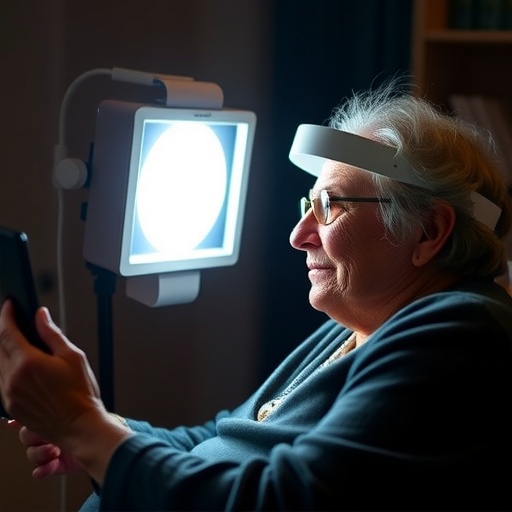
In a groundbreaking pilot study published in BMC Geriatrics in 2026, researchers have explored the potential benefits of bright light therapy on cognition, sleep quality, and psychological stress in older adults experiencing mild-to-moderate cognitive impairment. This study, conducted within long-term care facilities, opens new doors to non-invasive interventions that may profoundly enhance the quality of life for a vulnerable demographic often grappling with compounded health challenges.
Bright light therapy (BLT) has been an established non-pharmacological treatment primarily recognized for its effects on circadian rhythm regulation and mood disorders such as seasonal affective disorder. However, its application in improving cognitive functions and reducing psychological stress among the elderly with cognitive impairments remains relatively underexplored. This pilot study marks a significant stride toward filling that gap by evaluating cognitive outcomes alongside sleep and stress levels within a carefully monitored clinical context.
The study employed a rigorously designed intervention protocol featuring daily exposures to intense, full-spectrum light at predetermined times. Participants, residents of long-term care facilities, were exposed to bright light therapy sessions designed to simulate natural sunlight, meticulously adjusted for intensity and duration. This approach aims to stimulate the suprachiasmatic nucleus, the brain’s master circadian clock, thereby potentially recalibrating disrupted biological rhythms commonly observed in older adults with cognitive decline.
Assessment of cognitive function was executed through standardized neuropsychological tests tailored to detect changes in memory, attention, and executive functions. Unlike prior studies focusing solely on mood or sleep, this work integrated multidimensional cognitive assessments to ascertain the broader neuropsychological impact of BLT. The preliminary data suggest statistically significant improvements in attention and memory recall abilities, drawing attention to the neuroplastic potential harnessed by strategic light exposure.
Sleep quality—which often deteriorates alongside cognitive decline—was another primary outcome measure. Using objective sleep monitoring technologies combined with participant and caregiver reports, the study revealed notable enhancements in sleep efficiency and decreased nocturnal awakenings. These findings indicate that BLT might counteract the fragmented sleep architecture commonly found in older adults with mild-to-moderate cognitive impairment, facilitating restorative sleep cycles essential for cognitive resilience.
Interestingly, psychological stress metrics measured through validated scales demonstrated a meaningful reduction post-intervention. Psychological stress exacerbates cognitive deterioration and sleep disturbances through complex neuroendocrine pathways involving cortisol regulation and inflammatory mediators. By alleviating stress, bright light therapy may indirectly promote neuroprotective mechanisms that preserve cognitive functioning.
Mechanistically, the therapeutic benefits of bright light therapy can be traced back to its influence on circadian biology and neurochemical pathways. Exposure to bright light modulates melatonin secretion patterns, synchronizing internal clocks with external environmental cues. This synchronization is expected to optimize neurotransmitter release, including serotonin and dopamine, thereby enhancing mood, cognitive alertness, and sleep-wake cycles.
Moreover, BLT’s impact on the hypothalamic-pituitary-adrenal (HPA) axis may underlie its observed stress reduction effects. Chronic stress dysregulates the HPA axis, contributing to neurodegenerative processes. By restoring circadian alignment, bright light therapy might mitigate HPA axis hyperactivity, translating into reduced cortisol levels and improved psychological well-being.
The pilot study also carefully monitored safety and tolerability aspects of bright light therapy in a sensitive population prone to frailty and comorbidities. Encouragingly, no adverse effects related to the light exposure protocol were reported, making BLT a low-risk adjunct intervention. This safety profile enhances its feasibility for widespread clinical application in long-term care settings, where pharmacological options may be limited due to polypharmacy concerns.
Beyond the immediate clinical implications, this research invites a broader reconsideration of environmental and lifestyle factors influencing cognitive health in aging populations. Traditional therapeutic strategies have largely focused on pharmacological targets, whereas this study encourages the integration of circadian biology-informed interventions as complementary modalities. In doing so, it paves the way for multidimensional treatment paradigms harnessing environmental stimuli.
The long-term ramifications of implementing bright light therapy extend into public health policy and geriatric care models. Given the increasing global prevalence of cognitive impairment and dementia, interventions that are scalable, cost-effective, and easy to administer are urgently needed. Bright light therapy fits these criteria, offering a potential tool to delay cognitive decline progression and reduce healthcare burdens linked to chronic neuropsychiatric conditions.
It is essential, however, to acknowledge the study’s pilot nature—characterized by limited sample size and controlled conditions—which necessitates further large-scale, randomized controlled trials to validate and generalize these findings. Future research should aim to delineate optimal dosing parameters, treatment schedules, and identify subpopulations most likely to benefit from BLT.
Simultaneously, neuroimaging studies could elucidate the precise neural circuits engaged by bright light therapy, clarifying how circadian entrainment translates to cognitive improvements on a structural and functional level. Such insights would deepen our mechanistic understanding and refine intervention strategies, tailoring them to individual circadian phenotypes or cognitive profiles.
In conclusion, the pilot study carried out by Cheng, Zhang, Li, and colleagues compellingly supports the therapeutic potential of bright light therapy to enhance cognition, ameliorate sleep disturbances, and relieve psychological stress in older adults with mild-to-moderate cognitive impairments residing in long-term care facilities. This innovative approach underscores light—an elemental environmental factor—as a powerful modulator of brain health, heralding a promising avenue in the fight against cognitive decline. The intersection of circadian biology, neuroscience, and geriatric medicine encapsulated in this research embodies a forward-thinking paradigm shift that may redefine how we approach aging-related brain disorders.
As the population ages worldwide and the societal impact of cognitive decline escalates, harnessing naturalistic interventions like bright light therapy could transform geriatric care. Bridging gaps between basic science and clinical application, this research sets a precedent for interdisciplinary collaborations to innovate accessible, non-pharmacological therapies that promote holistic health and cognitive longevity.
The unfolding narrative around bright light therapy challenges entrenched clinical paradigms, positioning environmental modulation as a frontline defense against age-associated cognitive deterioration. By illuminating pathways to improved cognitive resilience, enhanced sleep, and reduced psychological distress, bright light therapy invites us to reconsider the fundamental role of light—not only in visual perception but as a cornerstone of brain health and human vitality.
Cite Scienmag News
Glenn Wilkins. (April 21, 2026). Bright Light Therapy Boosts Cognition, Sleep in Seniors. Scienmag. https://scienmag.com/bright-light-therapy-boosts-cognition-sleep-in-seniors/
Glenn Wilkins. "Bright Light Therapy Boosts Cognition, Sleep in Seniors." Scienmag, 21 April 2026, https://scienmag.com/bright-light-therapy-boosts-cognition-sleep-in-seniors/. Accessed 4 September 2026.
Glenn Wilkins. "Bright Light Therapy Boosts Cognition, Sleep in Seniors." Scienmag. April 21, 2026. https://scienmag.com/bright-light-therapy-boosts-cognition-sleep-in-seniors/


