


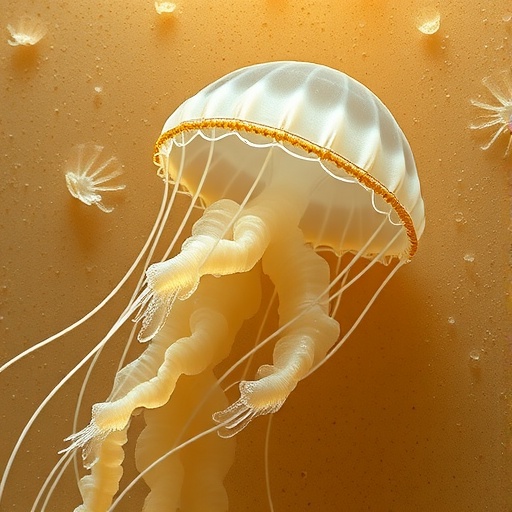
In a groundbreaking discovery that sheds new light on early marine ecosystems, researchers have unearthed a remarkable fossil species dating back approximately 450 million years. This newly identified species, named Paleocanna tentaculum, represents a basal medusozoan—a soft-bodied, tube-shaped polyp distinguished by a delicate ring of tentacles. What sets Paleocanna tentaculum apart is not just its age but its exceptional state of preservation, offering an unprecedented glimpse into the soft-bodied relatives of modern jellyfish, a group whose evolutionary history has been notoriously difficult to trace due to the fragility of their bodies.
The fossils were discovered roughly 50 kilometers northeast of Quebec City in the Upper Neuville Formation, a renowned geological site recognized for its rich Ordovician fossil deposits. This region, part of the Saint Lawrence Lowlands, is celebrated as one of the world’s most species-diverse fossil beds from the Ordovician period, providing an invaluable window into marine biodiversity of an era that predates much of the complex life that thrives today.
The importance of discovering a soft-bodied medusozoan like Paleocanna tentaculum cannot be overstated. Soft-bodied organisms typically do not fossilize well, as their lack of hard parts makes their remains far less likely to survive geological timescales. The preservation of such delicate structures in this case suggests an extraordinary set of conditions—rapid burial in fine sediment and anoxic (low-oxygen) environmental conditions that inhibited decay and scavenging. This kind of snapshot of ancient marine life is exceedingly rare and offers scientists a unique opportunity to study the morphology and evolutionary relationships of early cnidarians.
Detailed examination of 15 slabs of shaly limestone containing approximately 135 individual specimens allowed paleontologists to conduct a rigorous comparative analysis. By assessing various morphological features and contrasting these findings against 69 other fossil and extant jellyfish-like species, the researchers were able to establish that Paleocanna tentaculum shares a closer evolutionary relationship with contemporary jellyfish than with other more distantly related medusozoan ancestors. This provides critical insights into the early diversification and morphological stasis within this group.
The methodology employed highlights the meticulous nature of modern paleontological research. Specimens were carefully measured and photographed, allowing for high-resolution imaging and detailed morphometric analysis. These scientific efforts underscore how advanced imaging technologies and comparative anatomy continue to revolutionize our understanding of life’s deep past, transforming data from fragile fossils into meaningful evolutionary narratives.
Dr. Greta Ramirez-Guerrero, lead author of the study and a doctoral candidate at the Université de Montréal, explained that the alignment of these specimens in a uniform direction strongly supports the hypothesis of in situ burial, rather than transportation after death. Such rapid sequestration on the ocean floor preserved critical anatomical features by minimizing disruption from current flows or scavenging, key factors that typically degrade soft-bodied fossils.
The collaborative effort between researchers from McGill University and Université de Montréal was bolstered by the expertise of John Iellamo, an amateur fossil collector whose keen eye led to the initial discovery of these fossils in 2010. His donation of the specimens to the Musée de paléontologie et de l’évolution (MPE) in Montreal ensured their availability for rigorous scientific investigation, exemplifying the vital role that citizen scientists play in paleontology.
Beyond adding a significant species to the fossil record, the find challenges previously held assumptions about the paleobiogeography and biodiversity of the Saint Lawrence Lowlands during the Ordovician. It suggests that this area harbors many more undiscovered fossils with the potential to illuminate the evolutionary history of early marine invertebrates, potentially sparking a renewed focus on the region in future paleontological research.
Louis-Philippe Bateman, co-author and graduate student at McGill University, emphasized the broader implications of the discovery. He noted that although the fossil record in Quebec may not have the same renown as those in regions like British Columbia or Alberta, it possesses a treasure trove of paleontological treasures waiting to be uncovered. This breakthrough encourages a reassessment of the scientific potential embedded within less-studied fossil localities.
The researchers posit that the Upper Neuville Formation’s unique sedimentological and geochemical characteristics played a pivotal role in the remarkable preservation of these medusozoan polyps. It is believed that a sudden depositional event buried the organisms quickly in fine mud under low-oxygen conditions, creating an environment conducive to the preservation of soft tissues and fine anatomical details, which are crucial for understanding the organism’s biology and ecology.
As these fossils are now curated at the Musée de paléontologie et de l’évolution in Montreal, they will be subjected to further analyses that may use cutting-edge techniques such as 3D imaging, elemental mapping, and potentially even molecular residue analysis, pushing the boundaries of what can be learned from Ordovician soft-bodied fossils. The continued study of Paleocanna tentaculum promises to deepen our comprehension of early cnidarian evolution and the environmental factors that governed marine life half a billion years ago.
In summary, the identification of Paleocanna tentaculum not only enriches the fossil record but also exemplifies the confluence of fortuitous fossil preservation, meticulous scientific analysis, and interdisciplinary collaboration. This discovery provides a rare and invaluable glimpse into the morphology and ecology of early medusozoans, highlighting the dynamic evolutionary trajectory that eventually gave rise to modern jellyfish. It reaffirms the Saint Lawrence Lowlands as a critical region for paleontological research and underscores the vast unexplored potential of soft-bodied fossils to illuminate the ancient history of life on Earth.
News Publication Date: 13-Feb-2026
Web References: 10.1017/jpa.2025.10211
References:
Ramirez-Guerrero, G., Alghaled, H., Bateman, L.-P., Cournoyer, M., & Cameron, C. B. (2026). Thecate stem medusozoan polyp from the Upper Ordovician of Québec. Journal of Paleontology. https://doi.org/10.1017/jpa.2025.10211
Cite Scienmag News
Violet Maxwell. (April 21, 2026). Scientists Discover New Jellyfish Species in Fossil Finds Near Quebec City. Scienmag. https://scienmag.com/scientists-discover-new-jellyfish-species-in-fossil-finds-near-quebec-city/
Violet Maxwell. "Scientists Discover New Jellyfish Species in Fossil Finds Near Quebec City." Scienmag, 21 April 2026, https://scienmag.com/scientists-discover-new-jellyfish-species-in-fossil-finds-near-quebec-city/. Accessed 4 September 2026.
Violet Maxwell. "Scientists Discover New Jellyfish Species in Fossil Finds Near Quebec City." Scienmag. April 21, 2026. https://scienmag.com/scientists-discover-new-jellyfish-species-in-fossil-finds-near-quebec-city/


