


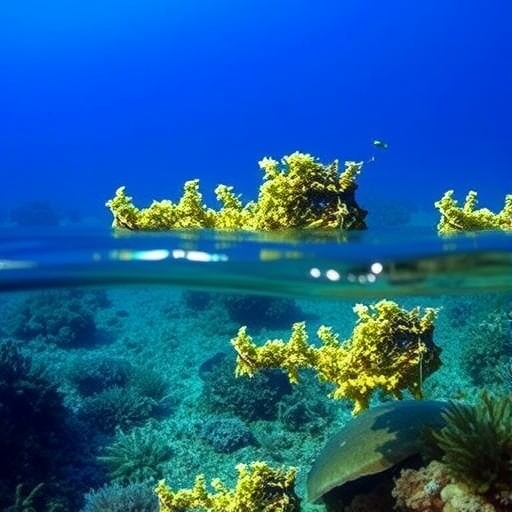
In a groundbreaking study poised to reshape our understanding of oceanic ecosystems, researchers have uncovered a striking shift in the forces driving one of the planet’s most expansive and enigmatic marine phenomena: the Great Atlantic Sargassum Belt. Long dominated by physical oceanographic factors, this vast floating expanse of brown algae now appears increasingly governed by complex ecological interactions. The findings, published in Nature Communications, mark a paradigm shift in marine ecology and offer compelling insights into the interplay between climate, biology, and ocean dynamics in the Atlantic Ocean.
Stretching thousands of kilometers across the tropical Atlantic, the Great Atlantic Sargassum Belt has attracted scientific and public attention for its massive seasonal blooms. These floating mats of Sargassum seaweed not only serve as critical habitats for diverse marine species but also affect coastal economies and ecosystems when they wash ashore in dense quantities. Until now, the belt’s growth and distribution have largely been attributed to physical drivers such as ocean currents, temperature fluctuations, nutrient availability driven by upwelling, and atmospheric conditions. However, the newly published research indicates that ecological processes — including species interactions, nutrient cycling within biological communities, and the behavior of herbivores and microbial populations — are increasingly influencing the belt’s dynamics.
The investigation integrated satellite data spanning over two decades with in situ biological sampling and advanced ecological modeling to dissect the underlying mechanisms fueling these unprecedented Sargassum blooms. Using this multidisciplinary approach, the authors documented how earlier models relying solely on physical forcing variables failed to predict recent bloom patterns with accuracy. Instead, they showed that biological feedbacks and the structure of the marine food web now play a dominant role, modulating the extent, persistence, and biomass of the Sargassum belt.
One of the most striking revelations is the role of ecological controls such as grazing pressure from specialized herbivores and the competition between Sargassum and other phytoplankton species. These interactions influence not only the growth rate of Sargassum populations but also the nutrient dynamics within the floating mats. The researchers found that microbial communities living on and around the Sargassum mediate nitrogen and phosphorus fluxes, thereby altering the nutrient landscape and potentially triggering bloom initiation or decline. This nuanced biogeochemical cycling was previously underappreciated in explaining the spatial variability of the blooms.
Furthermore, the study highlights the impact of climate change on these ecological controls. Rising sea temperatures and shifting ocean chemistry appear to favor certain Sargassum strains with higher growth efficiencies and tolerance to herbivory, allowing them to outcompete native phytoplankton and alter community composition. The researchers emphasize that this evolutionary dynamic could further entrench the dominance of Sargassum in the Atlantic, creating feedback loops that sustain or amplify bloom events despite fluctuating physical conditions.
The implications of these findings are profound for scientists, policymakers, and coastal communities alike. Improved predictive models incorporating ecological data could enable more accurate forecasting of Sargassum bloom size and movement, facilitating proactive responses to mitigate their disruptive impact on fisheries, tourism, and shoreline ecosystems. Moreover, understanding the balance between physical and biological drivers could inform management strategies to control or harness the Sargassum belt’s biomass, possibly through ecological engineering or targeted herbivory.
This study also challenges the broader scientific community to rethink marine ecosystem models that traditionally prioritize abiotic factors. The complex interplay between physical oceanography and ecological processes revealed here underscores the necessity of integrative frameworks combining climatology, biology, and oceanography. Such interdisciplinary approaches are essential to untangle the multifaceted drivers of large-scale phenomena like the Great Atlantic Sargassum Belt and to anticipate their future trajectories under ongoing global change.
Notably, the researchers drew attention to the dynamic spatial patterns exhibited by Sargassum blooms, which fluctuate yearly and seasonally in ways previously incomprehensible when considering physical forces alone. For instance, localized hotspots of rapid growth and decay within the belt coincide with shifts in ecological community composition detected via remote sensing and ecological sampling. These patterns point to a heightened sensitivity of the system to ecological disturbances such as predator population shifts or viral outbreaks among microbial populations.
Additionally, the study underscores the importance of long-term monitoring and high-resolution data acquisition to capture the evolving dynamics of the Great Atlantic Sargassum Belt. Technological advances in satellite imagery, autonomous underwater vehicles, and molecular ecology tools enabled the research team to unravel these complex ecological controls that operate at multiple temporal and spatial scales. Continued investment in such technologies will be vital to monitor the belt’s response to environmental perturbations, including ocean warming and nutrient loading from anthropogenic sources.
Despite the advances, the authors caution that many uncertainties remain regarding the specific mechanisms underlying ecological control in the belt. For example, the functional roles of many microbial taxa interacting with Sargassum are yet to be fully characterized, and the influence of viral pathogens on algal mortality is poorly understood. Addressing these knowledge gaps requires focused experimental studies and expanded genetic and metagenomic analyses to reveal the hidden drivers of bloom dynamics.
The research further calls attention to the interconnectedness of marine ecosystems, illustrating how changes in one component—such as an increase in herbivore populations or shifts in nutrient cycling microbes—can cascade through trophic levels and modify entire ecosystems. This insight is particularly urgent in light of mounting anthropogenic pressures including overfishing, habitat degradation, and climate change, which may disrupt these delicate ecological balances with unpredictable consequences for the Sargassum belt and broader ocean health.
Importantly, the Great Atlantic Sargassum Belt exemplifies a natural laboratory for studying ecological resilience and adaptation in marine systems. By documenting how biological factors are supplanting physical drivers, scientists gain unprecedented opportunities to understand adaptive responses and ecosystem feedbacks that may apply to other large-scale marine phenomena under climate stress. This vantage could improve global ocean management and conservation efforts by highlighting pivotal ecological thresholds and tipping points.
In conclusion, this seminal study ushers in a new era of oceanography where biological complexities and ecological interactions are recognized as decisive forces shaping some of the planet’s largest living structures. It demonstrates that comprehensive, multidisciplinary strategies combining satellite surveillance, field biology, and ecosystem modeling are indispensable for tackling the grand environmental challenges posed by phenomena like the Great Atlantic Sargassum Belt. With climate change poised to intensify marine ecosystem shifts, insights from this work will be critical to forecasting and mitigating future impacts on biodiversity, coastal livelihoods, and global biogeochemical cycles.
The revelation that the Great Atlantic Sargassum Belt’s drivers have transitioned from predominantly physical forcing to intricate ecological control reincarnates our understanding of oceanic processes. This transformative knowledge not only enhances scientific comprehension but also equips stakeholders with essential tools for managing and adapting to the evolving oceans. As the study’s authors eloquently posit, the ocean’s dynamic tapestry is woven not just by currents and temperatures but also by the living web of biological interactions that are now commanding the stage.
Cite Scienmag News
Violet Maxwell. (April 18, 2026). From Physical Forces to Ecological Control: Sargassum Shift. Scienmag. https://scienmag.com/from-physical-forces-to-ecological-control-sargassum-shift/
Violet Maxwell. "From Physical Forces to Ecological Control: Sargassum Shift." Scienmag, 18 April 2026, https://scienmag.com/from-physical-forces-to-ecological-control-sargassum-shift/. Accessed 3 September 2026.
Violet Maxwell. "From Physical Forces to Ecological Control: Sargassum Shift." Scienmag. April 18, 2026. https://scienmag.com/from-physical-forces-to-ecological-control-sargassum-shift/


