


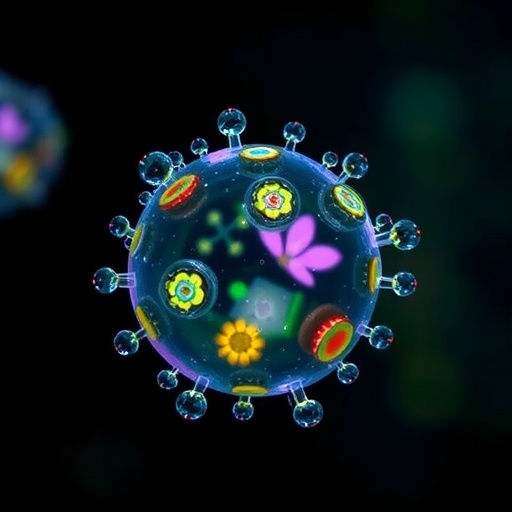
In the ever-evolving tapestry of aquatic ecosystems, the invisible exchanges between microbial communities symbolize a complex and dynamic form of communication and cooperation that has long evaded comprehensive understanding. Recently, a groundbreaking study conducted by Xu, Obeten, Zhu, and colleagues has peeled back the layers of this hidden dialogue, shedding light on the crucial role played by extracellular vesicles (EVs) in shaping microbial community assembly in natural water bodies. This research, conducted in the Xinglinwan Reservoir, reveals that EVs are not just passive carriers but active mediators of metabolic exchange, profoundly influencing microbial interactions, ecosystem functionality, and biogeochemical cycles.
Microorganisms have been known to secrete a variety of bioactive molecules facilitating interactions within and across species boundaries, but the concept of extracellular vesicles as specialized metabolic couriers in aquatic environments pushes the frontier of microbial ecology into new territory. EVs, nanoscale lipid-bound particles, encapsulate diverse biomolecules such as proteins, nucleic acids, and metabolites. While previous studies have elucidated their roles in model organisms under controlled laboratory settings, Xu and his team have ventured into the natural milieu to decipher their ecological significance amidst the seasonal shifts of complex microbial consortia.
The team’s ambitious integrative approach combined genome-scale metabolic modeling with cutting-edge multi-omics analyses focused on environmental EVs isolated from the Xinglinwan Reservoir. This methodological synergy allowed them to reconstruct the molecular cargo carried by vesicles in situ, offering an unprecedented glimpse into the biochemical maps that EVs traverse in natural ecosystems. Notably, the vesicle cargos predominantly consisted of amino acids, disaccharides, carbohydrate-active enzymes (CAZymes), and signal molecules – compounds integral to microbial metabolism and interspecies signaling.
One of the seminal findings of this research was the demonstration that EVs serve as crucial facilitators of growth for amino acid auxotrophic strains. These microbes, which lack the capacity to synthesize certain essential amino acids, appear to rely on environmental vesicles as nutrient supplements, which in turn supports more intricate community architectures and resilience. This discovery suggests that EVs not only mediate passive diffusion of metabolites but actively subsidize the metabolic needs of community members, potentially fostering cooperative relationships that transcend genomic constraints.
Beyond nutrient conveyance, EVs were also identified as dynamic reservoirs of functional traits, circulating enzymes such as CAZymes that degrade complex carbohydrates, thereby supplementing the extracellular enzymatic repertoire available within the microbial milieu. This externalization of metabolic capabilities via EVs likely enhances the breakdown and recycling of organic matter, contributing to ecosystem nutrient turnover and energy flow. Such vesicle-driven enzymatic activity introduces a layer of functional redundancy that stabilizes ecosystem processes against environmental fluctuations.
Intriguingly, the study postulated that the widespread distribution of EVs throughout the water column amplifies stochasticity in community assembly processes. By disseminating functional capacity across taxa and providing modular metabolic units externally, EVs support a non-deterministic pattern of microbial succession, which could explain the observed seasonal variability in microbial compositions. This stochastic model contrasts with traditional views centered on competitive exclusion and resource partitioning, highlighting EVs as agents fostering diversity and ecological plasticity.
Methodologically, the integration of genome-scale metabolic reconstructions was pivotal in quantifying the metabolic potentials encoded and expressed via EV cargo. This systems-level insight revealed that vesicle-mediated exchanges complement, rather than replace, classical nutrient transport mechanisms such as membrane transporters and diffusion. Essentially, EVs represent a parallel, vesicle-centric channel that effectively circumvents spatial and metabolic constraints, enabling microbes to exchange metabolites even in heterogeneous or nutrient-poor niches.
Moreover, the discovery that EVs carry signaling molecules opens new avenues for understanding microbial communication in natural waters. Quorum sensing and other signal-mediated behaviors underpin microbial cooperation, virulence, and environmental sensing. Vesicle carriage of signaling compounds thus represents an elegant strategy through which microbes coordinate activities at the population level, reinforcing community cohesion and functional integration.
The ecological implications of this work extend well beyond basic microbiology, offering transformative perspectives to biogeochemical cycling models. EV-mediated metabolite fluxes could alter existing paradigms concerning carbon and nitrogen turnover, as they introduce previously unappreciated pathways for organic matter transformation and nutrient exchange. Consequently, future ecosystem models might need to incorporate vesicle dynamics to achieve accurate predictions of microbial contributions to global elemental cycles.
This research also invites reconsideration of stochastic and deterministic paradigms in microbial ecology. By acting as a reservoir of functional traits and metabolic intermediates external to cells, EVs blur the lines between individual microbial genomes and community-level functions. Such communal public goods mediated by vesicles might confer resilience against environmental stresses, promote functional redundancy, and buffer communities against perturbations like pollutant influx or climate variability.
Practically, understanding the role of EVs could significantly impact environmental management and biotechnology. For example, harnessing vesicle-mediated exchanges might improve bioremediation strategies, stimulate beneficial microbial consortia in aquaculture, or optimize wastewater treatment processes by enhancing cooperative metabolic pathways. Equally, the manipulation of vesicle production or uptake could become a novel means of modulating microbial communities in situ.
Seasonality emerged as a crucial variable in the study, reinforcing that EV dynamics and their ecological roles fluctuate along temporal axes. The researchers noted that the functional composition, abundance, and community-level effects of EVs changed according to seasonal shifts in temperature, nutrient availability, and microbial population structure. This temporal coupling suggests that vesicle-mediated metabolic exchange is an adaptive mechanism attuned to environmental rhythms, possibly influencing microbial succession patterns and food web dynamics.
The multidisciplinary approach harnessed by Xu and colleagues exemplifies the future of microbial ecology research, where high-resolution molecular techniques intersect with ecosystem-scale analyses. By moving from laboratory models to natural field systems, this study opens up rich investigative terrains where the role of extracellular vesicles can be integrated into broader ecological theories and applications.
In summary, the study by Xu et al. represents a paradigm shift in our comprehension of microbial interactions within aquatic ecosystems, elevating extracellular vesicles from peripheral curiosity to central players in microbial community assembly and ecosystem functioning. By serving as vehicles for amino acids, carbohydrates, enzymes, and signals, EVs orchestrate complex metabolic exchanges that foster cooperation, resilience, and functional diversity. This research not only opens new conceptual horizons but also lays the groundwork for harnessing EVs in environmental management and biotechnology.
As aquatic ecosystems face mounting anthropogenic pressures and climate-induced changes, insights into microbial interactions mediated by EVs gain urgency. Elucidating these processes offers pathways to predict ecosystem responses, develop intervention strategies, and appreciate the subtle but vital microbial networks that sustain aquatic life.
The groundbreaking findings presented promise to catalyze a flurry of research across disciplines, ultimately enriching our understanding of microbial ecology and the microscopic exchanges that govern macroscopic ecological balances. Extracellular vesicles emerge not merely as biochemical curiosities but as keystones in the quest to unravel nature’s most intricate and fundamental transactions.
Cite Scienmag News
Morgan Morrow. (April 16, 2026). Extracellular Vesicles Shape Seasonal Aquatic Bacteria. Scienmag. https://scienmag.com/extracellular-vesicles-shape-seasonal-aquatic-bacteria/
Morgan Morrow. "Extracellular Vesicles Shape Seasonal Aquatic Bacteria." Scienmag, 16 April 2026, https://scienmag.com/extracellular-vesicles-shape-seasonal-aquatic-bacteria/. Accessed 5 September 2026.
Morgan Morrow. "Extracellular Vesicles Shape Seasonal Aquatic Bacteria." Scienmag. April 16, 2026. https://scienmag.com/extracellular-vesicles-shape-seasonal-aquatic-bacteria/


