

WASHINGTON, July 23, 2024 — Faced with the world’s impending freshwater scarcity, a team of researchers in Singapore turned to solar steam generators (SSGs), which are emerging as a promising device for seawater desalination. Desalination can be a costly, energy-intensive solution to water scarcity. This renewable-powered approach mimics the natural water cycle by using the sun’s energy to evaporate and isolate water. However, the technology is limited by the need to fabricate complex topologies to increase the surface area necessary to achieve high water evaporation efficiency.

Credit: Yanbei Hou et al.
WASHINGTON, July 23, 2024 — Faced with the world’s impending freshwater scarcity, a team of researchers in Singapore turned to solar steam generators (SSGs), which are emerging as a promising device for seawater desalination. Desalination can be a costly, energy-intensive solution to water scarcity. This renewable-powered approach mimics the natural water cycle by using the sun’s energy to evaporate and isolate water. However, the technology is limited by the need to fabricate complex topologies to increase the surface area necessary to achieve high water evaporation efficiency.
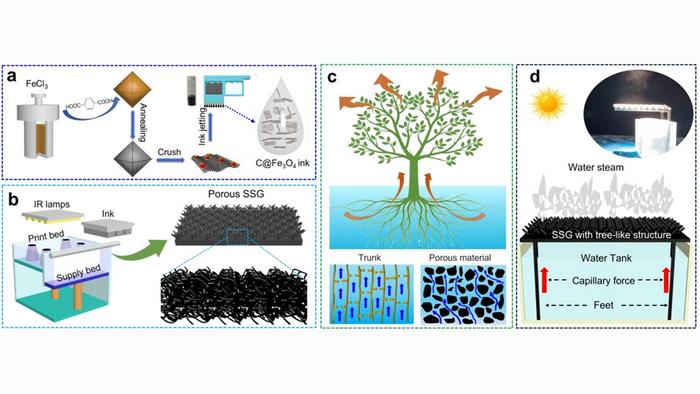
To overcome this barrier, the team sought design inspiration from trees and harnessed the potential of 3D printing. In Applied Physics Reviews, the team presents a state-of-the-art technology for producing efficient SSGs for desalination and introduces a novel method for printing functional nanocomposites for multi-jet fusion (MJF).
“We created SSGs with exceptional photothermal performance and self-cleaning properties,” said Kun Zhou, a professor of mechanical engineering at Nanyang Technological University. “Using a treelike porous structure significantly enhances water evaporation rates and ensures continuous operation by preventing salt accumulation — its performance remains relatively stable even after prolonged testing.”
The physics behind their approach involves light-to-thermal energy conversion, where the SSGs absorb solar energy, convert it to heat, and evaporate the water/seawater. The SSG’s porous structure helps improve self-cleaning by removing accumulated salt to ensure sustained desalination performance.
“By using an effective photothermal fusing agent, MJF printing technology can rapidly create parts with intricate designs,” he said. “To improve the photothermal conversion efficiency of fusing agents and printed parts, we developed a novel type of fusing agent derived from metal-organic frameworks.”
Their SSGs were inspired by plant transpiration and are composed of miniature tree-shaped microstructures, forming an efficient, heat-distributing forest.
“Our bioinspired design increases the surface area of the SSG,” said Zhou. “Using a treelike design increases the surface area of the SSG, which enhances the water transport and boosts evaporation efficiency.”
One big surprise was the high rate of water evaporation observed in both simulated environments and field trials. The desalinated water consistently met standards for drinking water — even after a long-time test.
“This demonstrates the practicality and efficiency of our approach,” Zhou said. “And it can be quickly and easily mass-produced via MJF commercial printers.”
The team’s work shows significant potential for addressing freshwater scarcity.
“Our SSGs can be used in regions with limited access to freshwater to provide a sustainable and efficient desalination solution,” said Zhou. “Beyond desalination, it can be adapted for other applications that require efficient solar energy conversion and water purification.”
###
The article “3D printing of bio-inspired porous polymeric solar steam generators for efficient and sustainable desalination” is authored by Yanbei Hou, Ming Gao, Xueyu Bai, Lihua Zhao, Hejun Du, and Kun Zhou. It will appear in Applied Physics Reviews on July 23, 2024 (DOI: 10.1063/5.0200505). After that date, it can be accessed at https://doi.org/10.1063/5.0200505.
ABOUT THE JOURNAL
Applied Physics Reviews features articles on significant and current topics in experimental or theoretical research in applied physics, or in applications of physics to other branches of science and engineering. The journal publishes both original research on pioneering studies of broad interest to the applied physics community, and reviews on established or emerging areas of applied physics. See https://pubs.aip.org/aip/apr.
###
Journal
Applied Physics Reviews
Article Title
3D printing of bio-inspired porous polymeric solar steam generators for efficient and sustainable desalination
Article Publication Date
23-Jul-2024

