



Credit: OES
A new publication from Opto-Electronic Sciences; DOI 10.29026/oes.2024.240013 , discusses highly sensitive and real-simultaneous CH4/C2H2 dual-gas LITES sensor based on Lissajous pattern multi-pass cell.
Trace gases are atmospheric constituents with a volume fraction of less than 1%. Despite their low concentrations, nitrogen oxides, hydrocarbons, and sulfides in the atmosphere have a significant impact on the environment, closely related to phenomena such as acid rain, greenhouse effects, and ozone layer depletion. Therefore, race gas detection of is crucial for environmental protection. In addition, it has important research and application values in fields such as industry, medicine, and fire warning.
In 2018, light-induced thermoelectric spectroscopy (LITES) was reported by Ma in 2018 for the first time. In this technology, the modulation laser passes through the test gas and is focused on the surface of quartz tuning fork (QTF). The light carrying the concentration information of the gas is absorbed by the quartz and converts into a heat signal. Because of the thermal expansion and piezoelectric property of QTF, the heat signal is further converted into an electronic signal to obtain gas concentration information. This technology quickly became a research focus due to its high sensitivity, fast response, and noncontact full-band spectrum detection capabilities. How to further improve the sensitivity, response speed and integration of LITES sensor system will be the focus of subsequent research. By extending the propagation path of laser in gas, the detection sensitivity of LITES sensor can be effectively improved. Therefore, developing new optical multi-pass cells (MPC) is crucial for achieving higher performance LITES sensors.
In dual-gas simultaneous detection technologies, time-division multiplexed (TDM) is difficult to achieve fast response and suit volatile environments. As for frequency-division multiplexed (FDM), it is unsuitable for sensor system with resonance frequency. To address these issues, Lissajous spot patterns based on three-mirror MPC for optical path separation in LITES technology was presented in this paper.
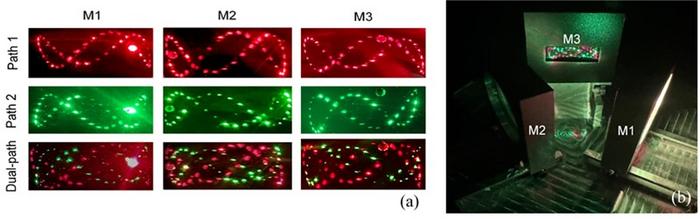
The real distribution of light spots obtained with red/green diode lasers was shown in Fig. 1. Two different modulated lasers are incident through mirror 1 and exit through mirrors 2 and 3, respectively. Compared to the circular spot pattern of the Herriott MPC, this distribution optimally utilizes the mirror surface area, reducing the system’s size. The total optical path volume ratio can achieve 26.8 cm-2.
Two self-designed trapezoidal-head QTFs with low resonant frequencies of less than 10 kHz and quality factor of ~ 12000 were adopted to enhance the detection ability. Two kinds of fiber amplifier, erbium doped fiber amplifier (EDFA) and Raman fiber amplifier (RFA), were combined to amplify the output power of two diode lasers to improve the excitation strength. Signal values increased linearly with the output power and reached the highest when the output power of RFA and EDFA were set to the maximum 300 mW and 1000 mW, respectively. Corresponding minimum detection limits (MDLs) were determined to be 268.8 ppb and 91.4 ppb, respectively. Based on Allan deviation analysis, when the integration time of the system were 150 s and 100 s, the MDLs could be improved to 54.8 ppb and 26.1 ppb, accordingly. The relationship between signal values and concentrations of double gases were researched simultaneously and is displayed in Fig. 3. The experimental results indicated that two signals of CH4 and C2H2 were proportional to each concentration. Corresponding values of R-square after linear fitting were both 0.99, indicating an excellent linear concentration response.
# # # # # #
Yufei Ma received his PhD degree in physical electronics from Harbin Institute of Technology, China, in 2013. From September 2010 to September 2011, he spent as a visiting scholar at Rice University, USA. Currently, he is a professor at Harbin Institute of Technology, China. He is the winner of National Outstanding Youth Science Fund. His research interests include optical sensors, trace gas detection, laser spectroscopy, solid-state laser and optoelectronics. He has published ~200 publications (including ~50 ESI hot/highly cited papers) and given more than 30 invited presentations at international conferences. He is the winner of 2021, 2022 Most Cited Researchers from Elsevier.
# # # # # #
Opto-Electronic Science (OES) is a peer-reviewed, open access, interdisciplinary and international journal published by The Institute of Optics and Electronics, Chinese Academy of Sciences as a sister journal of Opto-Electronic Advances (OEA, IF=15.3). OES is dedicated to providing a professional platform to promote academic exchange and accelerate innovation. OES publishes articles, reviews, and letters of the fundamental breakthroughs in basic science of optics and optoelectronics.
# # # # # #
Editorial Board: /editorialboard/list
OES is available on OE journals (/archive)
Submission of OES may be made using ScholarOne (https://mc03.manuscriptcentral.com/oes)
CN 51-1800/O4
ISSN 2097-0382
Contact Us: oes@ioe.ac.cn
Twitter: @OptoElectronAdv (https://twitter.com/OptoElectronAdv?lang=en)
WeChat: OE_Journal
# # # # # #
Sun HY, He Y, Qiao SD et al. Highly sensitive and real-simultaneous CH4/C2H2 dual-gas LITES sensor based on Lissajous pattern multi-pass cell. Opto-Electron Sci 3, 240013 (2024). doi: 10.29026/oes.2024.240013
Journal
Opto-Electronic Science
Cite Scienmag News
Denise Maddox. (July 23, 2024). Lissajous pattern multi-pass cell: Enhancing high sensitivity and simultaneous dual-gas LITES sensing. Scienmag. https://scienmag.com/lissajous-pattern-multi-pass-cell-enhancing-high-sensitivity-and-simultaneous-dual-gas-lites-sensing/
Denise Maddox. "Lissajous pattern multi-pass cell: Enhancing high sensitivity and simultaneous dual-gas LITES sensing." Scienmag, 23 July 2024, https://scienmag.com/lissajous-pattern-multi-pass-cell-enhancing-high-sensitivity-and-simultaneous-dual-gas-lites-sensing/. Accessed 5 September 2026.
Denise Maddox. "Lissajous pattern multi-pass cell: Enhancing high sensitivity and simultaneous dual-gas LITES sensing." Scienmag. July 23, 2024. https://scienmag.com/lissajous-pattern-multi-pass-cell-enhancing-high-sensitivity-and-simultaneous-dual-gas-lites-sensing/

