


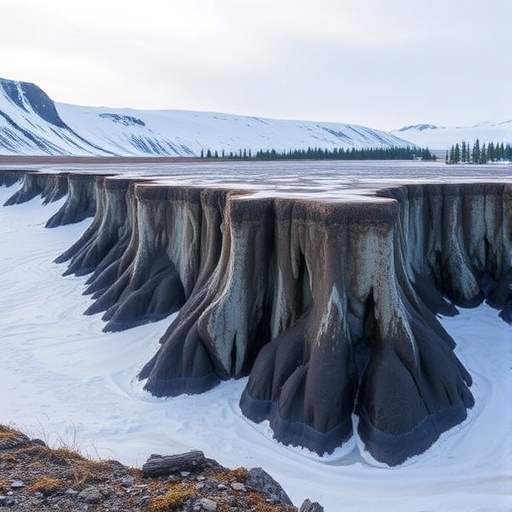
In the rapidly evolving fields of climate science and earth system research, understanding the dynamics of permafrost and its role in carbon cycling remains a critical frontier. A groundbreaking study led by Heffernan, Vaziourakis, and Sannel, published in Communications Earth & Environment, has unveiled pivotal insights into how legacy permafrost conditions act as a controlling factor for carbon decomposition in thaw-affected peatlands and ponds, known as thermokarst landscapes. This novel research sheds light on the complexity of deep carbon processes and their broader implications for climate feedback mechanisms in the Arctic and sub-Arctic regions.
Permafrost, the permanently frozen layer of soil and organic matter found extensively in polar and alpine environments, serves as a vast, frozen reservoir of organic carbon accumulated over millennia. With accelerating global temperatures triggering widespread permafrost thaw, scientists have been alarmed by the potential release of greenhouse gases—primarily carbon dioxide and methane—from previously sequestered organic material. However, this new study challenges some expectations by demonstrating that legacy permafrost conditions significantly restrain the decomposition of deep carbon pools in thermokarst peatlands and ponds, complicating prior assumptions about carbon emissions from these ecosystems.
The research team employed a multidisciplinary approach, combining field observations, geochemical analyses, and advanced modeling to assess carbon decomposition rates across a range of thermokarst environments. Thermokarst features, which form as permafrost thaws unevenly and the ground subsides, create complex peatland ecosystems and ponds that are hotspots for biogeochemical activity. The authors meticulously characterized the physical and chemical properties of soils and sediments at various depths, emphasizing the historical context – or “legacy” – of permafrost presence and disturbance.
One of the most striking discoveries was that even though thawing increases microbial activity and surface-level decomposition, deep carbon reservoirs remain remarkably resistant to breakdown. This phenomenon is attributed to the unique chemical and physical conditions preserved by the legacy permafrost. The legacy permafrost exerts a preservative effect, maintaining suboxic to anoxic—oxygen-poor—conditions and a cold thermal regime in deeper strata. Such environments restrict the activity of decomposer microbes and limit exposure of organic matter to decomposition processes.
Furthermore, the study highlights how thermokarst processes intricately influence carbon cycling pathways. While methane emissions from surface pools and peatlands are well-documented, the legacy permafrost appears to inhibit significant methane generation at greater depths, altering the overall greenhouse gas emission profiles of these thawing landscapes. This finding underscores the importance of capturing permafrost history and heterogeneity, as these characteristics profoundly affect microbial ecology and biogeochemical functioning.
The implications of this study are manifold. For one, it suggests that existing models of carbon feedback loops in Arctic regions might overestimate the immediate release of deep soil carbon as permafrost thaws. Incorporating legacy permafrost conditions into predictive models may refine forecasts of carbon emissions and improve climate change projections. Additionally, understanding these constraints at depth informs conservation strategies that aim to mitigate greenhouse gas releases from thawing landscapes.
Methodologically, the study pushes the envelope by integrating legacy landscape analysis with modern biogeochemistry. Techniques such as radiocarbon dating and stable isotope tracking allowed the researchers to unravel the age and transformation pathways of organic carbon deposits. Concurrently, geophysical surveys tracked subsurface temperature and moisture gradients, crucial for interpreting microbial activity potential. These comprehensive datasets presented a nuanced narrative of carbon stability amid dynamic thermokarst evolution.
Moreover, the research illuminates how thermokarst ponds—small, shallow water bodies formed by thaw—function both as sources and sinks of atmospheric carbon. Although ponds emit methane through microbial metabolism in surface sediments, legacy permafrost beneath constrains the penetration of labile carbon and microbial colonization deeper down. This layered interaction complicates the carbon budget of northern ecosystems and highlights the multifaceted nature of permafrost-thaw feedbacks.
The study’s revelations also bring attention to temporal scales of decomposition. Carbon stored in legacy permafrost layers has been immobilized for thousands of years; its gradual mobilization, therefore, does not proceed uniformly or instantaneously upon thaw. This temporal dimension suggests that some deep carbon stocks may persist in a semi-frozen state longer than anticipated despite surface warming, providing a potential buffer against rapid greenhouse gas release but also underscoring the challenges of predicting long-term carbon dynamics.
Importantly, these insights affect how climate policy makers and Arctic stakeholders interpret the vulnerability of permafrost carbon pools. Assumptions of swift, extensive carbon liberation may need reevaluation in light of the moderating role of legacy conditions. Consequently, adaptive management strategies in northern regions must account for spatial variability and legacy effects to be robust and scientifically grounded.
The findings also propel a broader scientific dialogue regarding earth system feedbacks. The interplay between past environmental conditions (legacy) and present ecological responses calls for interdisciplinary research frameworks that bridge geology, microbiology, atmospheric science, and hydrology. Only through such integrative perspectives can humanity accurately decipher the changing face of the cryosphere and its global implications.
In sum, the study by Heffernan et al. adds a vital piece to the puzzle of permafrost-carbon feedbacks, emphasizing the enduring legacy of ancient frozen soils in regulating carbon fate in an era of rapid climatic upheaval. The discovery that deep carbon pools in thermokarst peatlands and ponds are more resistant to decomposition than previously understood invites reconsideration of carbon cycle models and cautions against simplistic projections of permafrost carbon vulnerability. As Arctic warming proceeds unabated, these nuanced understandings will be indispensable for both science and policy aimed at addressing climate change.
The research underscores the complexity inherent in the Earth’s frozen ecosystems and reveals that while surface thaw may be visible and fast, the deep cryotic memories embedded in soils continue to influence carbon dynamics quietly but significantly. Future investigations are poised to unravel further the underlying mechanisms at molecular and microbial scales, exploring how legacy permafrost shapes biogeochemical trajectories over decades to centuries. This emergent comprehension heralds a new chapter in Arctic science—one that respects the past to predict the future.
Ultimately, the legacy of permafrost is not just a relic of earth’s climatic history but a living regulator of carbon feedbacks, playing an indispensable role in the trajectory of global warming. The insights yielded by this landmark study serve as a clarion call to deepen our scientific inquiry and adaptation strategies in the face of a warming world whose polar frontiers harbor secrets yet to be fully unveiled.
Cite Scienmag News
Sloane Callahan. (April 14, 2026). Legacy Permafrost Slows Deep Carbon Decay. Scienmag. https://scienmag.com/legacy-permafrost-slows-deep-carbon-decay/
Sloane Callahan. "Legacy Permafrost Slows Deep Carbon Decay." Scienmag, 14 April 2026, https://scienmag.com/legacy-permafrost-slows-deep-carbon-decay/. Accessed 4 September 2026.
Sloane Callahan. "Legacy Permafrost Slows Deep Carbon Decay." Scienmag. April 14, 2026. https://scienmag.com/legacy-permafrost-slows-deep-carbon-decay/


