


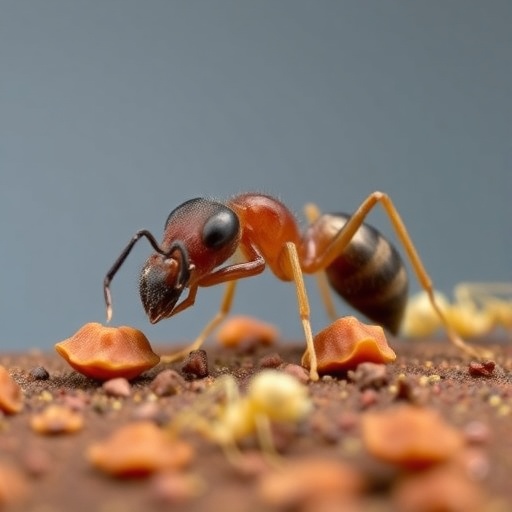
In the arid landscapes of southeastern Arizona, a remarkable behavioral phenomenon has been documented involving two distinct ant species. Harvester ants, known scientifically as Pogonomyrmex barbatus, congregate outside the nests of a considerably smaller congener, a previously undescribed species within the genus Dorymyrmex, commonly referred to as cone ants. Contrary to expectations of interspecies antagonism inherent to ants, these diminutive cone ants engage in a unique interaction wherein they meticulously lick and nibble at the exoskeleton of the much larger harvester ants. This discovery, representing the first documented instance of one ant species acting as a cleaner for another, parallels cleaner fish behaviors known in marine ecosystems.
The observational study, recently published in Ecology and Evolution, was conducted by entomologist Mark Moffett of the Smithsonian National Museum of Natural History. Moffett, leveraging both his extensive expertise in social biology and patient field observation techniques, witnessed harvester ants unexpectedly pausing their seed-gathering activities. Their typically aggressive mandibles were held open as smaller cone ants climbed aboard, carefully grooming the larger ants by removing microscopic particulates from their bodies. This behavior is strikingly analogous to mutualistic cleaning behaviors observed in marine environments, where cleaner fish remove parasites and dead tissue from host fish, sometimes entering even the formidable mouths of predatory species.
Moffett’s fieldwork in the Chiricahua Mountains facilitated detailed documentation of this interspecies interaction. The harvester ants approached the cone ant nests and exhibited a rigid posture, standing tall on their legs with mandibles agape. Within a short span, several cone ants emerged to inspect and subsequently groom the visiting harvester ants. These interactions ranged widely in duration, lasting from seconds to several minutes. Notably, the cone ants employed their specialized, tongue-like mouthparts to meticulously clean the harvester ants, including within their serrated jaws, an area usually off-limits to intruders.
This newly discovered behavior challenges traditional understandings of ant ecology, where interspecific interactions are predominantly competitive or predatory. The cleaner ant analogy to cleaner fish introduces a novel mutualistic framework within terrestrial arthropods, expanding the conceptual landscape of symbiotic relationships. The harvester ants tolerate this grooming meticulously, refraining from defensive behaviors such as biting during the process—a behavior that itself warrants closer ethological scrutiny given the inherent aggressiveness of harvester ants in other contexts.
Despite extensive observation, the precise physiological or ecological benefits accrued by either participant species remain speculative. One hypothesis posits that the cone ants acquire nutritional benefits by consuming dust-sized particles dislodged during grooming, possibly remnants of seed flakes processed by the harvester ants. Conversely, the harvester ants may receive parasite removal or hygienic benefits that complement their own grooming capabilities, potentially reducing microbial infections or improving cuticular health. Future research employing microbiological assays and parasitological assessments could illuminate these mutualistic benefits.
The specificity and selectivity of the cleaning behavior were further underscored by experiments in which cone ants ignored dead or immobilized harvester ants, suggesting a sensory mechanism that differentiates living hosts and possibly interprets behavioral cues indicative of consent or readiness. This aspect parallels cleaner fish selectivity and indicates evolved communication or recognition systems facilitating safe and effective cleaning engagements.
Importantly, this discovery exemplifies the critical importance of field-based naturalistic observations in revealing unexpected biological phenomena. Moffett emphasizes the value of attentiveness and methodological patience, noting that such complex interspecies interactions may evade detection under laboratory or short-term study conditions. The intricate social behaviors among ants, long studied in controlled settings, continue to surprise when examined within their natural ecological networks.
The implications of this research are manifold, touching upon evolutionary biology, mutualism theory, and the intricate balance of desert ecosystems. Understanding how mutualistic partnerships evolve and stabilize among eusocial insects may provide insights transferable to broader biological contexts, including microbiome interactions and parasite-host dynamics. The harvester and cone ant relationship serves as a fascinating model system to explore these dynamics in a previously unconsidered domain.
Moreover, this novel behavior invites comparative analyses with other known mutualisms in Hymenoptera and beyond. Could similar cleaning symbioses exist but remain undiscovered in other ant communities or insect groups? Such questions open avenues for broader surveys and refined ethological investigations in diverse biogeographical regions.
Ultimately, this cleaner ant behavior embodies a paradigm shift in insect sociality and interspecies cooperation. It challenges preconceptions regarding competitive dominance among insects, proposing instead a complex behavioral ecology where cooperation transcends species boundaries for mutual benefit. As scientific inquiry progresses, this discovery fosters a deeper appreciation of the nuanced and multifaceted interactions shaping life in extreme environments like the deserts of the American Southwest.
Subject of Research: Animals
Article Title: The First Cleaner Ant? A Novel Partnership in the Arizona Desert
News Publication Date: 13-Apr-2026
Web References: https://doi.org/10.1002/ece3.73308
References: Ecology and Evolution, DOI: 10.1002/ece3.73308
Image Credits: © Mark Moffett, Minden Pictures
Keywords: Ants, Ethology, Organismal biology, Hymenoptera, Behavioral ecology, Sociobiology, Mutualism, Cleaner ants, Terrestrial symbiosis, Desert ecology
Cite Scienmag News
Gavin Prescott. (April 13, 2026). Smithsonian Research Associate Uncovers Novel Insect Behavior: Ants Assemble to Be Cleaned by ‘Cleaner’ Ants. Scienmag. https://scienmag.com/smithsonian-research-associate-uncovers-novel-insect-behavior-ants-assemble-to-be-cleaned-by-cleaner-ants/
Gavin Prescott. "Smithsonian Research Associate Uncovers Novel Insect Behavior: Ants Assemble to Be Cleaned by ‘Cleaner’ Ants." Scienmag, 13 April 2026, https://scienmag.com/smithsonian-research-associate-uncovers-novel-insect-behavior-ants-assemble-to-be-cleaned-by-cleaner-ants/. Accessed 4 September 2026.
Gavin Prescott. "Smithsonian Research Associate Uncovers Novel Insect Behavior: Ants Assemble to Be Cleaned by ‘Cleaner’ Ants." Scienmag. April 13, 2026. https://scienmag.com/smithsonian-research-associate-uncovers-novel-insect-behavior-ants-assemble-to-be-cleaned-by-cleaner-ants/


