


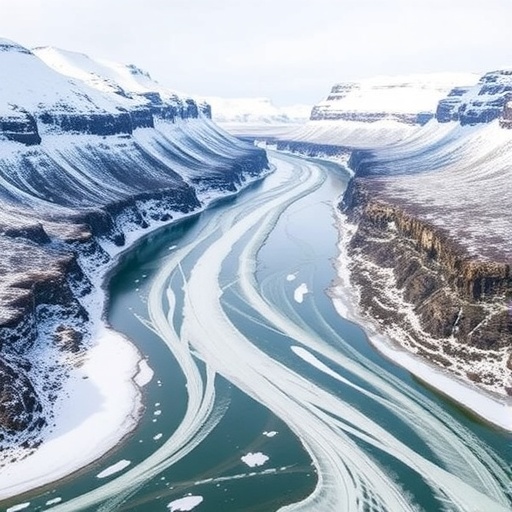
In a groundbreaking study published in Nature Geoscience, researchers have unveiled new insights into the evolving dynamics of Arctic rivers, revealing a pronounced increase in sediment concentration and flux across the pan-Arctic region over the past four decades. This revelation is pivotal, given the crucial role that Arctic river systems play in transporting freshwater, sediment, and organic carbon from terrestrial landscapes to the Arctic Ocean, thereby influencing coastal stability and broader biogeochemical cycles in this rapidly changing environment.
Arctic rivers have long been recognized for their significant influence on the coastal and marine ecosystems of the Arctic Ocean. They act as conduits conveying enormous volumes of freshwater and particulate matter, which have direct implications for sedimentary processes and the carbon cycle. However, monitoring these extensive and remote river networks has been a formidable challenge for scientists, obstructing a comprehensive understanding of long-term sediment transport patterns and their driving mechanisms.
To overcome these obstacles, the authors of the study developed an innovative satellite- and machine learning-based methodology specifically tailored for the pan-Arctic context. This advanced framework enabled the reconstruction of suspended sediment concentration trends over the last forty years at unprecedented spatial resolution, covering an impressive 4,331 individual river reaches. By leveraging multispectral satellite imagery and sophisticated algorithms, they achieved a system-wide assessment that was previously unattainable through traditional observational approaches.
A key finding from the analysis is that approximately 40% of river reaches located within the continuous permafrost zone exhibited statistically significant increases in suspended sediment concentration. This trend was largely attributed to factors such as rising river discharge, widespread thermokarst disturbances — which involve the thawing and subsequent collapse of permafrost — and increasingly frequent and intense wildfires. Each of these drivers contributes to enhanced sediment mobilization and transport, reflecting the multifaceted impact of climate warming on Arctic landscapes.
Quantitatively, the pan-Arctic sediment flux to the ocean has been estimated at an average of 315 ± 33 million tonnes per year. Strikingly, while the six major rivers — Yenisey, Lena, Ob’, Kolyma, Yukon, and Mackenzie — are responsible for approximately 63% of this load, the study highlights that smaller and medium-sized coastal rivers, constituting 263 previously overlooked fluvial systems, supply roughly 37% of the sediment flux. This substantial contribution from smaller rivers underscores the necessity of considering the entire basin-scale network, rather than focusing solely on large river systems, when assessing Arctic sediment dynamics.
Over the study period from the 1980s to the 2010s, the total land-to-ocean sediment flux increased by nearly 15%, rising from about 299 ± 28 million tonnes per year to 344 ± 29 million tonnes per year. This upward trend is indicative of both climatic and landscape changes manifesting across the circumpolar region. The increase not only affects sediment delivery but also has major implications for marine sedimentation patterns, carbon cycling, and coastal morphology, potentially altering habitats that underpin Arctic marine biodiversity.
The integration of machine learning techniques with satellite remote sensing data represents a methodological breakthrough in Arctic research. This approach allowed for the robust estimation of suspended sediment concentration across a vast and heterogeneous geography without the logistical constraints of in situ sampling. Such innovation sets a new standard for monitoring other remote and climatically sensitive river basins under stress from environmental change.
Thermokarst disturbances, which have intensified with Arctic warming, play a prominent role in the enhanced sediment flux. As permafrost thaws, the ground subsides and destabilizes, releasing previously frozen sediments into fluvial systems. This process accelerates sediment availability and transport, influencing water quality and sediment deposition downstream. Likewise, fires burn away surface vegetation, exposing soil to erosional forces and increasing sediment entrainment in river waters during subsequent rainfall or snowmelt events.
The study’s findings hold critical implications for the Arctic carbon cycle. Suspended sediments can carry large quantities of organic carbon, both labile and refractory, from terrestrial sources into the marine environment. Changes in sediment flux therefore directly influence carbon burial rates and release processes, affecting feedback loops associated with global climate regulation. Moreover, increased sediment inputs can modify the optical properties of coastal waters, impacting photosynthesis and nutrient dynamics.
With the Arctic experiencing some of the most rapid climatic transformations globally, understanding the evolving sediment transport mechanisms is essential for predicting future landscape and ecosystem trajectories. This research provides a much-needed baseline for pan-Arctic sediment dynamics, enabling better forecasting of environmental changes and assisting policymakers in devising adaptive strategies for Arctic conservation and resource management.
Importantly, by spotlighting the underappreciated role of small- and medium-sized coastal rivers, the study challenges previous paradigms that prioritized major riverine contributors. Smaller rivers, often situated in sensitive permafrost zones and undergoing rapid environmental change, could serve as early indicators of broader regional trends and deserve heightened scientific attention.
The authors suggest that ongoing monitoring efforts should incorporate the expanded river network and leverage emerging satellite platforms and artificial intelligence tools to refine sediment flux estimations further. Such continuous advancements will be crucial for capturing the fast-evolving nature of Arctic fluvial processes in the context of accelerating climate change.
Ultimately, this research bridges a critical knowledge gap, demonstrating how advanced remote sensing and machine learning can unravel complex, large-scale environmental phenomena in the Arctic, a region poised at the frontline of global change. By elucidating sediment dynamics over multiple decades, the work provides a foundational resource that is invaluable for scientists, policymakers, and stakeholders invested in the sustainable stewardship of Arctic environments.
As Arctic rivers continue to alter their transport regimes, the cascading impacts on coastal erosion, marine ecosystems, and carbon feedbacks will likely intensify, emphasizing the urgent need for enhanced observation and modeling capabilities. This landmark study not only advances scientific understanding but also underscores the interconnectedness of terrestrial and marine systems under climatic stress, painting a comprehensive picture of Arctic change that reverberates far beyond its icy bounds.
In conclusion, the study led by Tian et al. establishes a new benchmark in Arctic river research, revealing a substantial and accelerating rise in sediment concentration and flux driven by climatic warming, thermokarst, and fire disturbances. These insights illuminate the evolving processes shaping Arctic landscapes and biogeochemical cycles, while calling for holistic approaches to address the complexities of an emerging Arctic future.
Cite Scienmag News
Violet Maxwell. (April 13, 2026). Rising Sediment Levels Transform Pan-Arctic Rivers. Scienmag. https://scienmag.com/rising-sediment-levels-transform-pan-arctic-rivers/
Violet Maxwell. "Rising Sediment Levels Transform Pan-Arctic Rivers." Scienmag, 13 April 2026, https://scienmag.com/rising-sediment-levels-transform-pan-arctic-rivers/. Accessed 3 September 2026.
Violet Maxwell. "Rising Sediment Levels Transform Pan-Arctic Rivers." Scienmag. April 13, 2026. https://scienmag.com/rising-sediment-levels-transform-pan-arctic-rivers/


