


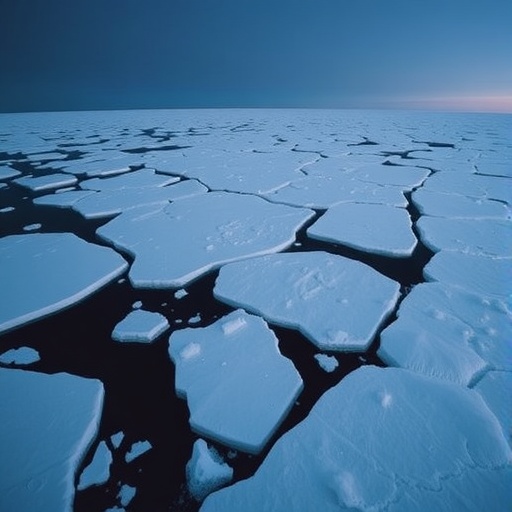
As the Arctic plunges into its long, unyielding night, one might imagine a frozen desert devoid of life and activity. However, groundbreaking new research reveals an extraordinary process beneath the ice that radically transforms our understanding of Arctic ecosystems during this sunless period. Scientists now demonstrate that the formation of sea-ice ridges plays a vital role in sustaining pelagic food webs in these polar waters, unlocking a hidden lifeline in one of Earth’s most extreme environments.
Sea-ice ridges, created as ice sheets fracture and pile against each other, have long been viewed merely as physical barriers shaping the ocean surface. Yet, this new study led by Olsen, Salganik, Müller, and colleagues, published in Communications Earth & Environment, emphasizes the crucial biological functions these structures perform. By reshaping habitat complexity and influencing biogeochemical cycles, ridges stimulate bursts of biological productivity when sunlight is absent—a phenomenon previously underestimated and largely unexplored in polar night conditions.
The Arctic polar night spans months of darkness and extreme cold, conditions generally interpreted as harsh limits to biological activity. However, the researchers utilized cutting-edge sensors and autonomous underwater vehicles to monitor changes within the water column beneath developing ridges. Their findings revealed that the mechanical forces shaping these ice formations simultaneously enhance nutrient mixing and water turbulence, effectively delivering sustenance to microbial communities and zooplankton populating the pelagic zone.
This mixing is vital because it transports essential nutrients from deeper waters upward, replenishing the surface layers where pelagic food webs operate. Moreover, as ridges displace the ice and water interface vertically, they create localized habitats enriched in algae and bacteria that colonize ice crystals. This microbial colonization then forms the base of a complex Arctic food chain, supporting higher trophic levels even in near-complete absence of sunlight.
Intriguingly, the study highlights how sympagic algae—those living within and on the ice—exploit the structured ridge environments to thrive year-round. Under normal polar night conditions, algal activity markedly diminishes, threatening the survival of species dependent on this primary production. Yet, ridge formation mitigates this decline by increasing ice porosity and light penetration, enabling some photosynthetic processes to persist despite the darkness.
The consequences for Arctic pelagic ecosystems are profound. Zooplankton populations, which rely on algal blooms for nutrition, are buoyed by this unexpected wintertime productivity. These tiny animals, in turn, serve as prey for a diverse array of fishes and marine mammals, ensuring a continuous flow of energy through the food web. The study suggests this mechanism fundamentally alters our understanding of seasonal food availability, offering life-sustaining resources when—according to previous models—food scarcity would be critical.
Methodologically, the research team combined in situ observations with advanced modeling to simulate ridge-driven ecosystem dynamics. Their integrative approach revealed nonlinear feedback loops: ridge formation fosters microbial colonization, which enhances nutrient recycling, promoting further biological activity. This biological augmentation then influences sea-ice structural integrity, potentially accelerating ridge development and maintaining ecosystem productivity during extreme winter conditions.
These findings have broader implications amid accelerating climate change. As Arctic ice dynamics shift with rising temperatures, the frequency, size, and distribution of sea-ice ridges may alter unpredictably, impacting these critical biological processes. Given the Arctic Ocean’s role as a barometer of global climate health and its importance in regulating atmospheric patterns, understanding ridge ecology is pivotal for predicting future ecosystem resilience and carbon cycling.
From a biogeochemical perspective, ridge formation substantially affects the cycling of carbon and other nutrients. Enhanced microbial activity at ridge sites promotes carbon sequestration within the ice-ocean interface, potentially moderating greenhouse gas emissions during the polar night. Furthermore, the processes uncovered may influence the Arctic’s role in global carbon budgets, shedding light on previously unknown pathways of carbon flux under the ice.
The research also challenges established paradigms that cast the polar night as a dormancy period. Instead, it unveils a portrait of a dynamic, interconnected system where physical ice formation and biological processes intertwine to sustain life under the most extreme light deprivation. This paradigm shift calls for refined models of polar ecosystems and reevaluation of conservation strategies to protect these fragile, yet resilient, Arctic habitats.
In addition to ecological insights, the study’s technological advancements in remote sensing and underwater robotics unlock new frontiers for polar research. Deploying autonomous instruments to monitor inaccessible winter seas overcomes limitations imposed by hazardous conditions, enabling continuous, high-resolution data acquisition vital for capturing transient phenomena such as ridge formation effects.
Considering the Arctic’s critical importance for indigenous communities and global biodiversity, this knowledge offers tangible benefits for managing fisheries, local economies, and international policy frameworks aimed at mitigating environmental harm. By illuminating the underappreciated biological roles of sea ice ridges, the study provides a nuanced foundation for sustainable stewardship of polar marine resources.
Future research pathways now include exploring the variability of ridge-driven food webs across different Arctic regions and seasons, assessing the contributions of ridge habitats to broader oceanic food web connectivity, and modeling the impacts of rapid ice melt on these systems. This holistic understanding will refine predictions of ecosystem trajectories under compounding human and environmental pressures.
Ultimately, the revelation that sea-ice ridges act as integral bioengineers of Arctic pelagic food webs during the polar night redefines the conceptual boundaries of polar ecology. This discovery not only enriches our appreciation of life’s adaptability but also underscores the intricate links between physical processes and biological survival strategies in Earth’s coldest realms. As we confront the challenges of a changing Arctic, such interdisciplinary insights form the cornerstone of informed, effective environmental stewardship.
Cite Scienmag News
Gavin Prescott. (April 10, 2026). Sea-Ice Ridges Sustain Arctic Food Webs in Darkness. Scienmag. https://scienmag.com/sea-ice-ridges-sustain-arctic-food-webs-in-darkness/
Gavin Prescott. "Sea-Ice Ridges Sustain Arctic Food Webs in Darkness." Scienmag, 10 April 2026, https://scienmag.com/sea-ice-ridges-sustain-arctic-food-webs-in-darkness/. Accessed 4 September 2026.
Gavin Prescott. "Sea-Ice Ridges Sustain Arctic Food Webs in Darkness." Scienmag. April 10, 2026. https://scienmag.com/sea-ice-ridges-sustain-arctic-food-webs-in-darkness/


