


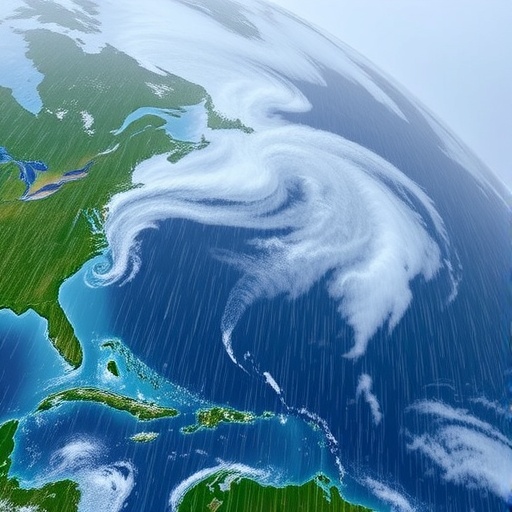
As the world’s oceans continue to absorb unprecedented amounts of heat due to anthropogenic climate change, one of the most striking consequences is becoming increasingly evident: tropical cyclones in the North Atlantic are intensifying in their rainfall and altering their behavior in complex ways. A groundbreaking study spearheaded by researchers at Newcastle University has illuminated the nuanced and divergent responses of tropical cyclones and their post-tropical progeny to surface warming, revealing profound implications for future flood risks and storm dynamics in vulnerable coastal regions. Utilizing extensive satellite observation data, this research offers novel insights into how rising temperatures and humidity are reshaping these storms, with a potential cascade of impacts that stretch from the tropics to Europe.
Over the last two decades, tropical cyclones have been identified as critical agents driving extreme precipitation events in warm, low-latitude zones, contributing significantly to seasonal rainfall totals and flash flooding episodes. Within the North Atlantic basin, the influence of these storms is particularly pronounced during the August to October hurricane peak, with quantifiable metrics showing that tropical cyclones can account for nearly 30 to 40 percent of the total seasonal precipitation accumulation in specific locales. This substantial contribution underscores the critical importance of understanding how these storms evolve in a warming climate, especially as atmospheric moisture content and ocean temperatures rise concurrently.
The study, published in the respected journal npj Climate and Atmospheric Science, delineates a troubling trend: storm precipitation rates increase by a median of approximately 21 percent per each degree Celsius rise in local dewpoint temperatures. Dewpoint—a measure closely linked to atmospheric moisture content—serves as a pivotal variable driving rainfall intensification. Furthermore, the spatial footprint of heavy rainfall expands by roughly 12.5 percent with each degree of warming, suggesting that tropical cyclones are not only becoming wetter but also afflicting larger areas with intense precipitation. These changes manifest alongside complex alterations in storm morphology, with cyclones generally shrinking in size as temperatures increase, though this trend may reverse under exceedingly high sea surface temperatures, like those often found in the Caribbean.
Crucially, the warming-driven modifications extend beyond mere precipitation increases. Tropical cyclones in warmer regions frequently exhibit reduced translation speeds, meaning they move more sluggishly across the ocean surface. This deceleration, combined with elongated storm lifespans, enhances the potential for catastrophic flooding by permitting prolonged rainfall over single locations, especially near the storm core. Such hydrometeorological shifts exacerbate the flooding hazard, significantly magnifying the risks to coastal infrastructure and populations already vulnerable to climate-induced stresses.
In a striking contrast to their tropical counterparts, tropical cyclones undergoing extratropical transition as they migrate northeastward toward Europe expand in size rather than contracting. These post-tropical cyclones exhibit less sensitivity to local temperature fluctuations in their rainfall patterns. Typically steered by baroclinic weather systems—a dynamic distinct from the tropical thermally driven mechanisms—these systems concentrate precipitation to the northeast quadrant of the storm, spreading heavy rain over broad areas due to appreciably faster storm speeds. This fundamental difference in atmospheric dynamics suggests that warming impacts are phase-dependent, influencing tropical and post-tropical stages through disparate physical processes.
Dr. Haider Ali, the lead author of the study, articulates the critical implications of these findings: “Our results decisively show that global warming is driving increases in both the intensity and spatial extent of rainfall from tropical cyclones in warm, low-latitude regions.” He further emphasizes the heightened flood risks emerging in the North Atlantic corridor as some storms slow down. The persistence of these climatological patterns, especially under projected future warming scenarios, portends escalating challenges for disaster preparedness and water resource management in affected nations.
Perhaps one of the most innovative aspects of this research is the dynamic conceptualization of storm size. Historically, meteorological studies have employed static radius definitions anchored to wind field extents or rainfall thresholds, often underestimating variability over a storm’s lifecycle. This analysis leverages satellite-based observational datasets to characterize storm morphology as a fluctuating parameter that evolves with environmental conditions and thermodynamic forcing. By capturing these dynamics, the research team delivers a sophisticated framework for disentangling cyclone life stages, assessing heavy precipitation metrics, and elucidating storm translation velocities in relation to local climatological warming trends.
Professor Hayley Fowler, a climate change impact expert and co-author, contextualizes these insights within the broader societal and environmental narrative: “The intensification of tropical cyclone rainfall we observe directly stems from the warming climate driven by our sustained reliance on fossil fuels.” She warns that without decisive mitigation measures to reduce greenhouse gas concentrations in the atmosphere, these storms will become wetter and longer-lasting, thereby amplifying the frequency and severity of flood disasters. The trajectory outlined by this study offers a stark reminder of the tangible consequences wrought by global carbon emissions not only on atmospheric physics but also on human safety and infrastructure resilience.
Looking forward, the research team envisions extending their investigation beyond atmospheric analyses into hydrologic realms, transforming the understanding of how extreme rainfall translates into on-the-ground flood hazards. This next phase involves integrating climate datasets with sophisticated hydrological models to decipher the intricate pathways from storm precipitation characteristics to river flow responses. Such work is vital, given that flood impacts hinge not solely on rainfall volume but on spatial distribution, duration, antecedent soil moisture conditions, and landscape hydrology. By pursuing this cause-and-effect framework, the research aims to isolate storms that pose the greatest risk to communities, empowering stakeholders to implement targeted adaptation and risk management strategies.
This multi-disciplinary approach underlines an evolving paradigm in climate research, where atmospheric physics interfaces seamlessly with hydrology and risk analysis to yield more actionable knowledge. It highlights the necessity of dynamic conceptual models that capture the variability and complexity inherent in tropical cyclone behavior under climate perturbations and addresses the critical challenge of translating atmospheric change into tangible societal risk assessments. The findings from Newcastle University thus represent a compelling synthesis of observational rigor, methodological innovation, and practical relevance in the urgent context of climate adaptation.
In sum, the meticulous satellite-based study documents how warming temperatures are reshaping tropical cyclones in the North Atlantic, rendering them rainier, sometimes larger in their post-tropical phases, and more persistent where sea surface temperatures soar. These changing storm characteristics under a warming climate amplify flood hazards—an outcome with far-reaching implications for coastal infrastructure, emergency management, ecological systems, and human lives. As climate change continues unabated, understanding these evolving mechanisms is crucial for enhancing predictive capabilities, fortifying preparedness, and mitigating the profound societal impacts of extreme weather and hydrological disasters.
News Publication Date: 27-Feb-2026
Web References:
http://dx.doi.org/10.1038/s41612-026-01363-2
References:
Ali, H., Fowler, H. J., Reed, K., & Prein, A. F. (2026). Warmer temperatures lead to wetter tropical cyclones in the North Atlantic. npj Climate and Atmospheric Science.
Cite Scienmag News
Violet Maxwell. (April 10, 2026). Rising Temperatures Amplify Rainfall in North Atlantic Storms. Scienmag. https://scienmag.com/rising-temperatures-amplify-rainfall-in-north-atlantic-storms/
Violet Maxwell. "Rising Temperatures Amplify Rainfall in North Atlantic Storms." Scienmag, 10 April 2026, https://scienmag.com/rising-temperatures-amplify-rainfall-in-north-atlantic-storms/. Accessed 4 September 2026.
Violet Maxwell. "Rising Temperatures Amplify Rainfall in North Atlantic Storms." Scienmag. April 10, 2026. https://scienmag.com/rising-temperatures-amplify-rainfall-in-north-atlantic-storms/


