


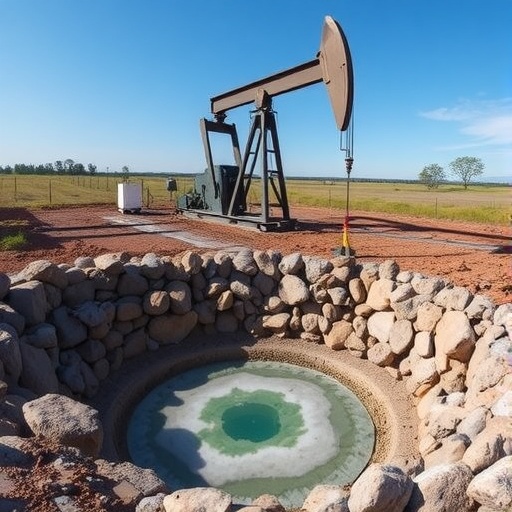
A groundbreaking study led by researchers at McGill University has unveiled startling new insights into methane emissions from non-producing oil and gas wells in Canada. This research reveals that microbial methane seepage from dormant wells is occurring at rates nearly 1,000 times greater than previously estimated, challenging longstanding assumptions about the environmental impact of these inactive sites. Given methane’s status as a potent greenhouse gas with a global warming potential significantly higher than carbon dioxide over a short-term horizon, these findings carry profound implications for climate change mitigation strategies worldwide.
Methane, a colorless and odorless hydrocarbon gas, is primarily produced through two pathways: thermogenic processes, which involve the thermal decomposition of organic material deep underground, and microbial processes, whereby microorganisms generate methane under anaerobic conditions near the surface. Previous research emphasized that most methane emissions from oil and gas infrastructure stem from thermogenic sources located in productive formations. However, the new study led by Associate Professor Mary Kang and her postdoctoral colleague Gianni Micucci reveals a far more complex picture, illustrating that microbial methane—a less energetic, biologically derived variety—also represents a significant and hitherto underestimated source of atmospheric methane leakage.
The research team conducted an extensive experimental campaign sampling 401 non-producing wells distributed across Canada, with a particular focus on Western Canada, home to over 90% of the nation’s dormant wells. These non-producing wells encompass a range of statuses including inactive wells, wells that have ceased production, and wells that have never successfully produced hydrocarbons. Employing advanced analytical methods, such as stable isotopic analysis and gas composition profiling, the researchers were able to distinguish the origin and character of the methane emissions emanating from these wells with unprecedented sensitivity and reliability.
One of the most compelling outcomes of this study is the identification of microbial methane in approximately 23% of the wells tested—a figure about three times higher than earlier estimates. Furthermore, trace quantities of microbial methane were detected in an additional 50% of the sampled wells, suggesting that microbial activity contributes to methane emissions even more broadly than initially believed. This challenges the previous consensus that thermogenic methane dominated emissions from oil and gas wells, casting microbial seepage as a potentially critical and overlooked factor in methane leakage dynamics.
Technically, the differentiation between microbial and thermogenic methane hinges on their isotopic signatures and compositional fingerprints. Thermogenic methane typically exhibits heavier carbon and hydrogen isotopes due to the temperatures and pressures under which it forms, whereas microbial methane, generally produced at lower temperatures by methanogenic archaea, shows lighter isotopic ratios. By measuring these parameters, the researchers could reliably attribute the methane detected to distinct underground processes, thereby disentangling the contributions of different methane sources in this complex subsurface environment.
Canada currently has an inventory of nearly half a million non-producing oil and gas wells, most of which have not been characterized with respect to their methane emission profiles. Previous studies by the same research team identified a phenomenon known as emission skewness, whereby a relatively small fraction of wells—the top 12% of emitters—account for an overwhelming majority (98%) of total methane emissions from dormant wells. This skewed distribution underscores the critical importance of targeted mitigation efforts focusing on ‘super-emitters’ rather than treating all wells uniformly.
Despite the detailed chemical and isotopic analyses, important questions remain about the precise mechanisms and pathways by which microbial methane migrates from subsurface formations to the atmosphere. The subsurface is a heterogeneous matrix of geological strata, along with complex networks of porous rock and fractured media, complexly intersected by well bores and casing materials. Understanding whether these wells intercept microbial methane-bearing formations or if they create conduits facilitating upward methane migration is vital for improving prediction and management strategies.
The study’s findings raise intriguing hypotheses about the extent to which subsurface microbial communities might influence methane emissions long after hydrocarbon reservoirs are depleted. This overturns previously simplified assumptions that non-producing wells cease to contribute meaningful environmental emissions. Instead, it suggests a dynamic subsurface biosphere capable of sustained methane production, potentially driven by residual organic substrates or other biogeochemical processes within well structures or the surrounding geological formations.
Moreover, the results carry critical implications for regulatory frameworks governing well abandonment, monitoring, and remediation. Current protocols often underestimate the longevity and environmental impact of dormant wells. This study underscores the need for enhanced monitoring technologies that can detect not only thermogenic but also microbial methane, and it advocates for more comprehensive risk assessment models spanning geological, microbiological, and engineering domains.
Technological innovation in methane detection is central to this process. The research team utilized sensitive isotopic fingerprinting techniques that are often limited to laboratory settings but hold promise for field deployment as sensor technology advances. The capacity to discern methane source origin at scale will empower policymakers and industry actors to design interventions that are both more effective and cost-efficient in reducing greenhouse gas emissions from legacy oil and gas infrastructure.
Associate Professor Mary Kang emphasizes that these findings contribute fundamentally to our understanding of the subsurface complexity, which is integral to managing environmental impacts. The hope is that such research will concurrently promote scientific progress and inform public discourse on the nuanced challenges posed by fossil fuel infrastructure legacy emissions in the era of climate urgency.
This study, titled “Origins of Subsurface Methane Leaking from Nonproducing Oil and Gas Wells in Canada,” was recently published in the journal Environmental Science and Technology. It represents a significant milestone in methane emissions research and highlights the pivotal role of interdisciplinary collaboration combining civil engineering, geochemistry, and environmental science. The investigation was financially supported by the Natural Sciences and Engineering Research Council of Canada, reflecting a strong commitment to addressing pressing environmental challenges through rigorous research.
In conclusion, the McGill team’s revelations about microbial methane emissions from dormant oil and gas wells drastically reshape the landscape of methane emission inventorying and mitigation efforts. By shining a light on an overlooked source of potent greenhouse gas emissions, the study adds urgency to enhancing well management policies and contributes valuable knowledge crucial for global climate action.
News Publication Date: 12-Jan-2026
References:
- Micucci, G., & Kang, M. (2026). Origins of Subsurface Methane Leaking from Nonproducing Oil and Gas Wells in Canada. Environmental Science and Technology. https://doi.org/10.1021/acs.est.5c07132
Cite Scienmag News
Morgan Morrow. (April 9, 2026). Non-Producing Oil and Gas Wells Release Microbial Methane at Rates 1,000 Times Higher Than Earlier Estimates. Scienmag. https://scienmag.com/non-producing-oil-and-gas-wells-release-microbial-methane-at-rates-1000-times-higher-than-earlier-estimates/
Morgan Morrow. "Non-Producing Oil and Gas Wells Release Microbial Methane at Rates 1,000 Times Higher Than Earlier Estimates." Scienmag, 9 April 2026, https://scienmag.com/non-producing-oil-and-gas-wells-release-microbial-methane-at-rates-1000-times-higher-than-earlier-estimates/. Accessed 3 September 2026.
Morgan Morrow. "Non-Producing Oil and Gas Wells Release Microbial Methane at Rates 1,000 Times Higher Than Earlier Estimates." Scienmag. April 9, 2026. https://scienmag.com/non-producing-oil-and-gas-wells-release-microbial-methane-at-rates-1000-times-higher-than-earlier-estimates/


