


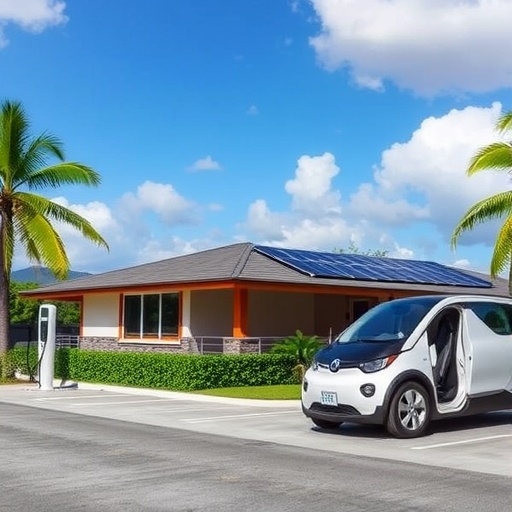
In a groundbreaking study published in Nature Communications, researchers have unveiled a novel approach to integrate extensive photovoltaic (PV) systems in tropical cities by leveraging decentralized electric vehicle (EV) charging. This innovative strategy promises to overcome significant challenges related to energy management and grid stability, paving the way for a green energy revolution in urban environments where solar energy potential is abundant yet underutilized due to infrastructural and grid constraints.
Tropical cities are uniquely positioned to harness solar energy thanks to their abundant sunshine throughout the year. However, integrating large-scale photovoltaic arrays into the existing power infrastructure has proven problematic. Conventional grid designs struggle with the intermittent nature of solar generation and peak load demands, often leading to inefficiencies or the curtailment of valuable renewable energy. The research team, led by Zhou et al., explores how the rapid expansion of electric vehicle adoption can be modeled as an asset to this puzzle rather than a complicating factor.
At its core, the study revolves around decentralized EV charging systems that are intelligently coordinated to match PV generation profiles. Unlike centralized charging strategies, where EVs draw power at fixed stations often leading to peak load stresses, the decentralized framework allows vehicle charging patterns to adapt dynamically to local PV output. This method transforms EVs into flexible, distributed loads capable of absorbing excess solar power during peak generation and easing grid burdens when renewable supply dips.
The research utilizes extensive data simulations based on actual tropical urban settings, incorporating real-world variables such as solar irradiance fluctuations, traffic patterns influencing EV availability, and the built environment’s electrical characteristics. The results substantiate that decentralized charging can significantly increase the utilization of generated photovoltaic electricity, reducing reliance on fossil-fuel backup generators and minimizing grid congestion risks inherent to renewable integration.
One of the study’s pivotal findings is the temporal synergy between daytime solar production and urban EV usage patterns. Most EVs remain parked during daylight hours, particularly in city environments, providing a substantial aggregated capacity for energy storage and demand flexibility. By scheduling charging sessions in alignment with PV generation peaks, the system capitalizes on clean energy and simultaneously alleviates stress on urban electrical networks.
Moreover, the decentralized approach enhances grid resilience by distributing demand rather than concentrating it, thereby reducing transmission losses and enhancing voltage stability. This is particularly important in tropical cities where grid infrastructures are often older and less robust, challenging the scalability of renewable integration. The model proposed demonstrates how smart control algorithms embedded within local EV charging units can autonomously optimize their load profiles, requiring minimal centralized oversight.
The integration framework also considers the socioeconomic implications of widespread EV use combined with PV systems. The researchers highlight that incentivizing decentralized, adaptive charging methods can accelerate the adoption of sustainable technologies while maintaining affordability and accessibility. By facilitating the efficient use of existing resources, urban energy equity can be improved, ensuring solar benefits reach a broad spectrum of the population.
Critically, the study addresses concerns related to the environmental footprint of expanding EV infrastructures in tropical urban areas. The intelligent coordination of vehicle charging not only maximizes renewable energy use but also reduces the need for costly and environmentally disruptive grid upgrades. This approach promises a sustainable path forward, aligned with global decarbonization goals and urban livability enhancements.
The implications extend beyond the immediate benefits of energy efficiency and decarbonization. The system’s inherent flexibility introduces new possibilities for demand response markets and ancillary services, potentially creating economic incentives for EV owners and utility operators alike. The decentralized model lays the groundwork for a smarter, more adaptable urban energy ecosystem where consumers and producers interact seamlessly within a clean energy framework.
In terms of technological realization, the authors discuss the deployment of communication protocols enabling vehicle-to-grid (V2G) capabilities and real-time data exchange. These advancements are crucial for maintaining system reliability, ensuring cybersecurity, and fostering user trust. The scalability of such infrastructures is carefully analyzed, emphasizing modular and interoperable designs suitable for integration with emerging smart city platforms.
As the number of electric vehicles surges worldwide, especially in developing tropical metropolises, leveraging their widespread presence as mobile energy buffers can redefine urban power management. This study represents a milestone by quantitatively demonstrating how decentralized controls can harmonize the intermittent nature of solar resources with the dynamic urban demand landscape.
Zhou et al.’s research is timely and impactful, offering actionable insights for policymakers, city planners, and energy stakeholders tasked with orchestrating the transition to sustainable urban energy systems. By embracing decentralized EV charging strategies, tropical cities can unlock the full potential of their abundant photovoltaic resources while strengthening the resilience and sustainability of their electrical grids.
Ultimately, this work underscores the importance of cross-sectoral innovation, intertwining transportation electrification with renewable energy proliferation. It offers a persuasive blueprint for urban centers worldwide seeking to navigate the complexities of clean energy integration without compromising system stability or economic viability.
This pioneering research opens exciting avenues for future investigations, including the exploration of real-life pilot projects, the refinement of predictive algorithms for EV availability, and the development of market mechanisms to incentivize decentralized charging behaviors. As cities continue to grow and climate urgency escalates, such integrative approaches will be indispensable in shaping sustainable urban futures.
In conclusion, decentralized electric vehicle charging presents a transformative opportunity to accelerate the deployment of photovoltaic energy in tropical urban settings. The study’s comprehensive simulations, innovative control schemes, and holistic consideration of technological and social factors position it at the forefront of smart energy integration research. It sets a new standard for how complex, interdependent urban systems can collaboratively fuel a cleaner, greener tomorrow.
Cite Scienmag News
Faith Mcneil. (April 7, 2026). Decentralized EV Charging Boosts Tropical Solar Integration. Scienmag. https://scienmag.com/decentralized-ev-charging-boosts-tropical-solar-integration/
Faith Mcneil. "Decentralized EV Charging Boosts Tropical Solar Integration." Scienmag, 7 April 2026, https://scienmag.com/decentralized-ev-charging-boosts-tropical-solar-integration/. Accessed 3 September 2026.
Faith Mcneil. "Decentralized EV Charging Boosts Tropical Solar Integration." Scienmag. April 7, 2026. https://scienmag.com/decentralized-ev-charging-boosts-tropical-solar-integration/


