


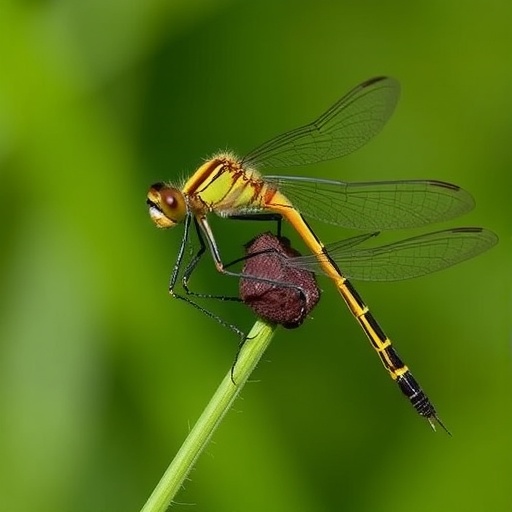
In the intricate tapestry of speciation, reinforcement acts as a pivotal force, fine-tuning reproductive barriers to prevent costly hybridization. While this phenomenon has been extensively studied in species with uniform reproductive traits, its role within polymorphic species—where distinct morphs coexist with varying behaviors and reproductive strategies—remains shrouded in complexity. A recent groundbreaking study delves into this uncertainty by investigating two closely related damselfly species, Ischnura elegans and Ischnura graellsii, each boasting female polymorphisms that significantly influence reproductive dynamics. This research illuminates how alternative reproductive strategies among morphs modulate the process of reinforcement, revealing a nuanced, asymmetric landscape of reproductive isolation.
The study focuses on polymorphic female morphs in these damselfly species, which are known for their striking color variations tied to different reproductive tactics. These morphs, broadly categorized into androchromes resembling males and gynochromes displaying distinct female phenotypes, exhibit profoundly contrasting behaviors that influence mating interactions and hybridization risk. By examining two independent hybrid zones where these species interact, the researchers harnessed a unique natural setup to dissect how reinforcement operates variably across morphs, affecting the strength and direction of reproductive barriers.
At the core of the findings lies a striking asymmetry: gynochrome females from both species demonstrated pronounced reinforcement of mechanical isolation, the physical barriers preventing successful mating between species. This contrasts starkly with androchrome females, which failed to exhibit comparable reinforcement. Such patterns are consistent with the divergent reproductive strategies associated with these morphs—gynochromes, often subject to higher heterospecific mating risk, face stronger selection pressures to evolve pre-mating barriers against hybridization. Conversely, androchromes, whose resemblance to males may afford them certain behavioral advantages or different mating risks, exhibit weaker reinforcement, highlighting morph-specific evolutionary trajectories.
Moreover, analysis extended beyond pre-mating mechanics to post-mating reproductive barriers, uncovering asymmetric gametic isolation between the species. In I. elegans, fertility isolation—where hybrids suffer reduced fecundity or viability—was intensified through reinforcement, effectively reducing gene flow from hybrid individuals. Conversely, I. graellsii showed a relaxation of certain reproductive barriers, specifically oviposition and fertility isolation, a phenomenon mirrored symmetrically across their female morphs. This dichotomy suggests complex interspecies dynamics that balance selection pressures with gene flow and genetic purging of incompatibilities.
Importantly, the observed asymmetric reinforcement highlights the interplay between pre-existing morph-level differences and the selective landscape shaping reproductive isolation. Gynochrome morphs, by virtue of their mating behaviors and susceptibility to heterospecific encounters, are more likely to experience heightened selection against hybridization, thus accelerating reinforcement. This dynamic underscores the notion that within-species polymorphisms can profoundly influence macroevolutionary patterns of speciation, challenging the assumption that reinforcement acts uniformly across populations.
The research also underscores the ecological and evolutionary significance of hybrid zones as natural laboratories for the study of speciation processes. In these zones of interspecies contact, the strength and nature of reproductive barriers are subjected to direct selection, permitting real-time observation of reinforcement dynamics. By contrasting two independent hybrid zones involving the same species pairs, the study robustly demonstrates the reproducibility and context-dependence of these asymmetric reinforcement patterns, reinforcing the complexity of speciation in polymorphic organisms.
From a methodological vantage, the researchers implemented a comprehensive suite of quantitative assessments to parse the multifaceted reproductive barriers. This included detailed morphological analyses of mating-related structures, behavioral observations in controlled and natural settings, and fertility assays that collectively provided a holistic portrait of reproductive isolation. Such integrative approaches are crucial for unravelling how morphological and behavioral traits co-evolve under reinforcement, especially in the context of intraspecific polymorphisms.
These insights carry profound implications for understanding the diversification mechanisms in polymorphic species, particularly those exhibiting alternative reproductive strategies. The asymmetric nature of reinforcement revealed here suggests that selective pressures do not uniformly shape all morphs within a species, potentially driving morph-level divergence and, over evolutionary timescales, contributing to the emergence of novel reproductive isolating mechanisms. Such processes could serve as catalysts for fine-scale speciation events even within ostensibly cohesive species complexes.
Looking forward, the study advocates for expanded research addressing cascading evolutionary effects of asymmetric reinforcement within species. Does the differential evolution of reproductive isolation among morphs influence overall genetic architecture or ecological interactions? Could such morph-specific dynamics foster incipient speciation or promote adaptive radiation? These tantalizing questions invite further scrutiny into the mechanisms by which polymorphism modulates the evolutionary trajectory of reproductive barriers.
Additionally, the differential responses of I. elegans and I. graellsii contribute valuable perspectives on how gene flow, hybrid fitness, and environmental contexts converge to shape reinforcement outcomes. The relaxation of reproductive barriers in one species juxtaposed with their intensification in the other may reflect asymmetries in demographic parameters or historical gene exchange, emphasizing the multifactorial nature of speciation.
This nuanced understanding of reinforcement and polymorphism could also inform broader ecological and evolutionary frameworks, from conservation biology to evolutionary developmental genetics. For instance, identifying morph-specific vulnerabilities or adaptive strengths in hybrid zones may guide strategies to preserve genetic diversity or predict species responses to environmental change. Moreover, elucidating the genetic underpinnings of alternative reproductive strategies may shed light on the origin and maintenance of polymorphisms across taxa.
In essence, this work spearheaded by Ordaz-Morales et al. marks a significant advance in evolutionary biology by pinpointing how alternative reproductive strategies translate into asymmetric reproductive isolation through reinforcement. It bridges the gap between microevolutionary behavior of polymorphic individuals and macroevolutionary patterns of species divergence, paving the way for a more integrated understanding of speciation.
As the field embraces these findings, researchers are encouraged to deploy similar multi-barrier frameworks across diverse polymorphic taxa, exploring whether analogous reinforcement asymmetries exist elsewhere in nature. Such comparative studies could unravel fundamental principles governing the balance between polymorphism, reproductive isolation, and diversification.
Ultimately, the intricate dance of sex, color, and species boundaries in these damselflies reveals the depth to which evolutionary processes can sculpt biological diversity. The asymmetric reinforcement molded by female morphs’ reproductive strategies challenges classical speciation models, foregrounding the role of intraspecific diversity in shaping the tree of life. Science stands at the cusp of deciphering these complexities, with this study heralding a new chapter in evolutionary inquiry.
Cite Scienmag News
Drew Townsend. (April 4, 2026). Damselfly Mating Strategies Shed Light on Reproductive Barriers. Scienmag. https://scienmag.com/damselfly-mating-strategies-shed-light-on-reproductive-barriers/
Drew Townsend. "Damselfly Mating Strategies Shed Light on Reproductive Barriers." Scienmag, 4 April 2026, https://scienmag.com/damselfly-mating-strategies-shed-light-on-reproductive-barriers/. Accessed 6 September 2026.
Drew Townsend. "Damselfly Mating Strategies Shed Light on Reproductive Barriers." Scienmag. April 4, 2026. https://scienmag.com/damselfly-mating-strategies-shed-light-on-reproductive-barriers/


