


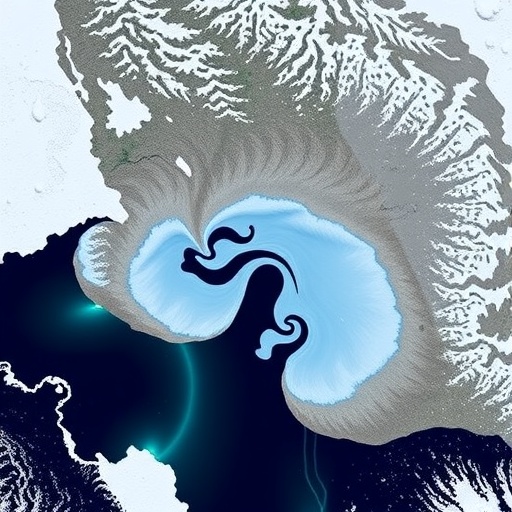
In recent years, the scientific community’s understanding of glacial lake outburst floods (GLOFs) has undergone a significant transformation, propelled by advances in satellite remote sensing and geophysical modeling. A pioneering study by Magnússon, Drouin, Pálsson, and colleagues, published in Nature Communications in 2026, leverages cutting-edge spaceborne observations to unravel the intricate dynamics of subglacial water flow and ice movement during these devastating events. This research not only unveils new mechanisms that govern ice-sheet behavior but also lays the groundwork for improved hazard prediction and climate change impact assessments.
Glacial lake outburst floods occur when a body of water, typically dammed by glacial ice or moraine material, catastrophically releases, unleashing torrents that reshape landscapes downstream. These sudden events carry enormous destructive potential, threatening ecosystems, infrastructure, and human settlements. Understanding what triggers these outbursts and how water flows under glaciers remains a formidable challenge due to the hidden nature of subglacial environments and the transient, sometimes chaotic character of flooding episodes.
The study employs high-resolution satellite radar interferometry and optical imagery to peer beneath the ice surface, accessing a window into the subglacial hydrological system that was previously unreachable at such spatial and temporal detail. By analyzing sequential observations across multiple GLOF events, the team reconstructs the evolution of water pathways beneath glacier ice, quantifying how these flows influence ice-shelf deformation and displacement patterns. This novel approach provides unprecedented insight into the coupling between subglacial hydraulics and ice dynamics.
Central to the findings is the identification of rapid reorganization in subglacial drainage networks in response to fluctuating water pressure during floods. Initial water accumulation beneath the glacier leads to elevated sub-ice water pressure, which decreases basal friction and triggers accelerated ice sliding. As outburst floods progress, the drainage system transitions from distributed sheets of water to more channelized conduits, fundamentally altering basal stress regimes. These transformations exert profound control over ice velocity and deformation, creating feedback loops that affect flood magnitude and duration.
The team’s observations highlight that subglacial water flow is not a passive conduit but an active driver of ice-sheet motion. Increases in basal water pressure reduce the effective normal stress, which weakens the ice-bed interface and fosters rapid ice displacement. This phenomenon has implications for ice-sheet stability models, suggesting that previously unaccounted for hydrological dynamics could accelerate glacier retreat under warming climates, ultimately impacting global sea level projections.
Moreover, the research reveals that the timing and intensity of outburst floods are heavily influenced by the architecture of the subglacial drainage system. Complex networks of channels dynamically evolve, responding to changes in water input, pressure gradients, and meltwater supply from the surface. The team’s data show that flood initiation often follows a threshold exceeding subglacial water pressure, triggering sudden opening of new channels and catastrophic water release. This insight refines predictive models of hazard emergence by identifying critical parameters governing system criticality.
Applying spaceborne observational tools to these traditionally inaccessible environments also underscores the value of multi-disciplinary techniques in glaciology. The integration of interferometric synthetic aperture radar (InSAR) with optical satellite data allows for detailed quantification of ice displacement alongside direct visualization of surface water bodies. These complementary datasets enable cross-validation and enhance confidence in interpretations, providing robust means to capture transient events such as GLOFs.
The authors caution that despite these advances, challenges remain in fully characterizing subglacial hydrology due to complex bed topography, variability in glacier basal conditions, and temporal sparseness in satellite revisit schedules. However, ongoing improvements in satellite missions—offering higher temporal resolution, enhanced radar penetration, and multi-spectral imaging—promise to fill these gaps, unlocking deeper understanding of ice-water interactions at the glacier bed.
Importantly, the research carries significant ramifications for risk management in mountainous and polar regions prone to GLOFs. By elucidating the mechanisms of subglacial water flow and ice dynamics during outburst floods, stakeholders can deploy more effective early warning systems. This proactive approach could mitigate loss of life and infrastructure damage by providing real-time monitoring capacity and evolution forecasts of hazardous glacial lakes.
From a broader scientific perspective, the study represents a step-change in the ability to observe and interpret the hidden processes beneath glaciers. It challenges existing paradigms by positioning subglacial water not merely as a passive agent but as a dynamic player in ice motion and stability. This paradigm shift is crucial in refining projections of ice-sheet response to climatic warming, in which increased surface meltwater production will likely intensify underground hydrological activity.
The implications extend to global sea-level rise predictions, as the dynamic interactions between water and ice at glacier beds modulate ice discharge into the oceans. Understanding these near-real-time processes allows climate scientists to incorporate more realistic subglacial physics into ice-sheet models, thereby reducing uncertainties in long-term forecasts.
Furthermore, the integration of spaceborne geodesy with glaciological theory exemplifies the transformative potential of remote sensing technologies in Earth system science. The ability to monitor inaccessible environments continuously from orbit revolutionizes data collection paradigms, enabling international collaboration and large-scale environmental monitoring critical to addressing global change.
In conclusion, the study by Magnússon et al. marks a milestone in glaciology by leveraging space-based observations to decode the complex interplay between subglacial water flow and ice dynamics during glacial lake outburst floods. Their insights deepen understanding of ice-sheet behavior under hydrological forcing and lay the foundation for improved predictive frameworks essential for climate resilience and hazard mitigation in a rapidly changing cryosphere.
Cite Scienmag News
Violet Maxwell. (April 3, 2026). Satellite Reveals Subglacial Water Flow During Ice Floods. Scienmag. https://scienmag.com/satellite-reveals-subglacial-water-flow-during-ice-floods/
Violet Maxwell. "Satellite Reveals Subglacial Water Flow During Ice Floods." Scienmag, 3 April 2026, https://scienmag.com/satellite-reveals-subglacial-water-flow-during-ice-floods/. Accessed 3 September 2026.
Violet Maxwell. "Satellite Reveals Subglacial Water Flow During Ice Floods." Scienmag. April 3, 2026. https://scienmag.com/satellite-reveals-subglacial-water-flow-during-ice-floods/


