


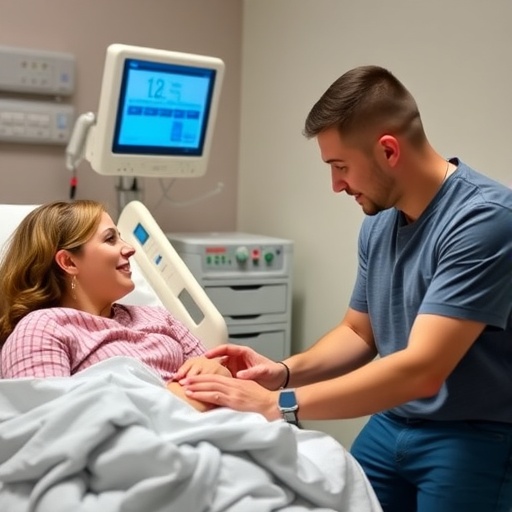
In a groundbreaking advancement at the intersection of neonatology and digital health communication, a recent study published in the Journal of Perinatology delves into the profound impact of automated patient engagement solutions on parental communication during neonatal discharge processes. This research uncovers how leveraging an Automated Patient Engagement Solution (APES) can fundamentally transform the way healthcare providers interact with families at a critical juncture: the time of discharge in neonatal care units. By employing sophisticated technology to deliver structured, timely, and clear communication, the study demonstrates meaningful improvements in the overall discharge experience and hospital length of stay.
The postnatal hospitalization phase, particularly for neonates requiring specialized care, is notoriously fraught with anxiety and information overload for parents. The transition from hospital to home is a vulnerable period where miscommunication, unclear expectations, and fragmented information can amplify parental stress and potentially impact neonatal outcomes. Traditional discharge communication typically relies on ad hoc conversations, handwritten notes, or verbal instructions, which can be inconsistent and subject to recall errors. This study introduces a vital digital interface, APES, designed to streamline and personalize patient-provider communication gravitating around discharge milestones.
At its core, APES is an automated platform that engages parents with stepwise updates, reminders, and educational content finely tuned to the neonate’s clinical trajectory. The system’s algorithm schedules interactions based on individualized care parameters, providing parents with sequential, digestible information packets that map out every key step leading to discharge. By automating the workflow, healthcare teams can ensure standardized delivery of critical information without the limitations of human timing or availability, addressing a long-standing gap in neonatal care continuity.
Technically, the APES platform integrates with electronic health records (EHRs), extracting real-time clinical data to dynamically generate and update communication content. This synchronization is crucial for maintaining accuracy and relevance as the neonate’s condition evolves. The study highlights how this integration facilitates a seamless feedback loop where clinical changes trigger adaptive messaging, enhancing parental preparedness and engagement. Furthermore, the system employs multi-modal communication strategies, including SMS, email, and app notifications, accommodating varying parental preferences and technological aptitudes.
The research methodology involved a comparative cohort design, enrolling neonates and their parents from multiple tertiary care centers. One cohort received conventional discharge communication, while the intervention group was supported by the APES tool. Metrics such as length of hospital stay (LOS), parental anxiety scores, comprehension assessments, and satisfaction ratings were meticulously collected and analyzed. The statistically significant findings revealed that families using APES experienced shorter LOS without compromising clinical safety, coupled with markedly improved confidence and clarity about discharge instructions.
Delving deeper into the mechanistic implications, the study posits that APES’s structured, consistent engagement contributes to cognitive offloading for parents, reducing the burden of assimilating complex medical information in fragmented bursts. This continuous, just-in-time knowledge delivery fosters a more proactive role for parents, enabling them to anticipate next steps, ask informed questions, and adhere more rigorously to discharge protocols. Health professionals, in turn, benefit from decreased redundancy in explanations and potential reduction in readmission rates attributed to misunderstandings.
Critically, the technological architecture of APES features adaptive learning components that personalize the timing and complexity of messages based on parental responsiveness and feedback. The system incorporates machine learning models that detect engagement patterns, thereby refining communication pacing to optimize user experience. This intelligent tailoring ensures that no parent is overwhelmed or left in the dark, representing a sophisticated marriage between artificial intelligence and patient-centered care.
From an operational perspective, integrating APES into existing neonatal unit workflows required cross-disciplinary collaboration among clinicians, IT specialists, and hospital administrators. The study documents challenges such as data privacy compliance, clinician training, and system interoperability, but underscores the value proposition in workflow efficiency and enhanced patient satisfaction. These findings suggest that adoption of APES-like solutions may herald a paradigm shift in discharge planning not only for neonatology but potentially other inpatient specialties where transitional care is complex.
The implications extend to healthcare economics as well. Shortening neonatal stay while improving discharge communication can generate substantial cost savings, which is crucial in resource-constrained environments. By preventing premature discharges due to miscommunication or unnecessary prolonged hospitalization from procedural delays, APES contributes to optimized bed utilization and reduced strain on hospital resources. The study anticipates that scalability of such digital platforms could democratize access to high-quality discharge education universally.
Moreover, the psychological ripple effects on parents are profound. The study quantitatively measured decreased anxiety and improved satisfaction scores, highlighting how technology-human interfacing can support emotional resilience in families during stressful neonatal care episodes. Parental confidence in home care routines, immunization schedules, and follow-up appointments was enhanced, arguably improving long-term infant health trajectories.
This pioneering investigation also opens new avenues for future research. Expanding the technological scope of APES to include real-time video consultations, biometric data integration, and multilingual support could further revolutionize parental engagement. The scalability to other patient populations with chronic conditions or postoperative care pathways appears promising. Additionally, longitudinal studies assessing developmental outcomes linked to improved discharge communication represent an exciting frontier informed by this foundational work.
In conclusion, the integration of an Automated Patient Engagement Solution within neonatal discharge workflows embodies the cutting edge of healthcare innovation. By harnessing automation and AI-driven personalization, the approach not only improves measurable clinical metrics such as length of stay but also enhances the qualitative experience of parents navigating the complexities of neonatal care transitions. This research marks a critical step toward embedding technology as a compassionate ally in patient and family-centered care—not simply as an administrative tool but as a transformative agent enhancing human connection and understanding in healthcare.
As hospitals worldwide seek scalable strategies to elevate care quality while managing increasing patient volumes, solutions like APES demonstrate that technology, thoughtfully designed and implemented, can deliver tangible benefits beyond efficiency. They can restore the centrality of clear communication and emotional support that underpin successful healthcare outcomes. The era of automated, intelligent patient engagement has dawned, promising a future where critical moments like neonatal discharge are navigated with clarity, confidence, and care.
Cite Scienmag News
Harold Sullivan. (March 30, 2026). Automated Engagement Enhances Parental Communication, Discharge Timing. Scienmag. https://scienmag.com/automated-engagement-enhances-parental-communication-discharge-timing/
Harold Sullivan. "Automated Engagement Enhances Parental Communication, Discharge Timing." Scienmag, 30 March 2026, https://scienmag.com/automated-engagement-enhances-parental-communication-discharge-timing/. Accessed 4 September 2026.
Harold Sullivan. "Automated Engagement Enhances Parental Communication, Discharge Timing." Scienmag. March 30, 2026. https://scienmag.com/automated-engagement-enhances-parental-communication-discharge-timing/


