


In recent years, groundwater management has emerged as a critical component in addressing the escalating global water crisis. With surface water sources increasingly strained by climatic variability and human consumption, managed aquifer recharge (MAR) systems have gained prominence as a sustainable solution to enhance groundwater supplies. A pivotal study published in Nature Water sheds light on revolutionary methods to trace and quantify groundwater dynamics using innovative isotopic techniques, offering unprecedented insight into the fate and movement of recharge waters within alluvial aquifers. This breakthrough holds immense promise for improving water security in heavily stressed river basins worldwide.
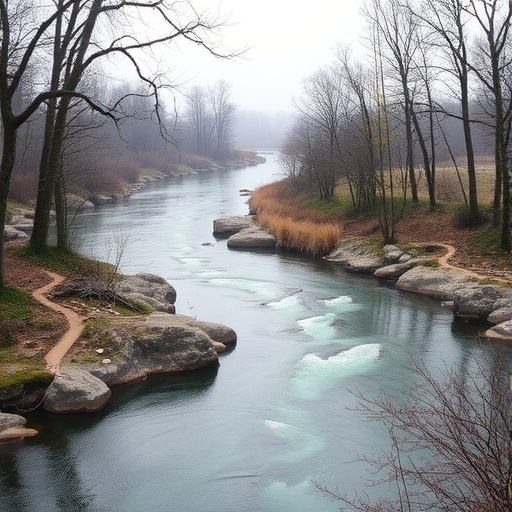
The study, led by van Rooyen, Vennemann, Purtschert, and colleagues, focuses on the Rhine River in Switzerland, a region characterized by complex anthropogenic influence and natural hydrological processes. Utilizing a combination of stable isotopes (δ^18O and δ^2H) alongside tritium (^3H)—a radioactive isotope of hydrogen—the researchers have devised a robust framework for tracking the movement of infiltrated river water through extensive alluvial MAR systems. This is particularly significant because tritium, influenced by nuclear power plant effluents bordering the river, acts as a quasi-conservative tracer, allowing for high-fidelity tracking of water flow over extended periods and distances.
At the heart of the methodology is high-frequency sampling. Researchers collected isotope data at daily and weekly intervals, achieving a level of temporal resolution that captures subtle changes in isotopic signatures and flow regimes within the aquifer. This sampling precision is crucial because it reveals dynamic processes that conventional, lower-resolution approaches tend to obscure, such as rapid transit events or seasonal shifts in water sources. By combining isotope data with advanced time-series deconvolution analysis, the team successfully isolated the travel time distribution of infiltrated water as it journeys through the subsurface aquifer network.
Time-series deconvolution, a sophisticated mathematical technique more commonly associated with signal processing, proved instrumental in this study. It enabled the researchers to disentangle overlapping isotopic signals within groundwater samples, thus deriving detailed travel time distributions and improving predictions of flow paths throughout the managed aquifer recharge scheme. This approach moves beyond traditional lumped parameter models, providing greater spatial and temporal granularity that can inform more refined groundwater management decisions.
One of the standout findings is the exceptional utility of tritium as a tracer under these conditions. In many natural environments, tritium levels have declined sharply since the cessation of atmospheric nuclear testing, limiting its effectiveness as a water age tracer. However, the Rhine’s proximity to nuclear power plants introduces a continuous anthropogenic tritium signal, essentially “tagging” the river water and providing a near-real-time indicator of recharge and transit through the alluvial aquifer. This phenomenon is not isolated to Switzerland but is increasingly common along major river basins worldwide, making the findings broadly applicable.
Complementing tritium analyses, the study also leveraged deuterium excess (d-excess) measurements. Deuterium excess is a sensitive indicator of climatic and hydrological conditions at the source of precipitation and runoff, reflecting processes such as evaporation and snowmelt. Intriguingly, the researchers discovered that deuterium excess served as an effective bulk tracer for travel time in the entire MAR system. The isotope’s seasonal variability, driven by European meltwater inputs, provided a natural temporal fingerprint that, when integrated with tritium data, enriched the understanding of groundwater recharge dynamics on both seasonal and annual scales.
Together, tritium and stable isotope data illuminated the multifaceted nature of recharge and transit within the MAR sites, quantifying recovery rates and delineating wellhead protection zones with unprecedented precision. Recovery rates are vital metrics for water resource managers, representing the proportion of infiltrated water that can be sustainably extracted without compromising aquifer health. By accurately defining these rates, the study enables better balance between recharge and withdrawal, safeguarding long-term groundwater viability.
Furthermore, delineation of wellhead protection zones—the areas surrounding groundwater withdrawal points where contaminants may be introduced—gains newfound reliability based on these tracer techniques. Traditional delineation methods often rely on hydrogeological modeling, which can be limited by assumptions and data scarcity. The isotope-based approach offered real-world, tracer-derived evidences specifying the movement and age of groundwater supplies, thereby enhancing the safety and security of drinking water extraction points.
The implications of this study extend beyond purely scientific advances. Managed aquifer recharge is increasingly positioned as a frontline defense against global water stress, particularly in regions where climate change intensifies drought frequency, interferes with surface water reliability, and exacerbates pollution. By supplying a rigorous toolset for quantifying recharge performance and aquifer health, the work by van Rooyen and team equips policymakers and engineers with evidence-based guidelines for designing and operating MAR systems optimally.
Moreover, the identification of anthropogenic tritium as a continent-scale tracer offers a transformative view towards continental groundwater management initiatives. Many large river basins, such as the Mississippi, the Danube, and the Yangtze, possess nuclear facilities or other sources of anthropogenic tritium discharges, opening the door to replicate and scale this isotope tracking methodology globally. This could foster international collaboration for transboundary aquifer management and promote harmonized monitoring standards.
The integration of natural isotopic signals with anthropogenic markers showcases a powerful synergy, tapping into the unique fingerprint of human influence on hydrological cycles. This paradigm shifts away from perceiving nuclear effluents solely as contaminants toward recognizing their ancillary scientific utility in water cycle tracing. It thus frames a new perspective on how human activities might paradoxically aid in resolving pressing environmental challenges.
Importantly, the study also highlights advances in analytical techniques and data processing, such as isotope ratio mass spectrometry and deconvolution algorithms essential for capturing precise flow dynamics. These technical innovations not only enhance sensitivity but also enable cost-effective sampling strategies designable for diverse geographies and hydrogeologies. This versatility could pave the way for widespread adoption, especially in developing countries struggling with groundwater scarcity.
The findings have direct applications in water resource institutions tasked with balancing extraction demands, maintaining ecosystem integrity, and preparing for climate-induced hydrological shifts. By tracking the origins and paths of recharge waters more accurately, these entities can craft adaptive management plans resilient to uncertainties posed by global change. This represents a critical advantage in an era when groundwater overstress threatens agricultural productivity, urban water supply, and biodiversity.
Future research building on this foundation may explore integrating additional isotopic and geochemical tracers, expanding temporal scales, and investigating MAR systems under varied climatic regimes worldwide. Further probing the interactions between surface water, engineered recharge efforts, and aquifer stratification could yield deeper mechanistic understanding, facilitating even more precise groundwater sustainability metrics. The intersection of isotope hydrology, data science, and environmental engineering invites a new generation of integrated water security approaches.
In summary, this landmark study fundamentally transforms how groundwater recharge processes are characterized, introducing anthropogenic tritium as a continent-wide tracer and pairing it with natural isotopic markers for robust travel time assessments. Its combination of innovative sampling, analytical technology, and computational methods offers not only a breakthrough in MAR system evaluation but also a scalable model applicable across diverse global river basins. As water scarcity intensifies, such scientific insights are invaluable cornerstones for securing freshwater resources and advancing sustainable hydrological stewardship.
Cite Scienmag News
Violet Maxwell. (March 25, 2026). Tracing River Recharge Using Anthropogenic Tritium Globally. Scienmag. https://scienmag.com/tracing-river-recharge-using-anthropogenic-tritium-globally/
Violet Maxwell. "Tracing River Recharge Using Anthropogenic Tritium Globally." Scienmag, 25 March 2026, https://scienmag.com/tracing-river-recharge-using-anthropogenic-tritium-globally/. Accessed 3 September 2026.
Violet Maxwell. "Tracing River Recharge Using Anthropogenic Tritium Globally." Scienmag. March 25, 2026. https://scienmag.com/tracing-river-recharge-using-anthropogenic-tritium-globally/


