


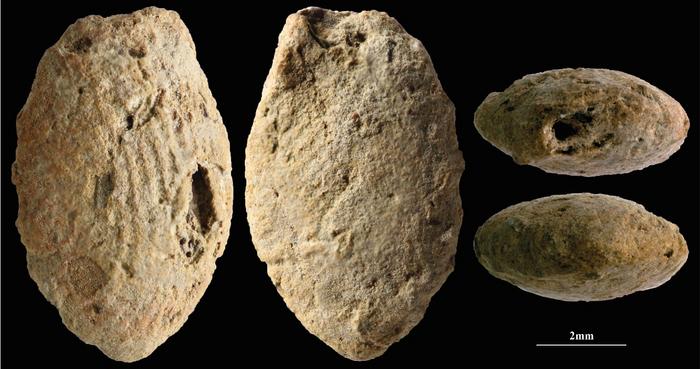
Long before humanity mastered pottery or cultivated the first crops, ancient communities in the Levant were already shaping clay with intention and care. These earliest artisans, who lived approximately 15,000 years ago during the Epipaleolithic period, were not only adults, but also children whose fingerprints remain preserved on the clay artifacts they created. This remarkable discovery reveals a hitherto unrecognized chapter in human prehistory, highlighting how symbolic expression through material culture was already flourishing among hunter-gatherers well before the dawn of agriculture and the Neolithic revolution.
An international research team led by Dr. Laurent Davin, a postdoctoral fellow at the Institute of Archaeology at the Hebrew University of Jerusalem under the mentorship of Professor Leore Grosman, has unearthed the earliest known collection of clay personal ornaments in Southwest Asia. These findings, recently published in the prestigious journal Science Advances, push back the timeline of symbolic use of clay in the region by several thousand years. Their work fundamentally redefines our understanding of the cultural and cognitive evolution of early sedentary communities.
The team analyzed a cache of 142 beads and pendants recovered from four Natufian archaeological sites—el-Wad, Nahal Oren, Hayonim, and Eynan-Mallaha—located within modern-day Israel. The Natufians are a pivotal culture credited with pioneering permanent settlement during the Late Epipaleolithic, predating the systemic advent of farming. Prior to this study, knowledge of clay’s ornamental use during this time was minimal, with global records listing only five such beads from this era. This new assemblage is therefore transformative, shining light on a significantly more complex and sustained tradition of clay decoration.
Technological analyses reveal that the beads were meticulously handcrafted from unbaked clay into various shapes, including cylinders, discs, and elliptical forms. Many of these objects were coated with a thin layer of red ochre clay slip, known as engobe. This early evidence of pigment use is the oldest recorded instance of such a technique, underscoring a sophisticated understanding of material manipulation for aesthetic and symbolic purposes. The presence of engobe suggests that these communities developed specialized methods for enhancing the visual impact of their ornaments, pointing to an established cultural practice rather than isolated experimentation.
A closer examination of the beads’ morphologies unveiled nineteen distinct types, several of which mimic the forms of plants integral to Natufian subsistence and symbolic life. These shapes draw inspiration from wild barley, einkorn wheat, lentils, and peas—species that not only served as staple food sources but also carried cultural and possibly spiritual significance. Traces of plant fibers found adhering to some beads indicate they were strung together, providing rare data on the use of organic materials that typically decay over millennia. Such findings speak to the complex interaction between natural resources and symbolic behaviors in these early communities.
Perhaps the most groundbreaking insight came from the unprecedented preservation of fifty fingerprints impressed on the clay artifacts. Through forensic-style analyses, researchers identified makers ranging in age from children as young as ten years old to adults. This landmark revelation offers a direct window into the demographic breadth of artifact production, highlighting ornament-making as an intergenerational social practice. Some clay pieces, including a miniature ring barely one centimeter across, seem tailored specifically for youthful users, suggesting that the creation and use of personal adornments played a critical role in social learning and identity formation.
This evidence radically challenges long-held assumptions that symbolic uses of clay emerged only with the Neolithic transition and the rise of farming. Instead, these ornate objects illustrate that symbolic and cognitive innovations were well underway during the earlier stages of sedentarization. The Natufian beads embody a “symbolic revolution,” whereby settled lifestyles encouraged new forms of visual communication that expressed identity, affiliation, and community bonds in public contexts. Such developments set the stage for the complex social structures characteristic of later agricultural societies.
Professor Leore Grosman emphasizes that these discoveries indicate profound, foundational changes in cognition and social organization already occurring in the Late Epipaleolithic. The results reframe the Natufians not solely as precursors to farming but as cultural innovators who harnessed clay as a medium to convey meaning and forge group identities. By documenting one of the world’s oldest traditions of clay personal ornamentation, this research broadens our perspective on the symbolic capacities of early humans and the roots of sociocultural complexity.
In addition to its archaeological implications, this study has methodological significance. The researchers employed cutting-edge analytical technologies, including microscopic imaging and residue analyses, to decode both the beads’ materiality and the human interactions documented on their surfaces. Fingerprint patterning, technological traces, and pigment compositions now contribute a novel suite of proxies in studying prehistoric symbolic behavior, enhancing interpretive frameworks for future studies focused on early human material culture.
Overall, this research enriches our understanding of the dynamics of cultural expression associated with the earliest permanent settlements. It reveals that the crafting and wearing of clay ornaments was not a marginal phenomenon, but an embedded social practice interwoven with ecological knowledge, technological skill, and identity negotiation. These insights compel a reevaluation of the cognitive and social evolution accompanying humanity’s transition from nomadic foragers to sedentary societies, highlighting that intangible symbolism often precedes and facilitates major economic and social transformations.
This compelling narrative opens new avenues for archaeological inquiry, inviting scholars to revisit other late Paleolithic sites with an eye toward identifying overlooked symbolic artifacts. At a time when modern society grapples with questions of identity and belonging, these ephemeral yet enduring tokens from our distant ancestors remind us that the human drive to craft meaning through material culture is both ancient and deeply rooted in our shared history.
News Publication Date: 18-Mar-2026
Web References:
Science Advances Article DOI: 10.1126/sciadv.aea2158
Cite Scienmag News
Courtney Benton. (March 18, 2026). 15,000 Years Ago, Children Molded Clay Long Before Pottery and Farming: New Discovery Unveiled. Scienmag. https://scienmag.com/15000-years-ago-children-molded-clay-long-before-pottery-and-farming-new-discovery-unveiled/
Courtney Benton. "15,000 Years Ago, Children Molded Clay Long Before Pottery and Farming: New Discovery Unveiled." Scienmag, 18 March 2026, https://scienmag.com/15000-years-ago-children-molded-clay-long-before-pottery-and-farming-new-discovery-unveiled/. Accessed 3 September 2026.
Courtney Benton. "15,000 Years Ago, Children Molded Clay Long Before Pottery and Farming: New Discovery Unveiled." Scienmag. March 18, 2026. https://scienmag.com/15000-years-ago-children-molded-clay-long-before-pottery-and-farming-new-discovery-unveiled/


