


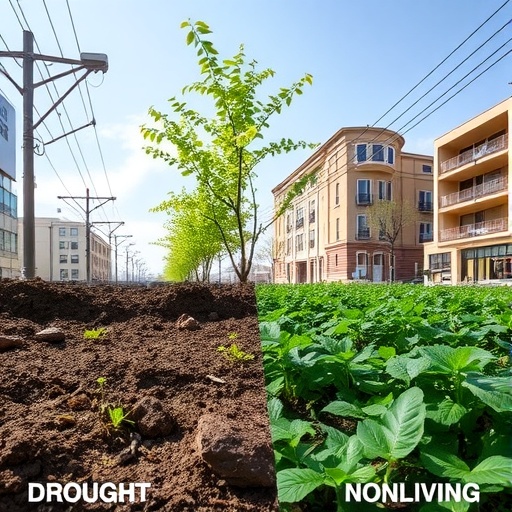
As climate change accelerates, urban ecosystems face increasing vulnerability to extreme weather phenomena, particularly drought. The intensification of drought events poses significant challenges for maintaining the resilience and functionality of green spaces within cities. These urban green spaces are critical for supporting biodiversity, regulating microclimates, and sustaining essential biogeochemical cycles. Yet, the mechanisms through which microbial communities and their multifunctionality respond to drought and subsequent rehydration remain insufficiently understood. New research led by Qin-Lin Chen and colleagues at the Institute of Urban Environment, Chinese Academy of Sciences, Xiamen, sheds light on these complex dynamics by exploring the shifting drivers of microbial multifunctionality under drought stress and recovery within a typical urban turfgrass system.
The study focused on Zoysia japonica, an extensively used turfgrass species in urban landscapes, chosen for its ecological relevance and adaptability. Employing controlled microcosm experiments, the researchers simulated four distinct drought intensities followed by a rehydration phase to mimic real-world drought-precipitation sequences. This experimental design enabled a detailed investigation of microbial structural and functional changes across both the rhizosphere—the soil region influenced by roots—and the phyllosphere, which encompasses the aboveground plant surfaces. Integrating high-throughput omics techniques with soil enzyme stoichiometry, the researchers intricately traced biochemical cycling associated with carbon, nitrogen, phosphorus, and sulfur pathways.
A striking finding from the analysis was the pronounced reorganization of microbial community composition in response to escalating drought stress. Both bacterial and fungal taxa exhibited substantial shifts, indicating a high sensitivity of urban microbiomes to water availability. Contrary to conventional expectations that drought would suppress microbial activity, the study revealed an enhancement in microbial multifunctionality. Specifically, twenty-one microbial functional potentials, including pivotal processes such as carbon fixation and denitrification, showed significant amplification during drought conditions. This suggests an adaptive microbial response aimed at maintaining crucial ecosystem functions amidst environmental stress.
However, the trajectory of multifunctionality was not uniform throughout the drought-rehydration cycle. Upon restoration of water availability, microbial multifunctionality coefficients largely reverted to baseline levels observed in undisturbed controls. Despite this resilience, some legacy effects of extreme drought endured, particularly within specific functionalities like organic nitrogen mineralization in the phyllosphere. This enduring impact underscores the profound and sometimes lasting consequences of acute drought episodes on microbial-mediated nutrient transformations in urban plant ecosystems.
Delving deeper into the regulatory mechanisms underpinning these shifts, the research identified an intrinsic regime transition between drought and recovery phases. During drought, biotic factors assumed a dominant role in steering microbial multifunctionality. Rhizosphere bacterial and fungal communities exerted direct influences on ecosystem functions, likely through active metabolic adaptations and resource allocation strategies. Such biotic-driven regulation highlights the microbial community’s capacity to buffer ecosystem processes against drought-induced perturbations.
Conversely, the recovery phase after rehydration manifested a distinct shift in the drivers of ecosystem function stabilization. The focus moved away from biological control towards abiotic factors, primarily soil physicochemical parameters. Variables such as soil pH and ammonium nitrogen (NH4+-N) concentrations emerged as significant direct determinants of microbial multifunctionality in the post-drought period. This abiotic predominance during recovery arguably reflects the resetting of soil environmental conditions requisite for microbial community reassembly and functional normalization.
The insights from this study elucidate a critical dual regulatory framework governing microbial functionality in urban grass ecosystems faced with drought challenges. Initially, microbial communities actively maintain ecosystem functions via biotic mechanisms during water deficits. Subsequently, the re-establishment of soil physicochemical equilibrium assumes greater importance in the rebound and continuity of ecosystem functions after drought relief. These findings emphasize that successful management of urban green infrastructure under climate stress necessitates a holistic approach incorporating both biotic resilience and abiotic soil quality control.
From an applied perspective, the research advocates for integrated strategies that combine the use of drought-tolerant plant species like Zoysia japonica with proactive soil management interventions aimed at optimizing pH and nutrient availability. Such strategies would not only sustain microbial multifunctionality during adverse conditions but also accelerate ecosystem recovery, thereby enhancing the overall stability and service provisioning of urban green spaces. This approach aligns with broader goals of urban sustainability and climate change adaptation policies seeking to safeguard ecosystem health in metropolitan environments.
Technically, the multi-omics approach employed captures microbial taxonomic shifts alongside functional gene expression dynamics and enzymatic activities, providing a comprehensive picture of ecosystem responses. The coupling of metagenomics with soil enzyme stoichiometry enables precise parsing of nutrient cycling pathways, revealing which elements of microbial metabolism are most sensitive or resilient to hydric stress. These methodologies represent cutting-edge tools in microbial ecology, promising advances in predictive modeling of urban ecosystem responses to climate extremes.
Importantly, the study highlights that the complexity of microbial interactions and feedback with soil chemistry is context-dependent, varying across temporal scales of drought and recovery. Such findings motivate further research into temporal hysteresis effects and the mechanisms by which legacy impacts manifest in urban microbiomes. Understanding these dynamics is fundamental for forecasting ecosystem trajectories under projected climate scenarios and for designing interventions that maximize ecosystem service continuity.
The implied dichotomy between biotic and abiotic drivers transforming during drought and post-drought phases redefines our conceptual framework for urban ecosystem functioning. It underscores the need to monitor and manage microbial communities and soil properties as interdependent components rather than isolated factors. This integrated perspective can lead to more nuanced environmental management approaches that anticipate ecosystem responses holistically rather than reactively.
Overall, Qin-Lin Chen and colleagues provide valuable empirical evidence that microbial multifunctionality in urban green spaces is not merely undermined by drought but can adaptively intensify under stress, with functional regimes shifting from microbial community control to soil physicochemical dominance upon rehydration. These revelations have broad implications for preserving urban biodiversity, optimizing ecosystem services under climate change, and enhancing resilience through targeted biotic and abiotic interventions.
For urban planners and ecologists, these findings offer a compelling case to rethink drought mitigation strategies by embracing the dynamic nature of microbial-soil-plant interactions and the critical roles these play across drought-rehydration cycles. Recognizing microbes as active agents of ecosystem stability rather than passive components can reshape urban ecosystem management paradigms, driving innovations that foster resilient and sustainable cities in an era of increasing climatic uncertainty.
News Publication Date:
Not explicitly stated.
Web References:
http://dx.doi.org/10.1007/s11427-025-3115-7
References:
Not detailed in the source content.
Cite Scienmag News
Morgan Morrow. (March 9, 2026). From Living to Nonliving: How Drought and Rehydration Transform Urban Microbial Functions. Scienmag. https://scienmag.com/from-living-to-nonliving-how-drought-and-rehydration-transform-urban-microbial-functions/
Morgan Morrow. "From Living to Nonliving: How Drought and Rehydration Transform Urban Microbial Functions." Scienmag, 9 March 2026, https://scienmag.com/from-living-to-nonliving-how-drought-and-rehydration-transform-urban-microbial-functions/. Accessed 4 September 2026.
Morgan Morrow. "From Living to Nonliving: How Drought and Rehydration Transform Urban Microbial Functions." Scienmag. March 9, 2026. https://scienmag.com/from-living-to-nonliving-how-drought-and-rehydration-transform-urban-microbial-functions/


