


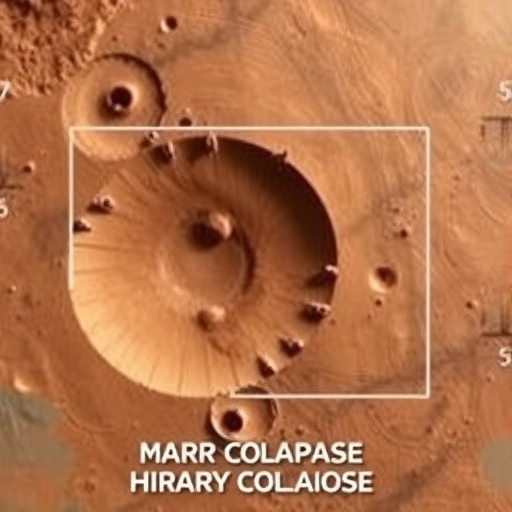
Recent research published in Communications Earth & Environment has spotlighted a remarkable phenomenon occurring on Mars — flood-related surface collapses in the Osuga Valles region. This discovery marks a transformative step in our understanding of Martian geomorphological activity, revealing dynamic processes previously undetected on the Red Planet. The comprehensive study led by Naor et al. deploys advanced remote sensing and modeling techniques to decipher the mechanisms behind these collapses, providing a fresh perspective on Mars’s hydrological past and present.
Osuga Valles, located in the northern hemisphere of Mars, has long intrigued planetary scientists due to its complex valley networks and evidence hinting at ancient water activity. The new findings reveal that these valleys are not merely relics of a bygone era but continue to undergo morphologic changes influenced by episodic flooding events. These floods, possibly triggered by subsurface ice melting or transient atmospheric phenomena, induce sudden collapses on the surface, reshaping the landscape at scales previously underestimated.
The investigation is centered around detailed analysis of high-resolution imagery combined with digital elevation models captured by Mars orbiters. These datasets allowed the researchers to identify distinct collapse features characterized by disrupted terrain, steep scarps, and chaotic blocky deposits. The spatial distribution and morphology indicate that these collapses originated from floodwaters undermining subsurface deposits, triggering a rapid failure of overlying strata.
What makes the Osuga Valles surface collapses particularly compelling is their implication for current Martian hydrology. The collapse events are believed to be linked to relatively recent flood episodes, suggesting the presence of liquid water or brines beneath the Martian surface. This challenges the longstanding notion of Mars as an entirely arid world and paves the way for hypotheses about transient hydrological cycles persisting in specific locales and under certain environmental conditions.
Moreover, the tectonic setting of the Osuga Valles region seems to facilitate these collapses. The valley system’s structural configuration, inclusive of fractures and faults, creates zones of mechanical weakness. When these structural features interface with floodwaters infiltrating subsurface layers, they act as conduits potentiating the collapse process. Thus, the interplay between geology and hydrology emerges as a critical driver of surface dynamics on Mars.
The authors also explore analogs from terrestrial environments—places where flooding induces surface collapse, such as in karst terrains or volcanic regions with subglacial lakes—to better interpret the Martian data. These Earth analogs provide a fertile framework for understanding how subsurface voids or weakened materials collapse under hydraulic pressure, refining our conceptual models applicable to Mars.
Advanced computational fluid dynamics simulations performed in the study reveal that the hydraulic pressures generated by transient floods are sufficient to disrupt sediment cohesion and trigger mass wasting events. The models incorporate variable sediment porosities, ice content, and fracture permeability, emphasizing how subtle changes in subsurface conditions can culminate in massive geomorphic transformations. This underscores the sensitivity of Martian surface processes to inundation events, even if these are limited in time and spatial extent.
In addition, the researchers analyzed mineralogical data from spectrometers aboard orbiters, detecting possible hydrated minerals and salts that corroborate the interaction between water and subsurface sediment. This mineralogical evidence supports the hypothesis of localized aqueous alteration driven by flood events, contributing to ongoing soil and sediment evolution in Osuga Valles.
The implications of these findings extend beyond geology and planetary science to astrobiology. The presence of liquid water, even transiently, opens up potential niches for microbial life or preserves biosignatures in subsurface refuges. Flood-related collapses could expose freshly altered materials, creating accessible targets for future rover missions endeavoring to seek signs of life or past habitability.
Technological advancements in orbital imaging and data analysis have thus unlocked a new era in Martian surface exploration. This study leverages these capabilities, illustrating how multidisciplinary approaches integrating geomorphology, hydrology, geochemistry, and computational modeling can unravel complex planetary phenomena. The Osuga Valles floods and collapses exemplify the dynamic and evolving nature of Mars, still shaped by aqueous forces despite its overall cold and dry climate.
Looking forward, these discoveries necessitate a revision in mission planning and surface hazard assessments. Understanding flood-related collapses aids in predicting surface stability and potential geomorphic hazards affecting landers or rovers. Moreover, unraveling the hydrologic cycles underlying these collapses could inform in situ resource utilization strategies, potentially enabling human exploration by identifying water reservoirs.
Furthermore, this research revitalizes the debate about Mars’s climatic variability and the possibility of episodic warming events facilitating surface liquid water. Such events might arise from volcanic outgassing, orbital shifts, or impact heating, temporarily altering atmospheric and subsurface conditions to create flood-triggering scenarios. Consequently, Osuga Valles may serve as a natural laboratory to study these transient climatic phenomena.
In summary, the study by Naor et al. dramatically expands our understanding of Martian surface processes by revealing active, flood-related collapses in Osuga Valles. By decoding the intricate linkages between subsurface hydrology, geological structure, and surface dynamics, it paints a picture of Mars as a planet where water still plays a crucial role in shaping landscapes. This breakthrough invites a new generation of explorations targeted at unraveling the mysteries of Mars’s watery past and its intermittent present.
The knowledge gained from these investigations not only transforms planetary science but also enriches comparative planetology, emphasizing how terrestrial analogs can illuminate extraterrestrial environments. As we decode Mars’s dynamic surface, the paradigm shifts from a static, desiccated world to one punctuated by active, fluid-driven geomorphology. The dynamic interplay between floods and collapses in Osuga Valles is a testament to this evolving narrative—a promise for thrilling discoveries yet to come.
Cite Scienmag News
Violet Maxwell. (June 20, 2026). Surface Collapse Reveals Mars Flood History at Osuga Valles. Scienmag. https://scienmag.com/surface-collapse-reveals-mars-flood-history-at-osuga-valles/
Violet Maxwell. "Surface Collapse Reveals Mars Flood History at Osuga Valles." Scienmag, 20 June 2026, https://scienmag.com/surface-collapse-reveals-mars-flood-history-at-osuga-valles/. Accessed 4 September 2026.
Violet Maxwell. "Surface Collapse Reveals Mars Flood History at Osuga Valles." Scienmag. June 20, 2026. https://scienmag.com/surface-collapse-reveals-mars-flood-history-at-osuga-valles/


