


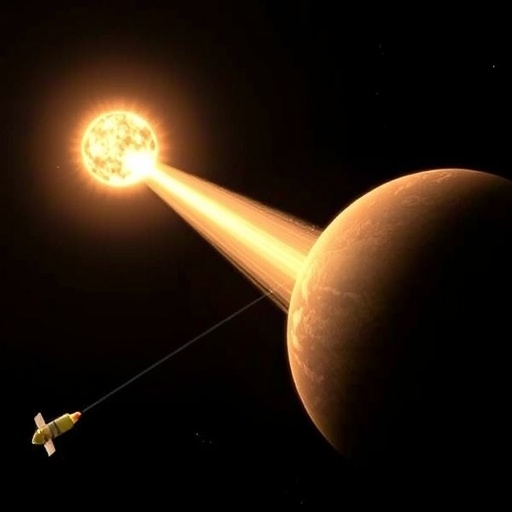
In May 2024, a colossal solar superstorm—unparalleled in intensity for over two decades—sent powerful shocks not only through Earth’s atmosphere but also rippled across our neighboring planet, Mars. While Earthlings witnessed dazzling auroras that stretched unexpectedly far southward to Mexico, Martian orbiters bore witness to an extraordinary tempest wreaking havoc in the Red Planet’s upper atmosphere. Thanks to the European Space Agency’s fleet of exploratory satellites, particularly Mars Express and the ExoMars Trace Gas Orbiter (TGO), scientists have now unveiled astonishing details about how Mars’ ionosphere responded to this violent solar onslaught.
The May 2024 event was characterized by a rapid influx of highly energetic particles and radiation streaming from the Sun, saturating Mars’ upper atmospheric layers with electrons at unprecedented levels. Radiation detectors aboard TGO recorded a radiation dose equivalent to what Mars would typically experience over 200 normal days, but compressed into a mere 64 hours. This extreme exposure led to a supercharging of Mars’s ionosphere, with electron densities leaping dramatically—up to a staggering 278% increase at roughly 130 kilometers altitude. Such a dramatic surge has never before been observed at Mars, marking this event as a landmark in planetary space weather research.
What sets Mars apart in this cosmic drama is its lack of a global magnetic field—a critical shield on Earth that deflects a substantial portion of the solar storm’s energy. Earth’s geomagnetic field directs charged particles towards the polar regions, sparking auroras but also mitigating the storm’s overall impacts on the atmosphere. Mars, with its fractured and patchy crustal magnetism, offers little resistance, allowing the storm’s high-energy plasma to plunge deeply and collide with neutral atoms in the ionosphere, stripping electrons free and dramatically altering its structure.
To scrutinize the aftermath of the storm, ESA scientists employed a cutting-edge method known as radio occultation between Mars Express and TGO. As TGO slipped below the Martian horizon from the perspective of Mars Express, the latter transmitted radio signals that bent and refracted through successive atmospheric layers. By carefully analyzing distortions in these transmissions, researchers could reconstruct detailed electron density profiles with remarkable precision. This orbiter-to-orbiter radio occultation technique, a novel adaptation of a method historically used between planetary spacecraft and Earth, offers an incisive tool for probing planetary atmospheres wirelessly from orbit.
Data from Mars Express and TGO were cross-validated using NASA’s MAVEN mission, which has been surveying Mars’ upper atmosphere since 2014. These complementary perspectives reinforced the conclusion that Mars’ ionosphere became intensely charged by the accompanying plasma and X-rays unleashed by the solar flare, high-energy particle burst, and a massive coronal mass ejection that collectively constituted this superstorm. The coupling of these phenomena forged a planetary environment drenched in magnetized plasma, profoundly altering the ionospheric dynamics.
The solar storm not only transformed Mars’s atmospheric conditions but also momentarily disrupted the orbiters themselves. Both Mars Express and TGO experienced transient computer errors induced by high-energy charged particles affecting onboard electronics. These “single event upsets” are well-known hazards of space weather and demonstrate the necessity of hardened spacecraft systems. Thanks to meticulous engineering choices, including radiation-resistant components and robust autonomous error correction protocols, the craft quickly recovered and continued returning valuable scientific data.
Understanding the intricate responses of Mars’s ionosphere to such extreme solar events holds immense importance. Mars has long been known to suffer atmospheric loss, a process intensified by the continual bombardment of solar wind particles that strip away gases and water molecules. This storm provided a rare opportunity to observe these interactions under extreme conditions, deepening insights into the mechanisms behind atmospheric erosion and evolution on Mars. Such insights are indispensable for future exploration and potential habitability assessments.
However, the implications extend beyond planetary science. The ionosphere’s electron content can significantly impact radio wave propagation, affecting how communication and radar signals travel between orbiters, landers, and potentially human explorers on the surface. During intense solar events, heightened electron densities can distort or block radio transmissions, posing operational challenges for ongoing and future Mars missions. This underscores the necessity of incorporating space weather considerations into mission design and planning.
The event also exemplifies contrasting space weather effects within the solar system. While Earth’s robust magnetic shelter produces auroras as a beautiful byproduct of storm particle deflection, Mars—bereft of such a shield—endures direct atmospheric impacts that more profoundly alter its upper atmospheric composition and structure. Such differences in response illuminate the vast diversity of planetary environments and their interactions with solar activity.
ESA’s innovative use of orbiter-to-orbiter radio occultation is poised to revolutionize the way we monitor planetary atmospheres. Already routine at Earth, this technique is now proving invaluable at Mars and is anticipated to be employed more extensively in forthcoming missions targeting various solar system bodies. It represents a leap forward in remote sensing technology, enabling precise atmospheric characterization without dependence on Earth-based observations alone.
The May 2024 superstorm incident, while extraordinarily intense, also highlights the stochastic nature of space weather—solar radiation and particle ejections occur irregularly and unpredictably, necessitating continuous vigilance and rapid-response observational capability. The fortunate timing of Mars Express’s radio occultation measurement just ten minutes after the major solar flare exemplifies both the challenges and rewards of opportunistic spacecraft observations of space weather phenomena.
Looking ahead, ESA’s suite of solar monitoring missions, including the Solar Orbiter currently surveying the Sun’s activity up close, the future Smile mission aimed at deciphering Earth’s magnetic response, and the planned Vigil mission designed for near-real-time solar storm detection, collectively form an integrated network poised to unravel and mitigate space weather impacts across the solar system. These endeavors, combined with in-situ planetary atmospheric measurements like those at Mars, are ushering in a new era of comprehensive space environment understanding.
This landmark study, set to be published in Nature Communications, not only expands Mars science but also informs protocols for safeguarding spacecraft and communication systems throughout the solar system amidst the tumultuous solar wind. It underscores a universal truth of planetary exploration: understanding and anticipating space weather effects is fundamental to our quest for knowledge and safe expansion into the cosmos.
News Publication Date: 5 March 2026
Web References:
- ESA May 2024 Solar Storm Overview: https://www.esa.int/Space_Safety/Space_weather/The_May_2024_solar_storm_your_questions_answered
- Radio Occultation Technique at Mars: https://blogs.esa.int/to-mars-and-back/2024/07/08/radio-occultation-to-explore-the-martian-atmosphere/
- MAVEN Mars Atmospheric Mission: https://science.nasa.gov/mission/maven/
References:
Parrott, J., et al. (2026). Martian ionospheric response during the May 2024 solar superstorm. Nature Communications. DOI: 10.1038/s41467-026-69468-z
Cite Scienmag News
Russell Cooper. (March 5, 2026). ESA’s Mars Orbiters Observe Solar Superstorm Striking the Red Planet. Scienmag. https://scienmag.com/esas-mars-orbiters-observe-solar-superstorm-striking-the-red-planet/
Russell Cooper. "ESA’s Mars Orbiters Observe Solar Superstorm Striking the Red Planet." Scienmag, 5 March 2026, https://scienmag.com/esas-mars-orbiters-observe-solar-superstorm-striking-the-red-planet/. Accessed 4 September 2026.
Russell Cooper. "ESA’s Mars Orbiters Observe Solar Superstorm Striking the Red Planet." Scienmag. March 5, 2026. https://scienmag.com/esas-mars-orbiters-observe-solar-superstorm-striking-the-red-planet/


