


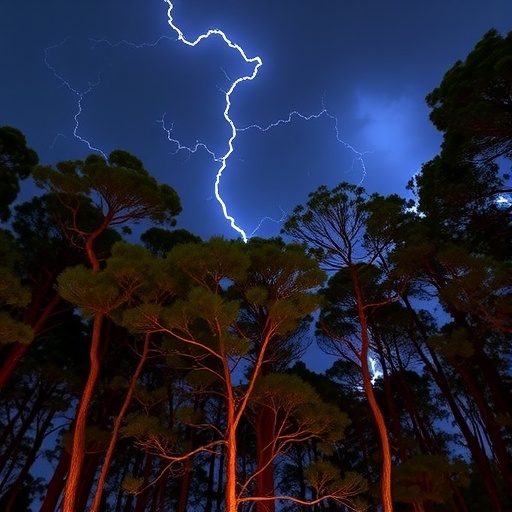
In a groundbreaking field study conducted during the summer of 2024, researchers from Penn State University achieved a scientific first by capturing and documenting corona discharges emanating from trees during thunderstorms in natural settings. These elusive atmospheric phenomena, long hypothesized but never observed outside controlled laboratory environments, involve electrical pulses that create a faint ultraviolet glow at the tips of tree leaves. This discovery sheds new light on forest-atmosphere interactions and expands our understanding of electrical processes within natural ecosystems.
The research team, led by distinguished professor William Brune alongside doctoral candidate Patrick McFarland and colleagues, embarked on an ambitious journey to the southeastern United States in search of the near-daily thunderstorms characteristic of Florida’s summer climate. Equipped with a custom-built observational platform—a modified 2013 Toyota Sienna fitted with telescopic weather instruments affixed to its roof—the team sought to capture evidence of corona discharges using novel sensing technologies. Their target was to validate decades of hypotheses suggesting that treetops serve as focal points for electrical activity during storms, resulting in corona effects visible primarily in the ultraviolet (UV) spectrum.
Corona discharges arise from intense electric fields generated when storm clouds accumulate significant negative charge, inducing a complementary positive charge accumulation on the ground and vegetation. This buildup causes minuscule but concentrated electrical discharges at microscopic protrusions on leaf surfaces, including fine hairs and tips. The resulting corona produces a diffuse glow detectable in UV wavelengths but too faint to be seen in daylight conditions. Crucially, this UV emission facilitates chemical transformations in the local atmosphere, particularly the dissociation of water vapor into powerful oxidizing agents like hydroxyl radicals.
Hydroxyl radicals play a pivotal role in atmospheric chemistry by initiating the breakdown of a variety of organic compounds and greenhouse gases, including methane. Prior laboratory work by the Penn State team demonstrated a correlation between artificially induced corona discharges on tree branches and the generation of hydroxyl radicals, suggesting that natural corona could serve as an atmospheric cleansing mechanism within forest canopies. This new research represents the first field confirmation of these processes occurring naturally during thunderstorms.
The breakthrough came after weeks of chasing intermittent storms with little success. The team finally achieved a breakthrough near the University of North Carolina at Pembroke, where prolonged thunderstorms allowed sustained observation of a sweetgum tree approximately 100 feet away. Using their Corona Observing Telescope System—a Newtonian telescope coupled with a calibrated UV camera and atmospheric electricity sensors—they recorded nearly a thousand distinct corona events. These ranged in duration from instantaneous blinks to multiple-second glows detected on various tree species including loblolly pine.
The observational setup was meticulously designed to isolate corona emissions. The system blocks out solar UV radiation, ensuring that only UV from corona, lightning, and fire are captured in the imaging data. Geolocation hardware allowed precise tracking of corona events relative to storm progress and tree species under study. The researchers also documented subtle physical impacts on leaf surfaces coinciding with corona activity, indicating localized electrical damage.
This revelation marks the dawn of a new frontier in atmospheric and environmental science. Corona discharges, previously relegated to theoretical constructs, reveal a dynamic interface where electrical phenomena actively influence forest chemistry and potentially ecosystem health. The subtle yet widespread presence of corona-induced oxidizers implicates these events in the natural mitigation of volatile organic compounds emitted by vegetation and anthropogenic sources alike.
Despite the confirmed presence and characterization of natural corona discharges, many questions remain. The biological implications for trees subjected to repeated electrical stimulation at leaf surfaces are unknown. It is unclear whether trees have adapted protective mechanisms or if these discharges contribute to physiological stress or damage. Moreover, the broader ecological role of corona-related oxidants in maintaining atmospheric balance and forest resilience requires further investigation.
The interdisciplinary team at Penn State is now collaborating with ecologists and biologists to explore these uncharted questions, aiming to integrate electrical atmospheric chemistry with plant science and ecosystem dynamics. Understanding how corona discharges influence forest health could unlock novel insights into forest-atmosphere feedback loops and inform predictions about forest responses to climate change and increasing storm frequency.
This groundbreaking research was supported by funding from the U.S. National Science Foundation and demonstrates the continuing power of discovery science in uncovering hidden processes within familiar environments. The peer-reviewed findings, published in Geophysical Research Letters, stand as a testament to the ingenuity of blending laboratory insights with innovative field instrumentation to reveal nature’s subtle electrical phenomena vividly at work within the thunderstorm canopy.
Cite Scienmag News
Russell Cooper. (April 17, 2026). Scientists Capture First-Ever Footage of Treetops Illuminated by Storms. Scienmag. https://scienmag.com/scientists-capture-first-ever-footage-of-treetops-illuminated-by-storms/
Russell Cooper. "Scientists Capture First-Ever Footage of Treetops Illuminated by Storms." Scienmag, 17 April 2026, https://scienmag.com/scientists-capture-first-ever-footage-of-treetops-illuminated-by-storms/. Accessed 3 September 2026.
Russell Cooper. "Scientists Capture First-Ever Footage of Treetops Illuminated by Storms." Scienmag. April 17, 2026. https://scienmag.com/scientists-capture-first-ever-footage-of-treetops-illuminated-by-storms/


