

Florida Atlantic University has announced a groundbreaking advancement in aerospace and artificial intelligence research with the acquisition of a state-of-the-art United States Air Force T-1A Jayhawk Mixed Reality (MR) and 3D Motion flight simulator. This significant in-kind grant, valued at approximately $4.5 million, was awarded by the U.S. Air Force Office of Scientific Research to FAU’s Center for Connected Autonomy and Artificial Intelligence (CA-AI). The integration of this advanced simulator into the university’s research infrastructure promises to radically enhance capacity in AI, autonomy, and aerospace system studies, and will be accessible to a wide range of researchers and industry collaborators.
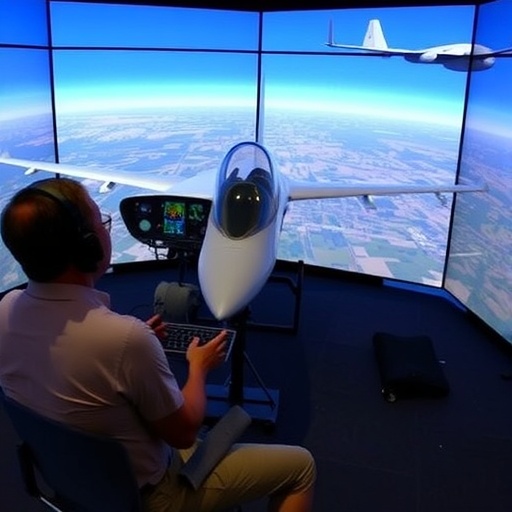
The T-1A Jayhawk flight simulator impeccably replicates the real aircraft’s cockpit layout, flight dynamics, and operational milieu, specifically modeling a medium-range, twin-engine jet used by the U.S. Air Force for advanced pilot training. Unlike traditional simulation platforms, this mid-tier device incorporates mixed reality technology along with a 3D-freedom motion platform. This fusion of tangible cockpit controls and immersive digital environments not only elevates the realism experienced by users but also enriches the data output for research applications. The system’s software architecture is open-source and non-CUI, enabling researchers to tweak flight models, embed experimental algorithms, and test complex adaptive autonomy frameworks within a fully controlled and dynamically adjustable setting.
One of the paramount research advancements offered by the T-1A simulator lies in its capacity for conducting flight operations under high-risk or degraded-condition scenarios that would be impractical or prohibitively expensive to execute in live environments. Live flight testing typically demands significant financial resources—running into thousands of dollars per flight hour—and poses inherent safety and operational constraints. The simulator circumvents these barriers by providing a repeatable platform where parameters can be systematically varied, enabling safer and more rigorous experimentation on flight dynamics, human-machine interactions, and autonomous system responses.
The simulator’s versatility extends well beyond aeronautics, serving as a fertile ground for interdisciplinary investigations into autonomous decision-making, sensor fusion, and human performance in complex environments. By coupling mixed reality with sophisticated motion feedback, FAU researchers can conduct controlled laboratory studies on cognitive workload, situational awareness, stress responses, and motor control. This high-fidelity environment supports the design and evaluation of emerging AI-driven support systems, new interface modalities, and innovative control architectures, pushing the boundaries of what can be achieved in human-robot collaboration and real-time autonomous system supervision.
Dimitris Pados, Ph.D., the principal investigator and director of CA-AI, highlighted the simulator’s transformative potential as a research tool for developing trustworthy AI in safety-critical domains. The reconfigurable platform allows for rigorous testing of intelligent systems alongside human operators, facilitating the development of technologies that are robust, resilient, and precisely aligned with mission-specific demands. Such capabilities are essential for progressing autonomous systems that must navigate unpredictable, high-stakes scenarios with precision and reliability.
In addition to engineering and computer science applications, the T-1A Jayhawk simulator has been embraced by neuroscience and biomedical research communities at FAU. The simulator enables novel experimental setups geared toward understanding cognitive workload management, fatigue effects, and human motor functions within controlled yet realistic task environments. These studies are critical for enhancing human performance and designing systems that mitigate fatigue and error in operational settings, spanning fields from aviation to healthcare technologies.
The spectrum of research supported by the simulator also crosses into cybersecurity, systems engineering, robotics, and advanced manufacturing. The platform serves as a testbed for evaluating cyber-physical systems under dynamic, complex conditions that mirror real-world operational environments. This facilitates prototyping and validation of new security protocols, resilient control schemes, and autonomous robotic mechanisms, which are increasingly vital in a technologically interconnected world.
The presence of this military-grade simulation system at FAU is also a pivotal asset for educational enrichment and workforce training. Students and faculty from engineering, computer science, human factors, and allied fields gain hands-on experience with mixed-reality flight operations and cutting-edge aerospace technologies. This exposure cultivates a highly skilled talent pool prepared to lead innovation in aviation, AI, and autonomous systems development, thereby strengthening FAU’s leadership position in these crucial domains.
Moreover, FAU’s T-1A Jayhawk simulator is situated at the university’s Tech Runway facility on the Boca Raton campus, within a newly configured space designed to foster synergy among diverse high-impact research initiatives. This environment encourages collaboration among academic disciplines, federal agencies, industry partners, and community stakeholders, reinforcing the simulator’s role as a nexus for innovation and cross-sector engagement.
The integration of the T-1A simulator directly complements and propels ongoing federally funded research projects, including computational neuroscience efforts supported by the NIH, as well as cybersecurity and trustworthy cyber-physical systems research funded by the AFOSR, AFRL, and NSF. These initiatives stand to benefit from the simulator’s unique capacity for scalable and nuanced experimentation in environments that replicate real operational challenges.
Dr. Stella Batalama, dean of FAU’s College of Engineering and Computer Science, emphasized that this acquisition represents a milestone by enabling the university to conduct aviation research and education with unparalleled depth and precision. She envisions the Jayhawk simulator as a cornerstone for pioneering advancements that extend well beyond traditional aerospace applications, catalyzing breakthroughs in AI, autonomy, human performance, and interconnected complex systems.
The collaborative model fostered by FAU around the T-1A Jayhawk simulator exemplifies how technological investment in mixed-reality and autonomous system platforms can redefine research and training paradigms. As autonomous vehicles, intelligent robotics, and AI-driven decision systems proliferate across land, air, sea, and space, facilities like this ensure that academic institutions remain at the forefront of cutting-edge exploration—and that innovations undergo rigorous validation before real-world deployment.
In sum, Florida Atlantic University’s acquisition of the U.S. Air Force T-1A Jayhawk Mixed Reality flight simulator establishes a versatile, high-fidelity research and education platform designed to advance the frontiers of aerospace systems, autonomous technologies, human factors engineering, and biomedical sciences. The simulator’s ability to replicate complex operational scenarios within a controlled mixed-reality environment positions FAU as an epicenter for innovation, scientific discovery, and workforce development dedicated to shaping the future of intelligent, connected, and trustworthy autonomous systems.
News Publication Date: Not specified
Web References:
- https://www.fau.edu/engineering/
- https://www.fau.edu/engineering/research/c2a2/
- https://www.fau.edu/engineering/directory/faculty/pados/
- https://www.fau.edu/engineering/directory/faculty/batalama/
Cite Scienmag News
Reid Dalton. (March 4, 2026). FAU Secures $4.5M Contract to Develop Advanced T-1A Jayhawk Flight Simulator for US Air Force. Scienmag. https://scienmag.com/fau-secures-4-5m-contract-to-develop-advanced-t-1a-jayhawk-flight-simulator-for-us-air-force/
Reid Dalton. "FAU Secures $4.5M Contract to Develop Advanced T-1A Jayhawk Flight Simulator for US Air Force." Scienmag, 4 March 2026, https://scienmag.com/fau-secures-4-5m-contract-to-develop-advanced-t-1a-jayhawk-flight-simulator-for-us-air-force/. Accessed 3 September 2026.
Reid Dalton. "FAU Secures $4.5M Contract to Develop Advanced T-1A Jayhawk Flight Simulator for US Air Force." Scienmag. March 4, 2026. https://scienmag.com/fau-secures-4-5m-contract-to-develop-advanced-t-1a-jayhawk-flight-simulator-for-us-air-force/


