


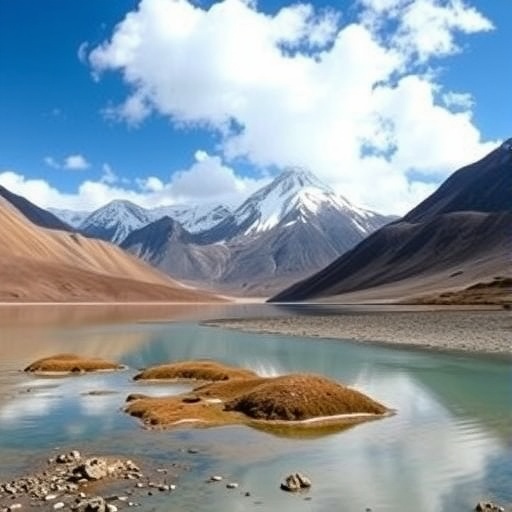
In a groundbreaking revelation that redefines our understanding of carbon cycles in high-altitude ecosystems, recent research published in Communications Earth & Environment illuminates the persistent role of Tibetan lakes as carbon dioxide (CO2) sources since the Last Glacial Maximum. This study, led by Liu, H., Liu, W., Wang, Z., and their colleagues, propels forward the narrative of global carbon emissions, pivoting attention toward a region previously underestimated in the global carbon budget.
The Tibetan Plateau, often dubbed the “Roof of the World,” is home to a myriad of lakes whose biochemical and physical processes have posed puzzling questions for earth system scientists. These water bodies, sprawling across a harsh, high-altitude environment, experience temperature fluctuations, hydrological changes, and unique geological formations that collectively influence their interaction with atmospheric gases. The latest findings underscore that these lakes have not merely been passive reservoirs but have actively emitted CO2, influencing atmospheric composition for thousands of years.
Delving into paleoenvironmental reconstructions, the research team employed a sophisticated combination of sediment core analyses, geochemical proxies, and isotopic signatures to trace back the carbon dynamics of Tibetan lakes dating from the Last Glacial Maximum approximately 21,000 years ago. Their multi-proxy approach allowed for a chronological dissection of biogeochemical processes, revealing a consistent pattern of CO2 efflux rather than the anticipated carbon sequestration, challenging assumptions of glacial-age lacustrine environments.
The investigation reveals that the Tibetan lakes have maintained this CO2 emission trait through drastic climatic shifts, including periods of glacial advance and retreat, as well as the Holocene’s warming phase. The coupling of lacustrine organic matter degradation and changing hydrology—especially fluctuations in lake levels driven by monsoonal variability—has orchestrated a persistent liberation of carbon from these stands of water into the atmosphere. These insights reshape how scientists model carbon sources within cold, arid, and high-altitude ecosystems.
What drives this sustained carbon emission, despite shifts in climatic conditions, lies in the combination of temperature-dependent microbial respiration and organic carbon availability trapped within lake sediments. The elevated UV radiation and lower atmospheric pressure at high altitudes potentially accelerate the decomposition of organic matter, intensifying CO2 outgassing. This phenomenon starkly contrasts with the carbon sequestration behavior typical in many lowland lake systems, underlining the uniqueness of the Tibetan Plateau’s ecological context.
Analytical data from the sediment layers indicate episodic pulses of enhanced CO2 outgassing synchronous with known climatic events, such as abrupt warming episodes and monsoon fluctuations. This temporal correlation suggests a sensitive feedback mechanism, where climate variability directly influences carbon turnover rates. The lakes’ role transcends isolated carbon cycling; they emerge as dynamic players intricately tied to regional climate oscillations, with implications cascading into global atmospheric chemistry.
Importantly, the lacustrine CO2 emissions identified are nontrivial when scaled across the numerous water bodies that pepper the Tibetan Plateau and adjacent highlands. With over 1,000 lakes of various sizes constituting this delicate alpine ecosystem, the cumulative release of CO2 over millennia likely represents a significant contribution to preindustrial atmospheric carbon levels. This finding calls for incorporation of these lacustrine fluxes into climate-carbon feedback models and global carbon budgets, where they have hitherto been absent or minimized.
The research further explores the interplay between permafrost thawing and organic carbon mobilization in lake catchments. As the Tibetan Plateau experiences warming trends exceeding global averages, permafrost degradation accelerates, leading to increased input of ancient organic matter into lake basins. This influx, coupled with enhanced microbial activity during warmer intervals, may amplify CO2 emissions, suggesting that future climate change could intensify these high-altitude carbon source dynamics.
Simulations performed by the researchers project that as regional temperatures continue to climb, the carbon emission potential of these lakes could escalate, potentially creating a positive feedback loop exacerbating atmospheric CO2 concentrations. This scenario aligns with broader concerns about climate vulnerabilities in cryospheric and alpine regions, highlighting the Tibetan Plateau as a critical “hotspot” for atmospheric carbon release as the world warms.
The interdisciplinary approach of the study, integrating paleoclimatology, biogeochemistry, and remote sensing, offers a robust framework for ongoing monitoring and predictive modeling of Tibetan lake ecosystems. The utilization of high-resolution environmental proxies enables a nuanced understanding of legacy carbon dynamics alongside contemporary processes, positioning this research at the forefront of environmental science aimed at decoding past and future carbon fluxes.
Moreover, the findings could influence policy frameworks oriented toward climate mitigation strategies, particularly those aimed at preserving sensitive carbon reservoirs in alpine regions. Recognizing that Tibetan lakes serve as persistent CO2 sources anchors the need for localized environmental management and informs global strategies addressing carbon emissions from natural systems once considered negligible.
This intensive exploration opens pathways for further inquiry into the mechanisms driving lacustrine carbon emissions at elevation extremes worldwide. Comparisons with high-altitude lakes in the Andes, Rockies, and Himalayas may uncover universal principles or regionally distinctive traits influencing carbon flux, refining our understanding of carbon cycle heterogeneity across diverse mountainous landscapes.
Ultimately, this research underscores the imperative of factoring in natural carbon sources that have historically been underrepresented in global models. By unveiling the persistent CO2 emissions of Tibetan lakes over millennia, this study reframes how scientists comprehend ancient carbon-climate interactions and equips the scientific community with critical data to anticipate future changes in Earth’s fragile, altitude-dependent ecosystems.
As humanity grapples with accelerating climate change, interpreting the complexities of carbon cycling in remote but globally significant regions like the Tibetan Plateau is paramount. This study’s pioneering revelations pave the way for enhanced stewardship of alpine environments, compelling an evolution in research, monitoring, and mitigation efforts aimed at safeguarding planetary health.
Cite Scienmag News
Violet Maxwell. (March 4, 2026). Tibetan Lakes Emitted CO2 Since Last Glacial Maximum. Scienmag. https://scienmag.com/tibetan-lakes-emitted-co2-since-last-glacial-maximum/
Violet Maxwell. "Tibetan Lakes Emitted CO2 Since Last Glacial Maximum." Scienmag, 4 March 2026, https://scienmag.com/tibetan-lakes-emitted-co2-since-last-glacial-maximum/. Accessed 4 September 2026.
Violet Maxwell. "Tibetan Lakes Emitted CO2 Since Last Glacial Maximum." Scienmag. March 4, 2026. https://scienmag.com/tibetan-lakes-emitted-co2-since-last-glacial-maximum/


