


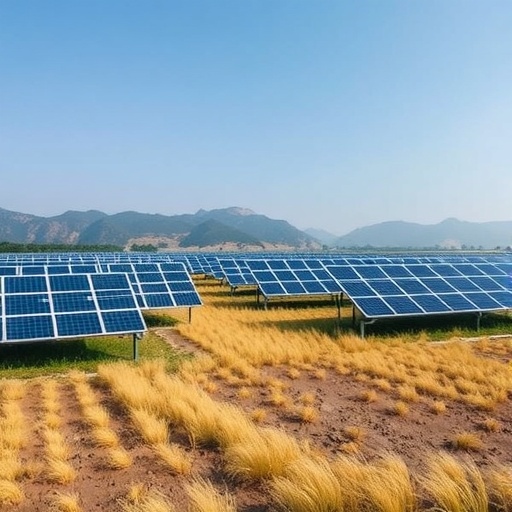
In a groundbreaking advancement poised to transform renewable energy strategies and land utilization, a recent study by Yang, Zhou, Chen, and colleagues presents a compelling investigation into the deployment of photovoltaic (PV) systems on marginal lands in China. This pioneering research, published in Communications Earth & Environment, elucidates how the strategic use of underutilized or less productive lands can simultaneously generate significant energy outputs and facilitate sustainability gains, marking a remarkable synergy between environmental stewardship and energy policy.
China, as the world’s largest energy consumer and carbon emitter, faces immense pressure to shift towards cleaner energy sources. The deployment of photovoltaic technology has surged globally over recent decades, but land availability and competing uses often constrain expansion. In this context, the concept of utilizing marginal land—areas that are typically unsuitable for agriculture or urban development due to poor soil quality, aridity, or other environmental factors—offers an innovative and pragmatic solution. The study provides a comprehensive framework for identifying such lands and evaluating their potential for solar energy projects without compromising ecological or agricultural integrity.
The authors embark on a multifaceted analysis that integrates remote sensing data, land-use classification, and solar irradiance mapping to pinpoint the most suitable marginal lands across China. These lands are characterized by minimal human activity, low agricultural productivity, and high solar exposure—making them ideal for large-scale PV installations. Crucially, the research avoids simplistic assumptions, instead carefully balancing the technical feasibility and ecological implications to ensure that the proposed deployment model is genuinely sustainable.
From a technical perspective, the study delves into photovoltaic system design parameters tailored for marginal land conditions. Given the often-harsh microclimate and soil properties typical of these areas, traditional PV configurations require adaptations to optimize energy yield and durability. Innovations such as adjustable tilt mounts to maximize solar capture during varying angles of sunlight, combined with dust-resistant coatings to sustain panel efficiency, have been critically assessed. These technical refinements not only boost performance but also reduce maintenance demands, which is paramount in remote or less accessible locations.
One of the principal sustainability co-benefits highlighted is the mitigation of land degradation and desertification processes. The installation of PV arrays acts as a protective cover, reducing surface erosion by stabilizing soil and minimizing wind speeds near the ground. This dual function transforms marginal lands from ecological liabilities into assets, promoting biodiversity recovery beneath solar panels by creating microhabitats less prone to extreme temperature and moisture fluctuations.
The energy output modeled by the research team demonstrates substantial potential to supplement China’s renewable energy portfolio. By exploiting an estimated 220 million hectares of classified marginal lands, the cumulative installed PV capacity could reach several terawatts, delivering gigawatt-scale electricity generation. This output would noticeably cut China’s dependence on fossil fuels, accelerating its transition to a carbon-neutral future. The study also discusses grid integration challenges, emphasizing the need for smart grid technologies and energy storage solutions to reconcile intermittent solar generation with demand patterns.
Economically, the use of marginal land for PV projects offers attractive prospects. Unlike prime agricultural or urban lands, these often neglected areas present lower acquisition costs and fewer social conflicts, easing project development timelines. Furthermore, such initiatives can stimulate rural economies by creating local employment opportunities in construction, maintenance, and ancillary services, thereby fostering inclusive growth alongside environmental benefits.
The research addresses concerns regarding competition with food production—an issue ubiquitously associated with land-intensive renewable energy projects. By directing PV deployment to lands unsuitable for crops, potential negative impacts on food security are minimized. This strategic alignment exemplifies a holistic approach to sustainable development, where energy goals harmonize rather than compete with other critical societal needs.
In terms of policy implications, the findings advocate for integrated land-use planning that recognizes marginal lands as vital resources in national renewable energy strategies. The study suggests amendments to existing regulatory frameworks to facilitate PV installations in these areas while safeguarding ecosystem services and community interests. Incentives such as tax breaks, streamlined permitting processes, and public-private partnerships are proposed to catalyze adoption.
Another salient aspect explored is the carbon balance associated with PV deployment on marginal lands. The authors conduct a lifecycle assessment demonstrating that the net greenhouse gas reductions significantly outweigh any emissions generated during manufacturing, installation, and maintenance stages. This robust carbon accounting reinforces the case for prioritizing such land-use conversions in climate mitigation policies.
The researchers also consider water resource management in the context of arid marginal environments. Traditional solar PV setups require minimal water, primarily for cleaning panels to maintain efficiency. The study evaluates innovative dry-cleaning technologies and autonomous robotic cleaning systems that mitigate water consumption, an essential consideration in water-scarce regions prevalent in China’s marginal lands.
Social acceptance of PV projects on marginal lands is examined qualitatively through stakeholder interviews and surveys. The authors report general positive sentiment among local populations, especially when projects incorporate community benefits such as electricity access, job creation, and environmental improvements. However, the research underscores the importance of transparent communication and participatory planning to address any concerns about land rights and visual impacts.
Importantly, the paper situates its findings within the broader context of global renewable energy transitions, suggesting that the methodologies and insights could be applicable beyond China. Marginal lands exist worldwide, and their potential as solar energy hubs remains largely untapped. The translatability of this research offers a blueprint for other nations seeking to expand renewable infrastructure while optimizing land resources.
In conclusion, this intensive investigation by Yang et al. illustrates not only the technical viability but also the systemic benefits of photovoltaic deployment on China’s marginal lands. By merging innovative technological adaptations with sustainable land management practices, the research delivers a compelling vision of how energy security and environmental preservation can be mutually reinforcing objectives. This paradigm shift holds promise for accelerating the global journey toward resilient and sustainable energy systems.
Emerging from this study is a roadmap for policymakers, industry leaders, and environmentalists alike, emphasizing data-driven decision-making and cross-sector collaboration. The transformative potential of marginal lands as reservoirs for green energy deployment underscores the need for integrated frameworks that protect ecological integrity while meeting accelerating energy demands. The research thus not only contributes valuable scientific knowledge but also inspires a future where renewable energy and natural systems coexist synergistically on the planet.
Cite Scienmag News
Faith Mcneil. (April 22, 2026). Photovoltaics on Marginal Land Boost China’s Sustainability. Scienmag. https://scienmag.com/photovoltaics-on-marginal-land-boost-chinas-sustainability/
Faith Mcneil. "Photovoltaics on Marginal Land Boost China’s Sustainability." Scienmag, 22 April 2026, https://scienmag.com/photovoltaics-on-marginal-land-boost-chinas-sustainability/. Accessed 4 September 2026.
Faith Mcneil. "Photovoltaics on Marginal Land Boost China’s Sustainability." Scienmag. April 22, 2026. https://scienmag.com/photovoltaics-on-marginal-land-boost-chinas-sustainability/


