


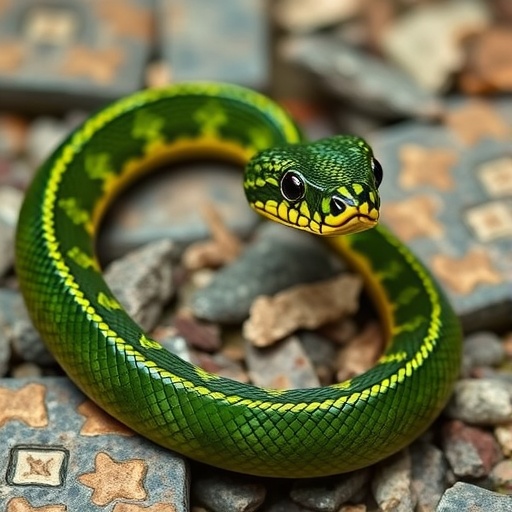
In the mist-covered highlands of western Sichuan, China, a vibrant new species of pitviper has emerged from the shadows, capturing the attention of herpetologists and biodiversity enthusiasts worldwide. This newly identified snake, named Trimeresurus lii, or the Huaxi Green Pitviper, represents a remarkable addition to the genus Trimeresurus, renowned for its strikingly beautiful yet venomous members. Cloaked in a uniform grass-green hue and adorned with eyes that gleam like polished amber, this snake defies the conventional understanding of its kind, revealing the complexity and richness of life concealed within one of the planet’s most biodiverse regions.
The discovery came during comprehensive biodiversity surveys conducted by a collaborative team from the Chengdu Institute of Biology and the Giant Panda National Park. These surveys targeted the West China Rain Zone, an area celebrated for its ecological wealth yet still harboring many enigmatic species. What was previously classified as a common bamboo pitviper, Trimeresurus stejnegeri, was found, upon closer scrutiny, to be an entirely separate species. This finding underscores the hidden diversity that can often elude even seasoned field experts, masked by superficial similarities and geographical overlap.
Naming the species Trimeresurus lii pays homage to the revered ancient Chinese philosopher Li Er, more commonly known as Laozi, whose philosophies stress harmony between humanity and nature. Such a name encapsulates the deeper message behind the discovery: a call for mindful coexistence with the environment, mirroring the conservation ethos of the Giant Panda National Park where the snake resides. This nomenclatural choice embodies the intertwining of cultural heritage and scientific progress, reminding us that nature and human wisdom are inexorably linked.
At a technical level, the identification process was rigorous, involving both genetic and morphological analyses. Researchers extracted DNA samples to conduct phylogenetic studies that decisively placed T. lii within an exclusive genetic lineage, distinct from its closest relatives. Complementing these genetic findings were meticulous morphological examinations, which revealed unique physical traits. Most notably, the Huaxi Green Pitviper’s head scales present a perfect smoothness, divergent from the scalation patterns observed in T. stejnegeri, aiding in clear taxonomic differentiation.
Sexual dimorphism in Trimeresurus lii is pronounced and visually captivating. Males exhibit a tricolor side stripe featuring red and white hues, contrasted by their eyes’ deep amber coloration. Females, however, display a simpler yellow lateral stripe and eyes of a soft orange-yellow shade. These differences are not mere curiosities but potentially indicate varied ecological roles or mating behaviors within the species, opening avenues for future ethological studies. Such dimorphism also facilitates easier identification in field observations, enhancing understanding of population structures.
The venomous nature of T. lii places it in the critical discussion of human-wildlife interactions. As a member of the pitviper family, its venom is capable of causing envenoming incidents, making knowledge of its distribution and behavior vital for local medical preparedness. The presence of this species near human settlements within mountainous regions raises public health considerations, emphasizing the crucial need for awareness campaigns and antivenom development tailored to the specific toxins present in its venom composition.
Growing to nearly 80 centimeters in length, the Huaxi Green Pitviper thrives in the humid montane forests of Mt. Emei and Xiling Snow Mountain — key components of the West China Rain Zone. This area is a recognized global biodiversity hotspot, known for its rich array of endemic species and ecological niches. The discovery of T. lii underscores how even in well-studied locations, significant biological treasures remain concealed, awaiting discovery through persistent and detailed fieldwork complemented by modern scientific tools.
The finding was published in Zoosystematics and Evolution in January 2026, an open-access journal dedicated to the taxonomy and evolutionary biology of animals. The documentation provides a comprehensive morphological description, genetic analysis data, and ecological context. It marks the 58th species assigned to the genus Trimeresurus globally, but only the second new species of its particular subgenus to be found in Sichuan Province, signifying both the genus’s diversity and the region’s underexplored herpetofauna.
Beyond adding to taxonomic records, the discovery of Trimeresurus lii has vital implications for conservation biology. The snake’s existence spotlights the importance of preserving habitat within the Giant Panda National Park and similar protected areas. Moreover, it exemplifies how targeted biodiversity assessments can uncover cryptic species masked by superficial similarities to more common taxa, emphasizing the dynamic nature of ecosystems and the continuous need for scientific vigilance.
From an evolutionary perspective, the differentiation of T. lii demonstrates the complex processes shaping biodiversity in mountainous biomes. Genetic divergence combined with ecological specialization suggests that geographic barriers and microhabitat preferences have played significant roles in speciation within this group. Such findings enhance understanding of evolutionary mechanisms in pitvipers and inform predictive models on how environmental changes might impact their survival.
The researchers involved stress that this discovery is a reminder of the vast unknowns still present in biodiversity research, even within regions subject to long-term scientific attention. It advocates for sustained investment in field surveys, integrative taxonomy, and the incorporation of genomic technologies to resolve intricate taxonomic puzzles. Ultimately, the unveiling of the Huaxi Green Pitviper serves as both an exciting scientific achievement and a clarion call for the preservation of nature’s hidden wonders.
- Zoosystematics and Evolution Journal
- DOI: 10.3897/zse.102.178601
Image Credits: Bo Cai
Keywords: Trimeresurus lii, Huaxi Green Pitviper, pitviper, venomous snake, biodiversity hotspot, Sichuan, West China Rain Zone, taxonomy, phylogenetics, sexual dimorphism, conservation, herpetology
Cite Scienmag News
Margaret Porter. (April 22, 2026). New Grass-Green Pitviper Species Discovered in China’s Giant Panda National Park: A Serpent Fit for a Philosopher. Scienmag. https://scienmag.com/new-grass-green-pitviper-species-discovered-in-chinas-giant-panda-national-park-a-serpent-fit-for-a-philosopher/
Margaret Porter. "New Grass-Green Pitviper Species Discovered in China’s Giant Panda National Park: A Serpent Fit for a Philosopher." Scienmag, 22 April 2026, https://scienmag.com/new-grass-green-pitviper-species-discovered-in-chinas-giant-panda-national-park-a-serpent-fit-for-a-philosopher/. Accessed 3 September 2026.
Margaret Porter. "New Grass-Green Pitviper Species Discovered in China’s Giant Panda National Park: A Serpent Fit for a Philosopher." Scienmag. April 22, 2026. https://scienmag.com/new-grass-green-pitviper-species-discovered-in-chinas-giant-panda-national-park-a-serpent-fit-for-a-philosopher/


