


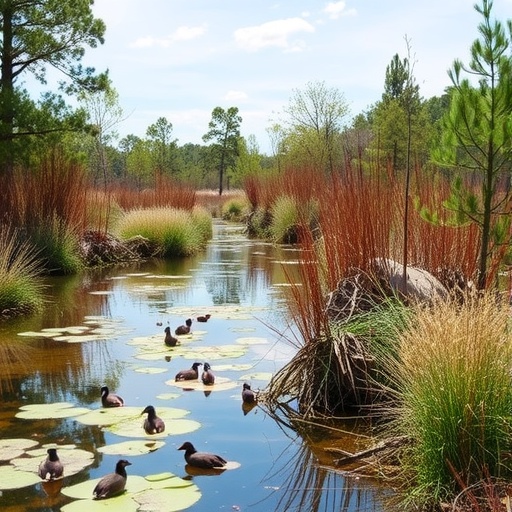
In the evolving discourse surrounding ecosystem services and environmental sustainability, wetlands frequently emerge as critical, yet often underestimated, components of terrestrial and aquatic landscapes. Recent research spearheaded by Dallosch and Creed has cast new light on the intricate ways “gatekeeper” wetlands function within continental basins, underscoring their pivotal role in governing nutrient pathways, thereby influencing water quality and ecosystem health on unprecedented scales. Published in Communications Earth & Environment in 2026, this groundbreaking study provides a comprehensive, mechanistic depiction of how these wetlands modulate nutrient fluxes, offering fresh insights that challenge conventional watershed management paradigms.
At the heart of this research lies an ecological inquiry into nutrient dynamics—a field critical for unraveling the complexities of riverine and lacustrine ecosystem responses to environmental stressors such as eutrophication and pollution. Gatekeeper wetlands, as defined by Dallosch and Creed, are specific wetland areas positioned strategically within continental drainage networks. They act as regulatory nodes that intercept, transform, or retain nutrients flowing downstream. Unlike isolated wetlands, these gatekeeper systems function as integral biogeochemical hubs that influence nutrient transport over vast spatial scales, extending their ecological consequence well beyond local settings.
Through innovative hydrological modeling and nutrient tracing techniques, the researchers quantified the nutrient retention capacity of these wetlands. They demonstrated that gatekeeper wetlands significantly reduce the flux of nitrogen and phosphorus—two major contributors to water quality degradation—from upland sources into downstream water bodies. This nutrient modulation occurs via a suite of biogeochemical pathways, including microbial denitrification, plant uptake, and sediment adsorption, processes that are dynamically regulated by seasonal hydrology and vegetation phenology. The study’s data suggest nutrient retention efficiencies that surpass those projected by earlier watershed models that treated wetlands as singular, homogeneous entities.
One of the study’s remarkable findings revolves around the role of hydrological connectivity in shaping the regulatory function of gatekeeper wetlands. These wetlands are not merely passive sinks; instead, their nutrient governing capacity depends critically on the timing, magnitude, and frequency of water inputs. By mapping spatial and temporal hydrological linkages within a continental basin, the authors revealed how gatekeeper wetlands serve as pulse-dependent mediators, buffering nutrient spikes associated with storm events and agricultural runoff. This pulse-driven mechanism highlights the dynamic interplay between hydrology, nutrient loading, and wetland biogeochemistry.
The research further delves into the implications of altered land use and changing climate regimes on the functionality of gatekeeper wetlands. Anthropogenic alterations such as urbanization, wetland drainage, and agricultural intensification compromise the structural integrity and hydrological connectivity of these systems, reducing their ability to act as nutrient gatekeepers. Concurrently, climate-induced shifts in precipitation patterns and temperature regimes may exacerbate nutrient release from soils and increase nutrient loads transferred through these wetlands. The study cautions that without targeted conservation and restoration efforts, the protective function of gatekeeper wetlands could be severely weakened, leading to exacerbated nutrient pollution downstream.
Beyond nutrient retention, gatekeeper wetlands also influence broader ecosystem processes, including primary productivity, carbon cycling, and biodiversity support. The interplay between nutrient mediation and carbon sequestration is particularly notable; by modulating nutrient inputs into aquatic systems, these wetlands indirectly influence algal growth and organic matter decomposition rates, with cascading effects on greenhouse gas emissions. Moreover, the research articulates how nutrient regulation by gatekeeper wetlands supports habitat complexity essential for diverse biota, creating ecological refuges that maintain both microbial and macrofaunal communities.
Technological advancements enabled much of this research’s success. High-resolution remote sensing combined with in-situ nutrient sensors provided fine-scale monitoring of wetland hydrology and nutrient transformations. The integration of isotope tracing techniques offered unprecedented resolution in tracking nitrogen species dynamics through the wetlands, elucidating denitrification pathways and rates. These methodological innovations allowed the researchers to disentangle overlapping biogeochemical processes and spatial heterogeneity, setting new standards for empirical investigation in watershed ecology.
Analyzing a continental basin scale rather than localized watersheds was a deliberate choice guided by the complexity of nutrient movement in large hydrological systems. The authors argue this broader perspective is essential for developing effective water quality management strategies at regional to national levels. Gatekeeper wetlands, although individually small, collectively exert outsized control in attenuating nutrient loads, reaffirming the importance of landscape-level conservation planning that recognizes spatial interdependencies across ecosystem networks.
This study also challenges environmental policy frameworks that have historically undervalued wetlands as nutrient regulators. By providing robust quantitative evidence of the gatekeeping function, Dallosch and Creed advocate for the integration of wetland conservation into nutrient management policies. They suggest that preserving and restoring gatekeeper wetlands should be prioritized alongside traditional point-source pollution controls to achieve measurable water quality improvements under the pressures of global environmental change.
Importantly, the insights from this research encourage interdisciplinary collaboration among hydrologists, ecologists, biogeochemists, and land use planners. The highlighted complexity of nutrient pathways, shaped by both abiotic and biotic factors, necessitates integrative approaches to address nutrient load mitigation comprehensively. Furthermore, the research underscores the value of combining empirical data with hydrological and biogeochemical modeling to design adaptive management strategies resilient to future climatic and anthropogenic perturbations.
The implications of gatekeeper wetlands extend into the domain of ecosystem services valuation. These natural wetlands provide essential functions that translate into economic benefits by mitigating eutrophication-associated costs, supporting fisheries productivity, and maintaining recreational water quality. By quantifying nutrient retention at large scales, the study lays groundwork for incorporating these ecosystem services into market-based conservation incentives, potentially redefining wetland protection priorities in policy arenas.
In sum, this research represents a paradigmatic shift in understanding nutrient dynamics within continental-scale basins. It elevates the ecological significance of gatekeeper wetlands as critical regulators of water quality and ecosystem resilience. As humanity faces mounting environmental challenges, insights such as these illuminate pathways toward sustainable watershed management that embrace nature-based solutions. Protecting and restoring gatekeeper wetlands emerges not merely as an ecological ideal but as a pragmatic necessity to safeguard freshwater resources on which societies depend.
Looking ahead, the research opens new avenues for exploring feedback mechanisms between climate variability, land cover change, and wetland biogeochemical performance. Further studies will be essential to unpack the nuances of nutrient transformations under varying environmental scenarios, assess long-term resilience of gatekeeper wetlands, and refine predictive models. The integration of social and economic dimensions into wetland governance will also be critical to translating scientific knowledge into effective conservation action.
Ultimately, the work by Dallosch and Creed exemplifies how cutting-edge science can dismantle long-standing ecological assumptions and reveal the hidden complexity of natural systems. By moving beyond simplified conceptions of wetlands as isolated landscape features, this research portrays them as active agents orchestrating crucial ecosystem processes. It is an invitation to rethink how humanity values and interacts with wetland ecosystems, recognizing their indispensable role as gatekeepers within the grand hydrological tapestry of continental basins.
Cite Scienmag News
Violet Maxwell. (April 22, 2026). Gatekeeper Wetlands Control Nutrient Flow in Basin. Scienmag. https://scienmag.com/gatekeeper-wetlands-control-nutrient-flow-in-basin/
Violet Maxwell. "Gatekeeper Wetlands Control Nutrient Flow in Basin." Scienmag, 22 April 2026, https://scienmag.com/gatekeeper-wetlands-control-nutrient-flow-in-basin/. Accessed 4 September 2026.
Violet Maxwell. "Gatekeeper Wetlands Control Nutrient Flow in Basin." Scienmag. April 22, 2026. https://scienmag.com/gatekeeper-wetlands-control-nutrient-flow-in-basin/


