


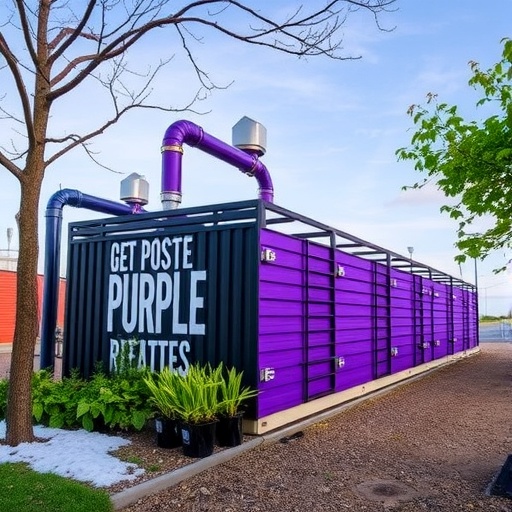
The launch of the POST-PURPLE project marks a groundbreaking advance in the realm of sustainable urban waste management, setting a new paradigm for how cities can transform their wastewater and organic waste streams into renewable, high-value products. Officially initiated at a dynamic kick-off meeting held on January 21–22, 2026, at the Universidad Rey Juan Carlos (URJC) campus in Madrid, this Horizon Europe-funded initiative represents a collaborative effort by leading European research institutions and industrial partners. Together, they have embarked on a mission to revolutionize urban biorefineries through cutting-edge bio-based technologies designed to extract nutrients, proteins, and natural compounds from waste materials that have traditionally been underutilized or discarded.
Urban wastewater treatment plants alongside organic waste processing facilities have long been recognized as significant sources of greenhouse gas emissions and substantial energy consumers across Europe. Despite the vast volumes of organics they handle, these waste streams often represent missed opportunities for resource recovery. POST-PURPLE pioneers a circular economy approach that seeks not only to reduce these emissions but also to unlock the inherent value of these organic substrates. By integrating innovative biochemical engineering methodologies, the project aims to convert emissions and waste solids into a portfolio of valuable bio-based products, thus fostering a zero-pollution and zero-waste framework.
The project’s technical strategy hinges on an integrated approach that combines the treatment of solid waste, wastewater, and gaseous emissions—entities often managed in isolation—into a unified waste valorization pathway. This holistic perspective is where POST-PURPLE’s true innovation lies. Through advanced bioprocess design and optimization, the project endeavors to harness metabolic pathways and microbial consortia to transform complex waste matrices into tailored biochemical outputs. These bio-conversions extend beyond mere treatment, delivering a circular solution that connects waste management to bioeconomy value chains, thereby creating new markets and sustainable economic opportunities.
POST-PURPLE’s approach incorporates state-of-the-art biochemical engineering techniques, such as the deployment of specialized bioreactors and integrated gas fermentation systems capable of capturing and converting methane and other greenhouse gases emitted from urban biowaste processes. This gas-to-product technology transforms harmful emissions into bio-proteins and specialty chemicals, offering an environmentally and economically attractive alternative to fossil-based product manufacturing. These advances hold the promise of reducing the carbon footprint of urban waste treatment facilities while generating commercially valuable by-products.
Throughout the kick-off meeting, partners exchanged detailed presentations showcasing their respective technical contributions, ranging from pilot-scale bioreactor configurations to innovative enzymatic and microbial consortia for enhanced nutrient recovery. A significant focus was placed on the scalable integration of these processes within urban settings, balancing technical feasibility with environmental sustainability. Discussions also underlined the critical role of monitoring and data analytics in process control and emissions tracking to ensure the environmental performance of the deployment sites.
Daniel Puyol Santos, the project coordinator based at URJC, emphasized the transformative potential of their work: “Our objective transcends traditional waste management paradigms. By converting emissions and organic residues into market-ready high-value products, we are effectively closing the loop on urban bio-waste streams. This strategy not only mitigates pollution but also generates new resource pathways that can stimulate green economies.” This vision underscores the disruptive character of moving away from linear waste disposal toward regenerative urban bio-refineries.
A distinctive feature of POST-PURPLE is its commitment to societal engagement and science communication alongside technological development. The consortium acknowledges that the most sophisticated biotechnologies risk failure if their social relevance and benefits are not properly communicated. The project aims to foster widespread public acceptance and stakeholder involvement from the outset, ensuring that innovative solutions address tangible environmental and social challenges while garnering broad support.
As the project progresses, research teams will rigorously develop and refine an integrated, modular technology portfolio that synthesizes biochemical conversion, nutrient recovery, and emission abatement. The subsequent demonstration activities will validate these solutions under real-world conditions in selected urban environments, highlighting replicability potential across European cities. Metrics for evaluation will include reductions in greenhouse gas emissions to air and water, enhanced resource recovery efficiencies, and socio-economic impact indicators.
POST-PURPLE stands at the forefront of the bioeconomy transition, combining multidisciplinary expertise from environmental engineering, biotechnology, and process innovation. The project’s work addresses critical bottlenecks—such as the heterogeneity of urban waste streams and the complexity of integrating diverse biological and chemical processes—while showcasing an exemplary model for circular urban waste treatment. Its outcomes are anticipated to shape future policy frameworks and industrial practices that promote sustainable urban living.
The expectation is that, through collaborative efforts and continuous innovation, POST-PURPLE will set new standards for urban bio-waste valorization by demonstrating operational biorefineries that are economically sustainable, environmentally sound, and socially embraced. These bio-refineries will not only minimize pollution and emissions but will serve as engines for creating bio-based value chains in urban economies, marking a hopeful trajectory towards climate resilience and resource efficiency.
In conclusion, the launch of POST-PURPLE inaugurates a bold chapter in transforming urban waste management. By harnessing biotechnological advancements and embracing an integrated, circular approach, the project paves the way for greener, cleaner cities where waste ceases to be a burden and instead becomes a cornerstone of sustainable growth. Across Europe and beyond, such initiatives could redefine how municipalities and industries collaborate in shaping a sustainable future, promoting bioinnovation as a prime driver of green urban transformations.
News Publication Date: January 22, 2026
Web References: https://mediasvc.eurekalert.org/Api/v1/Multimedia/2a63ecf2-24fc-4877-a41c-a2013830eae0/Rendition/low-res/Content/Public
Keywords
Wastewater, Sewage, Bioenergy, Refuse Derived Fuels, Biofuels Production, Biofuels, Biotechnology
Cite Scienmag News
Denise Maddox. (February 18, 2026). POST-PURPLE Initiative Propels Progress in Zero-Waste Urban Biorefineries. Scienmag. https://scienmag.com/post-purple-initiative-propels-progress-in-zero-waste-urban-biorefineries/
Denise Maddox. "POST-PURPLE Initiative Propels Progress in Zero-Waste Urban Biorefineries." Scienmag, 18 February 2026, https://scienmag.com/post-purple-initiative-propels-progress-in-zero-waste-urban-biorefineries/. Accessed 4 September 2026.
Denise Maddox. "POST-PURPLE Initiative Propels Progress in Zero-Waste Urban Biorefineries." Scienmag. February 18, 2026. https://scienmag.com/post-purple-initiative-propels-progress-in-zero-waste-urban-biorefineries/


