


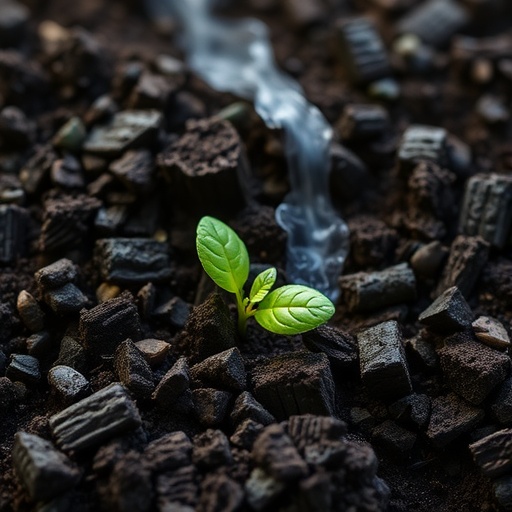
Antibiotic contamination in agricultural soils is increasingly recognized as a critical environmental issue, threatening soil health, crop productivity, and contributing to the global rise in antimicrobial resistance. A groundbreaking study, published in the forefront journal Biochar, unveils an innovative solution: an iron-modified biochar capable of exploiting soil’s intrinsic oxygen and iron redox chemistry to effectively degrade sulfamethoxazole (SMX), a widely prevalent antibiotic pollutant. This novel approach sidesteps reliance on harsh chemical oxidants, instead harnessing natural soil processes to achieve sustained, in situ remediation.
The research team engineered a functional biochar material, designated BC-Fe, using waste sawdust as the base feedstock. The preparation involved a meticulous sequence of pyrolysis, iron impregnation, and a secondary pyrolysis step, resulting in a highly active Fe-loaded biochar. Unlike traditional advanced oxidation processes that demand external chemical inputs, BC-Fe utilizes the molecular oxygen ubiquitously present in soils, catalyzing its activation through a sophisticated iron redox cycling mechanism. This activation leads to the generation of hydroxyl radicals, potent reactive oxygen species capable of decomposing complex organic contaminants including antibiotics.
Crucially, the standout variant named HBC-Fe400 emerged as the most efficacious catalyst, optimized in terms of iron content and the proportion of reduced iron species, Fe(II). Its unique structural and electronic properties enable it to serve simultaneously as an electron conduit—an “electron highway”—and a dynamic redox modulator. This dual functionality underpins a “charging and discharging” system where electrons are stored and transferred by the carbon matrix of biochar, while iron continually oscillates between Fe(II) and Fe(III) states. This cyclic interplay sustains long-lasting oxygen activation and continuous production of hydroxyl radicals, ensuring prolonged pollutant oxidation in soil environments.
Laboratory-scale soil incubation experiments revealed that HBC-Fe400 enhanced hydroxyl radical production by an extraordinary factor of 4.2, yielding concentrations as high as 881.6 micromolar. When tested under real-world field conditions, the biochar catalyst maintained a remarkable 3.58-fold increase in hydroxyl radical generation, underscoring its practical applicability outside controlled experimental settings. This resilience firmly establishes the material’s potential for scalable, long-term antibiotic remediation in agricultural soils.
The catalytic degradation of sulfamethoxazole proceeded through multiple intricate pathways, involving molecular transformations such as isoxazole ring opening, hydroxylation, and cleavage of the sulfur-nitrogen bond. These pathways collectively facilitate the breakdown of the complex antibiotic structure into less harmful intermediates. Importantly, toxicity assessments alongside germination and growth experiments with cherry radish plants confirmed that these degradation products are significantly less toxic, with treated soils supporting improved seed germination rates, greater fresh biomass, and enhanced stem growth compared to soils contaminated with untreated SMX.
Mechanistically, the system operates via two synergistic pathways. The first is a direct catalytic route where HBC-Fe400 activates oxygen through its iron centers. The second is indirect but equally vital: the biochar stimulates native microbial processes that drive soil iron cycling, particularly promoting microbial Fe(III) reduction, thereby maintaining a steady pool of Fe(II). This microbial-electrochemical collaboration fosters a self-reinforcing Fenton-like reaction that dramatically elevates oxidative degradation capacity in situ without requiring added chemicals.
This strategy heralds a significant advance in sustainable soil remediation technologies, positioning iron-modified biochar as a multifunctional remediation agent that integrates carbon material chemistry with biogeochemical cycling. By converting waste sawdust into a high-performance catalytic biochar, the approach embodies a circular economy model that valorizes agricultural residues for environmental cleanup applications, reducing reliance on expensive or environmentally detrimental chemical oxidants.
The research team emphasizes that the development of HBC-Fe400 exemplifies the broader potential of biochar materials to transcend their conventional roles as inert sorbents or soil amendments. With appropriate design, biochars can be engineered as active catalysts mediating electron transfer reactions and stimulating native soil microbial metabolism, thereby unlocking new degraded pathways for persistent organic pollutants such as antibiotics. This paradigm shift opens avenues for multifunctional soil conditioners that simultaneously improve soil health and pollutant cleansing efficacy.
Looking forward, the authors advocate for extensive field validation studies encompassing diverse soil types, climatic conditions, and agricultural practices to verify long-term stability and catalytic performance under variable real-world settings. Further investigations into the fate and ecotoxicology of the various transformation products formed during remediation will be critical to ensure environmental safety. Nonetheless, the present study lays a robust foundation for designing advanced iron-based biochar catalysts tailored for sustainable pharmaceutical pollution control.
By leveraging naturally abundant resources—oxygen and native iron cycling—and marrying them with engineered biochar platforms, this research proposes a low-impact, durable, and environmentally integrative methodology for soil antibiotic remediation. The innovative catalyst design unlocks the potential for broad implementation of Fenton-like advanced oxidation in agricultural lands, enhancing food safety, safeguarding soil ecosystems, and mitigating antibiotic resistance dissemination.
The results presented by Lei Zhang and colleagues emerge as a timely contribution to the growing focus on mitigating emerging contaminants with green materials. Their findings call for a reevaluation of biochar’s functional scope, suggesting a future where carbon-rich waste-derived catalysts become central players in environmental protection and sustainable agriculture, harnessing biogeochemical redox processes for cleaner, healthier soils.
This study thus represents a visionary step towards circular, nature-inspired solutions addressing the pressing global challenge of antibiotic pollution. With continued innovation and interdisciplinary collaboration, iron-modified biochar could soon be integral to a new generation of soil remediation technologies that empower farmers, conserve ecosystems, and promote safer crop production worldwide.
News Publication Date: 11-Mar-2026
Web References:
- Biochar journal: https://link.springer.com/journal/42773
- DOI link: http://dx.doi.org/10.1007/s42773-026-00585-0
References:
Du, H., Zhang, L., Liu, W. et al. In-situ and long-enduring oxidation of SMX by Fe-modified biochar activated O2 in soil: bridging Fe-redox cycling and electron transfer modulation. Biochar 8, 76 (2026).
Keywords
Iron redox cycling, biochar catalyst, sulfamethoxazole degradation, soil remediation, hydroxyl radical production, advanced oxidation, electron transfer, Fenton-like reaction, antibiotic pollution, soil health, microbial Fe(III) reduction, waste-to-remediation.
Cite Scienmag News
Denise Maddox. (June 3, 2026). Iron-Enhanced Biochar Transforms Soil Oxygen to Break Down Antibiotic Pollution. Scienmag. https://scienmag.com/iron-enhanced-biochar-transforms-soil-oxygen-to-break-down-antibiotic-pollution/
Denise Maddox. "Iron-Enhanced Biochar Transforms Soil Oxygen to Break Down Antibiotic Pollution." Scienmag, 3 June 2026, https://scienmag.com/iron-enhanced-biochar-transforms-soil-oxygen-to-break-down-antibiotic-pollution/. Accessed 4 September 2026.
Denise Maddox. "Iron-Enhanced Biochar Transforms Soil Oxygen to Break Down Antibiotic Pollution." Scienmag. June 3, 2026. https://scienmag.com/iron-enhanced-biochar-transforms-soil-oxygen-to-break-down-antibiotic-pollution/


