


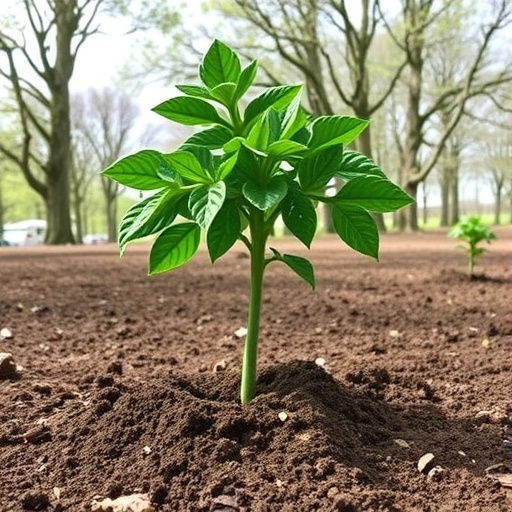
Forests have long been championed as a crucial natural solution to climate change, serving as vast reservoirs of carbon dioxide through the process of photosynthesis. Tree planting initiatives worldwide aim to leverage this natural ability by sequestering carbon not only in above-ground biomass, such as trunks and leaves, but also underground, where carbon can be stored long-term in forest soils. However, recent scientific findings led by researchers at the University of Stirling challenge the prevailing assumption that forest soils, particularly deep soils, consistently act as stable carbon sinks. This paradigm shift calls into question the efficacy of relying heavily on afforestation projects to mitigate greenhouse gas emissions when soil carbon dynamics are insufficiently considered.
Professor Jens-Arne Subke and colleagues, in collaboration with Dr. Thomas Parker of the James Hutton Institute, published a critical commentary in the journal Global Change Biology, dissecting evidence from a recent European study that assessed carbon stocks in beech forests across Central Europe. Their analysis elucidates that ignoring deep soil carbon measurements artificially inflates the perceived carbon sequestration benefits of forests. The commentary underscores a ubiquitous challenge in forest carbon accounting: below-ground carbon pools, especially those deeper within mineral soils, may exhibit significant carbon losses even as trees mature and accumulate biomass above ground.
This discovery is not isolated to deciduous beech ecosystems but echoes previous work by Subke’s team on non-native pine plantations in Scotland. Soil sampling from 16 sites where pines had been planted decades ago on land formerly under long-term grassland revealed a startling trend: soil carbon content diminished progressively with forest age. Critically, the carbon lost from forest soils accounted for roughly a third of the atmospheric carbon captured by tree biomass. This net carbon loss occurs despite forest growth, suggesting a decoupling between above-ground gains and below-ground carbon depletion, which complicates the narrative that tree planting unequivocally results in a net negative carbon balance in the atmosphere.
The implications of these findings extend to global afforestation campaigns, many of which incentivize landowners and policymakers to prioritize tree planting as a climate mitigation strategy. While trees undeniably provide myriad ecosystem services beyond carbon storage—such as biodiversity support, water regulation, and soil protection—the assumption that forest soils invariably act as enduring carbon reservoirs must be revisited. Subke’s research indicates that soil carbon stability diminishes beneath forests compared to prior grasslands, where carbon is more securely stored. This instability implies that soil organic matter may decompose and emit greenhouse gases over time, offsetting carbon sequestration achieved via photosynthesis.
Central to this emerging understanding is the concept of “carbon capital”—the aggregate amount of carbon stored in soils and ecosystems over extended periods. Although forests accumulate substantial carbon in living biomass, this does not guarantee a net positive carbon outcome if soils concurrently lose more carbon than is being sequestered above ground. The dynamic equilibrium between microbial decomposition, root turnover, soil chemistry, and environmental conditions determines whether soil carbon pools are replenished, stabilized, or lost. Factors such as soil texture, mineralogy, moisture regimes, and previous land use history critically influence these processes, yet remain insufficiently integrated into existing carbon accounting frameworks.
In their comprehensive soil assessments, the researchers employed advanced molecular and chemical analyses to quantify both carbon concentration and its molecular stability. Stability metrics provide insight into how resistant soil organic matter is to microbial breakdown, thereby predicting the longevity of carbon storage. The team’s findings were unequivocal: forest soils harbored carbon compounds more susceptible to degradation, signaling a potential temporal release of stored carbon that could exacerbate atmospheric CO2 concentrations. This refines our understanding of soil carbon beyond quantity towards quality—acknowledging that not all carbon is equally sequestered or permanent.
The geographic scope of this research, spanning Scottish Lowlands and Central European forests, highlights the pervasiveness of these processes across temperate regions. Yet, much remains to be elucidated concerning how these mechanisms operate in other biomes. The diversity of tree species, climatic conditions, and soil types interact in complex ways to mediate carbon dynamics. For example, root exudates from certain species may stimulate microbial activity leading to carbon mineralization, while others may promote humification and carbon stabilization. Therefore, nuanced, site-specific investigations are critical to inform effective land management and policy decisions.
Financial and regulatory incentives, including programs such as the Woodland Carbon Code, currently support forest planting as a climate mitigation measure. The new evidence presented by Subke and colleagues signals the urgent need for these schemes to incorporate potential soil carbon losses into their carbon budget models. Without accounting for below-ground carbon fluxes, carbon credits risk being overstated, undermining climate targets and potentially misguiding investment. Integrating soil carbon dynamics into forest carbon inventories demands refined methodologies, increased soil monitoring efforts, and perhaps reforms in the verification processes used to certify carbon offsets.
The complexity of forest-soil carbon relationships also presents a cautionary tale about the risks of treating forests as a simple panacea for climate change. Dr. Thomas Parker emphasizes that while forests remain indispensable for ecological and societal well-being, their capacity to sequester carbon long-term is neither linear nor guaranteed. Recognition of trade-offs, including possible unintended consequences such as soil carbon depletion, is vital to developing holistic strategies that maximize climate mitigation while preserving ecosystem health.
Experts advocating for continued research stress the importance of dissecting the myriad variables influencing soil carbon storage. Dr. Mike Perks of Forest Research highlights the necessity of understanding soil depth profiles, variations in soil texture, species-specific productivity, and root dynamics. Clarifying the ultimate fate of sequestered carbon—whether it remains in stable pools or returns to the atmosphere—is paramount to refining global carbon budget models. Multidisciplinary collaborations leveraging soil science, ecology, and climate modeling will be essential to unravel these complexities.
In conclusion, the narrative of forests as unequivocal carbon sinks demands revision in light of accumulating evidence demonstrating soil carbon vulnerability following afforestation. This evolving scientific knowledge calls for a paradigm shift in how climate mitigation policies and land use practices incorporate below-ground carbon dynamics. Tree planting remains a valuable tool in the climate response arsenal, but it must be complemented by a deep understanding of ecosystem carbon fluxes to ensure genuine net atmospheric carbon reductions over relevant timescales. Continued investigation will illuminate pathways to optimize forest management, ensuring that the carbon capital we invest in ecosystems indeed translates into enduring climate dividends.
News Publication Date: 30-Jan-2026
Web References:
References:
- Commentary by Professor Jens-Arne Subke and Dr. Thomas Parker, Global Change Biology, 2026.
Cite Scienmag News
Violet Maxwell. (February 10, 2026). Stirling Professor Warns: Soil Carbon Loss May Undermine Climate Benefits of Tree Planting. Scienmag. https://scienmag.com/stirling-professor-warns-soil-carbon-loss-may-undermine-climate-benefits-of-tree-planting/
Violet Maxwell. "Stirling Professor Warns: Soil Carbon Loss May Undermine Climate Benefits of Tree Planting." Scienmag, 10 February 2026, https://scienmag.com/stirling-professor-warns-soil-carbon-loss-may-undermine-climate-benefits-of-tree-planting/. Accessed 3 September 2026.
Violet Maxwell. "Stirling Professor Warns: Soil Carbon Loss May Undermine Climate Benefits of Tree Planting." Scienmag. February 10, 2026. https://scienmag.com/stirling-professor-warns-soil-carbon-loss-may-undermine-climate-benefits-of-tree-planting/


