


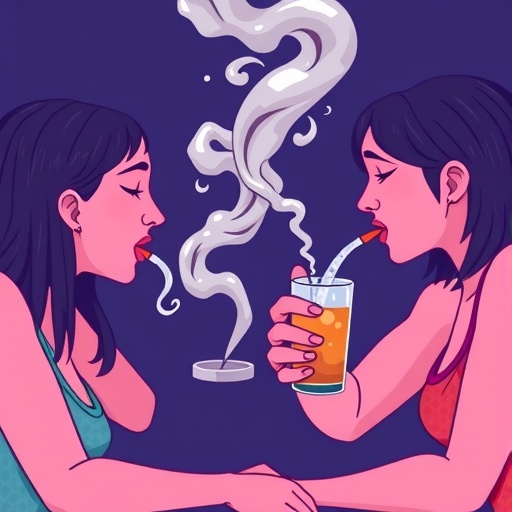
In an era shadowed by the enduring impacts of the COVID-19 pandemic, the complex interplay between stress, substance use, and sex differences has come under renewed scientific inquiry. A recent cross-sectional analysis of a nationally representative sample of U.S. adults, conducted by Cho, Pan, and Stallings-Smith, elucidates the nuanced associations between stress levels and two prevalent risk behaviors—heavy drinking and smoking—while factoring in sex and COVID-19 infection status. This multifaceted investigation, published in the International Journal of Mental Health and Addiction, offers groundbreaking insights that could reshape public health strategies aimed at mitigating substance abuse during ongoing and future public health crises.
Stress has long been recognized as a pivotal factor influencing health behaviors, with substantial evidence indicating its role in exacerbating tendencies toward alcohol and tobacco use. The COVID-19 pandemic has not only elevated baseline stress levels globally but has also introduced unique psychosocial stressors, including social isolation, economic uncertainty, and health anxieties. These unprecedented circumstances amplify the imperative to understand how stress contributes to harmful coping mechanisms, especially considering the differential effects across sex and infection status.
Cho and colleagues employed a robust methodological framework by analyzing data from a large, representative U.S. adult survey carried out during the pandemic. This approach allowed for a granular examination of stress levels and their correlation with heavy drinking and smoking habits, stratified by sex and whether individuals had contracted COVID-19. Stress was quantified through validated psychometric instruments, while substance use patterns were assessed via standardized self-report measures. Such comprehensive data collection adds rigor to the study’s conclusions.
The study reveals that elevated stress levels are significantly linked to increased odds of heavy drinking and smoking, reinforcing existing theories about stress-induced substance use. Intriguingly, the magnitude of this association varied markedly between men and women, underscoring the importance of sex-specific vulnerabilities and coping mechanisms. While stress correlated with heavy drinking in both sexes, the association was notably stronger in men, suggesting that male individuals may be more prone to escalate alcohol consumption as a maladaptive stress response.
Conversely, the relationship between stress and smoking demonstrated a contrasting pattern. Women exhibited a more pronounced link between high stress and smoking intensity, pointing to potential sex differences in nicotine’s role as an anxiolytic agent. This divergence between sexes is critical from a neurobiological perspective, suggesting that reward pathways and stress regulation circuits may respond differently to nicotine and alcohol depending on hormonal and psychosocial factors.
Moreover, the researchers unveiled compelling modifications in these behaviors contingent upon COVID-19 infection status. Individuals who had been infected displayed unique profiles in their stress-substance use relations. For example, infected men showed an intensified association between stress and heavy drinking relative to their non-infected counterparts, possibly reflecting heightened psychological distress following illness or quarantine experiences. Such findings implicate post-infection stress as a catalyst for exacerbated substance use, thereby compounding health risks in a vulnerable population.
Women with a history of COVID-19 infection, meanwhile, demonstrated increased stress-related smoking tendencies compared to uninfected women, suggesting that infection may amplify nicotine dependency or cravings under stress in this group. The biological aftermath of COVID-19, including systemic inflammation and neuropsychiatric sequelae, could mechanistically underlie these behavioral shifts. These data highlight the necessity for targeted interventions that consider the biological and psychosocial ramifications of COVID-19.
From a public health policy standpoint, this research underscores the need for differentiated approaches addressing substance use amid pandemic-induced stressors. Gender-sensitive interventions must be prioritized, recognizing that men and women might require tailored prevention and treatment strategies targeting alcohol and tobacco use, respectively. Furthermore, post-COVID care programs should integrate mental health support with substance use counseling to mitigate compounded risks.
The study’s reliance on cross-sectional data, while limiting causal inferences, nonetheless offers robust associative patterns that inform future longitudinal research. As ongoing waves of infection and evolving viral variants persist, continuous surveillance of substance use behaviors in relation to stress and infection status remains imperative. Understanding how acute and chronic stress responses to a global health crisis influence addiction pathways can guide preparedness for similar future events.
Importantly, this research contributes to a growing body of evidence emphasizing the biopsychosocial model of addiction. By integrating factors such as biological sex, infectious disease status, and psychological stress, the investigators present a multidimensional perspective that advances beyond one-size-fits-all paradigms. Such insights are invaluable for clinicians, epidemiologists, and policymakers seeking to curtail the intertwined epidemics of COVID-19 and substance misuse.
The findings also illuminate potential neuroendocrine mechanisms driving these sex-dependent behavioral variations. Hormones like estrogen and testosterone, known to modulate stress responses and addictive behaviors, may underlie the differential sensitivity to stress-induced alcohol and tobacco use. Investigating these pathways could lead to novel pharmacological interventions that are sex-specific and infection-sensitive.
Moreover, the social determinants of health cannot be overlooked when interpreting these results. Factors such as employment status, social support, and access to healthcare likely intersect with stress and substance use patterns, especially in the context of a pandemic. Future studies incorporating these variables can deepen the understanding of who is most at risk and why.
One particularly striking aspect of this research is its potential to inform digital health tools and telemedicine platforms designed to monitor and intervene in real time for stress-induced risky behaviors. As the pandemic has accelerated the adoption of remote health technologies, leveraging these findings can enhance personalized care that dynamically adjusts to an individual’s stress levels and COVID-19 history.
In conclusion, the study by Cho et al. offers a compelling, nuanced portrait of how stress intricately weaves into the fabric of heavy drinking and smoking behaviors amid the ongoing COVID-19 crisis. By highlighting the critical moderating roles of biological sex and infection status, this research charts a sophisticated roadmap for targeted interventions. As societies grapple with the dual legacies of the pandemic—the direct physiological impacts and the psychological aftermath—such evidence-based insights are crucial for fostering resilience and healthier coping mechanisms in vulnerable populations.
Cite Scienmag News
Ophelia Keating. (January 29, 2026). Stress, Drinking, Smoking: Sex and COVID Impact. Scienmag. https://scienmag.com/stress-drinking-smoking-sex-and-covid-impact/
Ophelia Keating. "Stress, Drinking, Smoking: Sex and COVID Impact." Scienmag, 29 January 2026, https://scienmag.com/stress-drinking-smoking-sex-and-covid-impact/. Accessed 4 September 2026.
Ophelia Keating. "Stress, Drinking, Smoking: Sex and COVID Impact." Scienmag. January 29, 2026. https://scienmag.com/stress-drinking-smoking-sex-and-covid-impact/


