


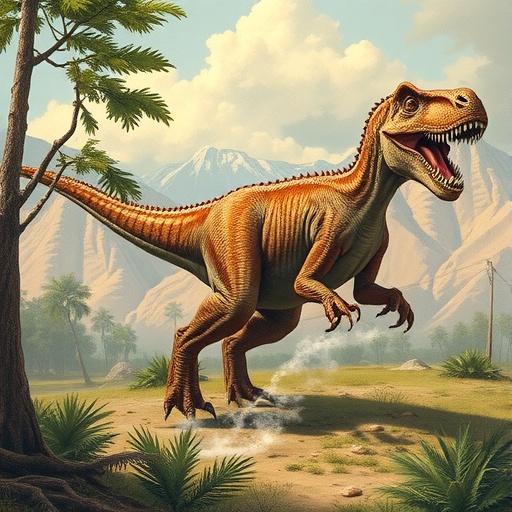
In a groundbreaking study published in Commun Earth Environ, researchers Chen, Niu, Ma, and their colleagues delve into the environmental conditions of the Triassic-Jurassic transition, a pivotal moment in Earth’s history that significantly influenced dinosaur evolution and dispersal. This research highlights the environmental instability that characterized the subtropical eastern Tethyan margin during this period, shedding light on the intricate connections between climatic changes, marine conditions, and terrestrial life. The authors meticulously analyze geological data to construct a narrative of how these environments shaped the life forms that thrived and migrated in response to shifting conditions.
The Triassic-Jurassic boundary, occurring approximately 201 million years ago, is recognized for its dramatic ecological transformations. Previous studies hinted at major global changes, but this new research presents a more nuanced understanding of the localized environmental phenomena influencing faunal distributions, particularly among dinosaurs. Chen and his team utilized sedimentological and paleontological evidence to describe the fluctuating marine and terrestrial ecosystems, which were crucial for understanding the spread of dinosaurs into new habitats.
One of the pivotal findings from this research is the instability of sea levels during the Triassic-Jurassic transition. The study reveals that fluctuations in marine environments were not merely a feature of the ocean but intertwined deeply with terrestrial ecosystems. These fluctuations likely created a mosaic of habitats that allowed low-latitude dinosaurs to disperse into different climatic zones, thereby enhancing biodiversity. Such findings underscore the importance of interdisciplinary approaches in paleontological research, blending sedimentology with geochemistry to produce a comprehensive view of past life.
The researchers employed advanced techniques to analyze sediment cores extracted from critical locations along the Tethyan margin. Their analyses indicated that periods of low sea levels corresponded with increased terrestrial habitat availability, which may have facilitated migrations of dinosaur species. This connection between marine regression and terrestrial expansion is a focal point of their discussions, suggesting that environmental cues were instrumental in guiding the top predators of this era to new territories.
In contrast to established theories that primarily attribute dinosaur dispersal to land-based factors, Chen et al. emphasize the role of marine environments in shaping evolutionary pathways. The study argues persuasively that understanding oceanic conditions is vital for a complete picture of how life adapted to and thrived in changing climates. Such innovative perspectives are critical in a field often reliant on surface-level interpretations of fossil records.
Moreover, the research details the climatic conditions prevalent during this transformative period. The team identified signs of increased atmospheric CO2 levels, which would have had profound implications for global climate patterns. It is well-documented that elevated CO2 levels can lead to warmer climates and altered precipitation patterns. These shifts likely impacted plant life significantly, resulting in changes to available food sources and, consequently, influencing the movement and habitation patterns of herbivorous dinosaurs and their predators.
In addition to these climatic insights, the article discusses the role of tectonic activities during the Triassic and Jurassic periods. The authors argue that the shifting plates and the resultant geological transformations contributed to the local environments that supported various species. By examining fossilized remains in tandem with geological data, the team pieced together a more cohesive timeline of ecological events and their potential impacts on biodiversity.
The implications of this research extend beyond the ancient world, informing modern conversations about climate change and its potential consequences on biodiversity. Identifying parallels between past and present can help scientists and policymakers alike to prepare for how contemporary climate shifts may affect ecosystems and species distributions today. Such forward-thinking perspectives are vital in a world grappling with rapid environmental changes and their myriad effects on life.
While this study makes significant contributions to understanding the past, it also raises crucial questions for future research. What additional factors might have influenced the dispersion of dinosaurs in other regions? How did interspecies interactions evolve in response to these shifting environments? Further investigations could offer even deeper insights into the resilience and adaptability of life amidst global changes, setting a foundation for ongoing research in the palaeobiological community.
The detailed methodologies applied in this research are also notable. The integration of multiple lines of evidence — including radiometric dating, isotopic analysis, and sedimentology — showcases the robustness of their approach. This multi-faceted viewpoint offers a template for future studies, encouraging researchers to draw connections across disciplines to comprehend complex historical narratives fully. Such cross-disciplinary collaboration is essential for advancing the frontiers of paleontological science.
In summary, the findings articulated by Chen et al. represent a significant leap in our understanding of the environmental variables that influenced the emergence and distribution of dinosaurs during the Triassic-Jurassic transition. Their work highlights the interconnectedness of marine and terrestrial systems, draws attention to the implications of past climate conditions, and calls for further exploration of the effects of geological dynamics. As the scientific community continues to unravel the mysteries of our planet’s history, studies like this illuminate the intricacies of life’s evolutionary path and underscore the importance of adaptive strategies in response to environmental instability.
By fortifying our comprehension of these ancient ecosystems, researchers are not just piecing together the puzzles of the distant past; they are also providing crucial insights into the present and future trajectories of life on Earth. This study is a testament to the power of scientific inquiry in unveiling the profound relationships that shape biodiversity through time.
Chen, J., Niu, YN., Ma, R. et al. Triassic–Jurassic environmental instability on the subtropical eastern Tethyan margin linked to low-latitude dinosaur dispersal.
Commun Earth Environ (2026). https://doi.org/10.1038/s43247-025-03083-6
Cite Scienmag News
Violet Maxwell. (January 13, 2026). Triassic–Jurassic Instability Spurs Low-Latitude Dinosaur Spread. Scienmag. https://scienmag.com/triassic-jurassic-instability-spurs-low-latitude-dinosaur-spread/
Violet Maxwell. "Triassic–Jurassic Instability Spurs Low-Latitude Dinosaur Spread." Scienmag, 13 January 2026, https://scienmag.com/triassic-jurassic-instability-spurs-low-latitude-dinosaur-spread/. Accessed 4 September 2026.
Violet Maxwell. "Triassic–Jurassic Instability Spurs Low-Latitude Dinosaur Spread." Scienmag. January 13, 2026. https://scienmag.com/triassic-jurassic-instability-spurs-low-latitude-dinosaur-spread/


