


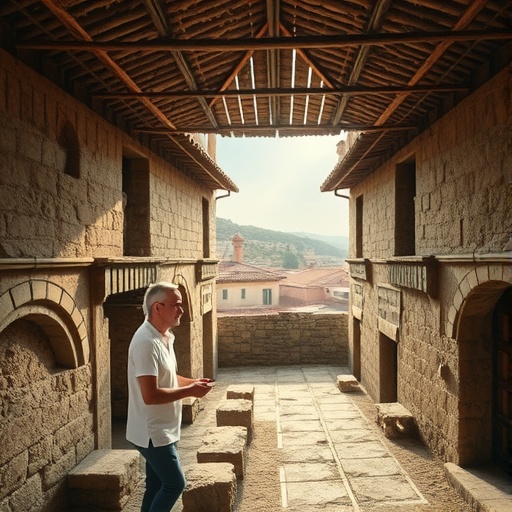
In a groundbreaking study published in the journal Archaeological and Anthropological Sciences, researchers have delved into the hidden facets of Etruscan urban life through meticulous micromorphological analysis. This research, led by an esteemed team including Marras, Marzullo, and Schmidt, unveils an intricate tapestry of daily existence in ancient Tarquinia, Central Italy, where urban infrastructure and ritual practices intermingled. The implications of their findings not only elucidate the sophisticated nature of Etruscan society but also demonstrate how micromorphology serves as a potent tool in archaeological investigations.
Micromorphology, a relatively contemporary technique in archaeological science, enables researchers to examine sediments and soils at a microscopic level. By studying thin sections of soil, scientists can reconstruct past human activities, behaviors, and environmental conditions with unprecedented precision. This study leveraged micromorphological methods to peel back the layers of time and reveal the physical evidence of Etruscan urban life. It affirms that interactions between inhabitants and their environment were far more complex than previously understood.
The significance of Tarquinia as a focal point for Etruscan culture cannot be overstated. Located in the Lazio region of Italy, this ancient city played a pivotal role in the political and economic landscapes of the Etruscan civilization. The researchers selected Tarquinia due to its rich archaeological heritage, which includes monumental tombs, urban structures, and evidence of social stratification. By focusing on specific sites within the city, the team aimed to document the interplay between daily life and ritual practices, thereby redefining our comprehension of Etruscan society.
One of the most compelling aspects of the research is its exploration of ritual spaces. The artifacts and architectural remnants unearthed during the excavation hint at elaborate ceremonial practices, suggesting that ritual life was deeply woven into the fabric of urban existence. The study employs micromorphological techniques to analyze the floors of these ritual spaces, revealing minute details such as residues from offerings and use-patterns that would otherwise go unnoticed. This nuanced understanding of ritual dynamics highlights the significance of these spaces not only as religious centers but as integral components of community life.
The researchers also examined urban infrastructure through their micromorphological lens. Streets, drainage systems, and public buildings all contributed to the daily rhythms of Etruscan life, serving not merely as functional spaces but as social and communal hubs. By analyzing sediment samples from these urban features, the team unearthed evidence of maintenance practices, waste management, and even the movement of goods and people. This intricate analysis provides an enriched view of how Etruscans interacted with their built environment and the implications these interactions had for urban organization and social hierarchy.
Understanding the environmental context of Tarquinia is critical to illustrating the relationship between the Etruscans and their landscape. The researchers meticulously documented the geological and environmental conditions, which influenced settlement patterns, agricultural practices, and resource management. By synthesizing this environmental data with their micromorphological findings, the researchers present a holistic view of Etruscan life, underscoring how dynamic interactions with the landscape shaped urban development and cultural practices.
Throughout the study, the authors emphasize the multivalent nature of archaeological interpretation. They argue that micromorphology, when coupled with traditional archaeological methods, offers a robust framework for understanding the complexities of ancient societies. This research invites further interdisciplinary collaboration, urging archaeologists, historians, and environmental scientists to work in concert to glean deeper insights from the archaeological record. By fostering such partnerships, the potential for unveiling new narratives from the past expands significantly.
The consequences of this research extend beyond academic circles; it sparks public interest in the Etruscan civilization and its rich cultural legacy. As the findings circulate, they have the potential to influence how we engage with ancient history. Educational institutions may incorporate these insights into curricula, while museums could develop exhibits that emphasize the holistic nature of Etruscan urban life, drawing connections between ancient practices and contemporary urbanization.
As the study of Etruscan culture continues to evolve, scholars are encouraged to adopt innovative methodologies that reveal previously hidden aspects of ancient life. The work conducted in Tarquinia stands as a testament to the value of integrating modern technological approaches within archaeological research. Moving forward, it serves as a guiding example for future studies, illuminating pathways to a more vibrant understanding of human history.
This research not only sheds light on the daily lives of Etruscans but also challenges prevailing narratives that often overlook the intricacies of urban life in ancient civilizations. By focusing on the intersections of life, ritual, and infrastructure, the authors of this study contribute significantly to our understanding of social dynamics in the Etruscan world, enriching the broader tapestry of human history.
In conclusion, Marras, Marzullo, Schmidt, and their team have revealed that beneath the surface of ancient Tarquinia lies a wealth of information about Etruscan urban life, infrastructure, and rituals. Their methodical application of micromorphology not only illuminates this ancient civilization but also sets a precedent for future archaeological research. By embracing these interdisciplinary approaches, scholars can unlock new dimensions of our past and deepen our appreciation for the complexities of ancient societies.
The rich findings from this study underscore the importance of ongoing research in exploring the intricate relationship between people and their environments throughout history. As we continue to journey into the depths of our collective past, the revelations from Tarquinia illustrate that every grain of soil tells a story—one that connects us with our ancestors in profound and transformative ways.
Cite Scienmag News
Courtney Benton. (December 10, 2025). Discovering Etruscan Urban Life Beneath Tarquinia’s Surface. Scienmag. https://scienmag.com/discovering-etruscan-urban-life-beneath-tarquinias-surface/
Courtney Benton. "Discovering Etruscan Urban Life Beneath Tarquinia’s Surface." Scienmag, 10 December 2025, https://scienmag.com/discovering-etruscan-urban-life-beneath-tarquinias-surface/. Accessed 3 September 2026.
Courtney Benton. "Discovering Etruscan Urban Life Beneath Tarquinia’s Surface." Scienmag. December 10, 2025. https://scienmag.com/discovering-etruscan-urban-life-beneath-tarquinias-surface/


