


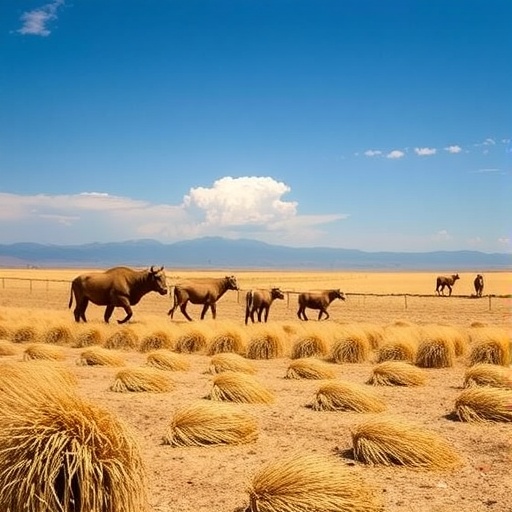
Across the central-eastern Eurasian Steppe, communities separated by thousands of kilometers appear to have changed what they ate at strikingly similar moments in history. A new study combining stable-isotope evidence from Xinjiang, Mongolia, Kazakhstan and neighboring regions reconstructs approximately 4,000 years of dietary change, revealing a broad shift from C3-based foods to greater millet consumption and then back toward C3 staples. The findings suggest that climate, expanding exchange networks, agricultural technology and social inequality jointly shaped food choices across one of the world’s largest cultural landscapes.
The research, led by Dr. Wei Wang of Nanjing University of Information Science and Technology and Professor Chengbang An of Fudan University, centers on the Baiyanghe cemetery in the northern foothills of the Tianshan Mountains in Xinjiang. The team analyzed carbon and nitrogen isotopes preserved in human and animal bones excavated from the cemetery, whose burials span the Late Bronze Age through the Tang Dynasty. By combining isotope measurements with radiocarbon dating, the researchers established a long-term record of what people consumed and how their diets changed across successive historical periods.
The study then placed the Baiyanghe results within a much larger regional framework. Nearly 1,500 previously published isotopic records were assembled from the Minusinsk Basin, the Altai Mountains, central Kazakhstan, southeastern Central Asia and central Mongolia. This extensive comparison allowed the researchers to distinguish local dietary variation from changes occurring across the steppe as a whole. Despite major differences in ecology, mobility, political organization and cultural traditions, populations in the six regions displayed a remarkably synchronized dietary trajectory.
The principal evidence came from carbon and nitrogen stable isotopes, chemical signatures that remain locked in bone collagen during an individual’s lifetime. Carbon isotope ratios, expressed as δ¹³C values, help identify the types of plants at the base of a food chain. C3 plants include wheat, barley and most temperate vegetation, while C4 plants include broomcorn millet and related crops. Because the isotopic signatures of these plants can pass through livestock and into human tissues, δ¹³C values can reveal whether people relied more heavily on C3 or C4 foods, even when ordinary food remains are scarce or poorly preserved.
Nitrogen isotopes, expressed as δ¹⁵N values, provide a different kind of information. They generally rise with each step up the food chain, meaning that consumers of animal protein often show higher values than the herbivores they eat. The researchers compared human δ¹⁵N measurements with those of sheep and goats, then used a typical trophic enrichment interval of approximately 3 to 6 parts per thousand to estimate the isotopic range associated with diets dominated by domesticated herbivores. This approach helped assess changes in animal-protein consumption while accounting for the ecological background of each region.
During the Bronze Age, roughly 5000 to 3000 years before the present, people across the central-eastern steppe appear to have relied predominantly on C3-based foods. These included wheat, barley and other C3 crops, together with meat and dairy products from domesticated herbivores such as sheep and goats. The picture changed dramatically between about 3000 and 2000 years before the present, corresponding broadly to the Early Iron Age through the Han Dynasty. Across several regions, δ¹³C values increased, indicating a substantial expansion of C4 foods, especially broomcorn millet. At the same time, elevated δ¹⁵N values suggest that animal protein also became more important in many communities.
The millet transition, however, was not equally intense everywhere. The Minusinsk Basin, southeastern Central Asia and the northern Tianshan Mountains emerged as high-intensity C4-use zones, where millet appears to have become a staple for much of the population. Central Kazakhstan, the Altai Mountains and central Mongolia showed more limited use. In these areas, millet may have been consumed primarily by elites or used in contexts where imported food carried social meaning. The evidence illustrates that a shared regional trend did not erase social distinctions: the same crop could function as everyday nourishment in one community and as a marker of prestige in another.
The Baiyanghe cemetery offers particularly suggestive evidence for the relationship between diet and status. Individuals buried with abundant grave goods or gold artifacts generally had higher δ¹⁵N values, consistent with greater access to animal protein. The pattern was not universal, and the researchers emphasize that social rank cannot be inferred from isotope values alone. Nevertheless, the association indicates that food inequality may have accompanied broader transformations in wealth, ritual display and political organization during the period when steppe societies were becoming more interconnected.
Between approximately 2000 and 1000 years before the present, during the Han-Tang era, millet consumption declined substantially and many populations shifted again toward C3-based staples. The researchers propose that the earlier move toward millet was supported by a warmer and more humid climate that encouraged movement and exchange among pastoralist and farming communities. The later reversal may have been linked to cooler, drier conditions as well as improved grain-processing technologies, which made C3 cereals more practical and attractive in changing economic environments. These explanations remain interpretations rather than direct proof of causation, but the alignment of climatic, archaeological and isotopic evidence provides a compelling framework for understanding the transition.
Published in Science China Earth Sciences, the study offers one of the most extensive reconstructions yet of dietary change across the central-eastern Eurasian Steppe. Its central message is that ancient food systems were neither static nor purely local. Climate fluctuations, crop dispersal, livestock economies, technological innovation and social hierarchy interacted across vast distances, producing dietary changes that were both regionally synchronized and locally distinctive. The findings show how the chemistry of human bones can transform scattered archaeological evidence into a continent-scale record of adaptation, exchange and inequality.
Web References: https://doi.org/10.1007/s11430-025-1861-y
References: Wang W, Duan F, Yan X, An C B. 2026. “Diachronic dietary evolution from the Bronze Age to the Tang Dynasty in the central-eastern Eurasian steppe revealed by stable isotopes of the Baiyanghe cemetery, Xinjiang.” Science China Earth Sciences, 69(6): 2102–2117.
Cite Scienmag News
Alan Morgan. (August 10, 2026). 4,000 Years of Steppe Diets: Climate, Mobility, and Milling Drove Millet-to-Wheat Shifts. Scienmag. https://scienmag.com/4000-years-of-steppe-diets-climate-mobility-and-milling-drove-millet-to-wheat-shifts/
Alan Morgan. "4,000 Years of Steppe Diets: Climate, Mobility, and Milling Drove Millet-to-Wheat Shifts." Scienmag, 10 August 2026, https://scienmag.com/4000-years-of-steppe-diets-climate-mobility-and-milling-drove-millet-to-wheat-shifts/. Accessed 3 September 2026.
Alan Morgan. "4,000 Years of Steppe Diets: Climate, Mobility, and Milling Drove Millet-to-Wheat Shifts." Scienmag. August 10, 2026. https://scienmag.com/4000-years-of-steppe-diets-climate-mobility-and-milling-drove-millet-to-wheat-shifts/


