


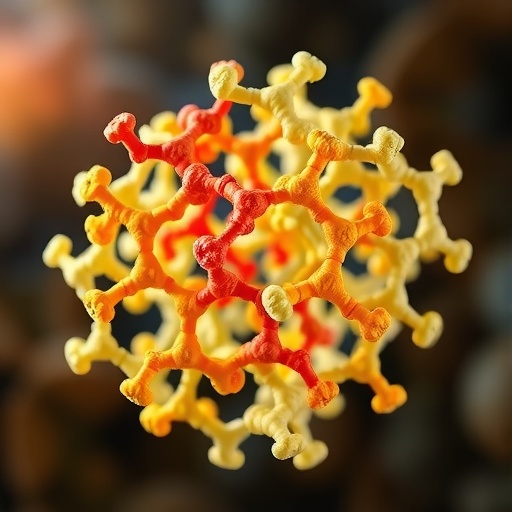
A groundbreaking study published in Nature unveils the intricate three-dimensional architecture of the Escherichia coli genome, shedding new light on the vital role of nucleoid-associated proteins (NAPs) in orchestrating spatial genome organization. Researchers led by Gavrilov et al. employed advanced Micro-C mapping techniques combined with targeted genetic knockouts to reveal how specific proteins sculpt the bacterial chromosome into discrete, functional domains.
Central to this investigation is the H-NS protein, a well-known transcriptional silencer and global regulator in E. coli. The deletion of the hns gene caused dramatic restructuring of the bacterial chromosome’s three-dimensional landscape, as the study reveals. Notably, contact hubs termed CHINs (Chromosomal Interaction Nodes) were largely dismantled or weakened, though intriguingly, some persisted or even intensified. These persistent CHINs showed increased spatial contacts in the absence of H-NS, suggesting complex regulatory compensations within the nucleoid.
To elucidate potential redundancy in genome organization, the researchers focused on StpA, a paralog of H-NS that shares structural and functional similarities. Remarkably, the double knockout of hns and stpA genes resulted in the complete disappearance of CHINs and another structural entity called CHIDs (Chromosomal Interaction Domains). In contrast, deletion of stpA alone had negligible effects, indicating that StpA plays a subsidiary but crucial backup role in maintaining higher-order genome folding when H-NS is absent.
Complementary experiments with other NAPs such as Fis and the chromosome-condensing MukBEF complex showed that their knockouts did not affect CHIN or CHID structures. These findings unequivocally position H-NS as the principal architect of these contact hubs, with StpA providing partial redundancy to safeguard genomic integrity at selective loci.
Intriguingly, chemical interference with nucleoid organization using netropsin—a drug known to disrupt H-NS and StpA binding to AT-rich DNA—mimicked the effects of the double hns stpA knockout. Treatment with netropsin led to a complete disassembly of CHINs and CHIDs, further corroborating the dependency of these spatial genome features on the binding activities of these key NAPs.
The study harnessed an elegant in vitro system to reconstitute CHIN-like structures by incubating plasmids harboring CHIN-forming DNA fragments with purified H-NS protein. Transmission electron microscopy revealed that these DNA–protein complexes formed looped and condensed domains reminiscent of in vivo CHINs, whereas control plasmids lacking CHIN DNA sequences failed to form such structures. This direct biochemical reconstitution adds a mechanistic layer of evidence for H-NS’s organizational role.
Beyond structural insights, the work underscores the functional consequences of disrupting nucleoid architecture. RNA sequencing after hns and stpA deletions uncovered widespread activation of horizontally transferred genes (HTGs), which are normally silenced by H-NS. The gene expression changes were statistically robust and specific to CHIN-associated HTGs, reinforcing the concept that H-NS-mediated genome compaction is intimately linked to transcriptional regulation.
Strikingly, double knockout strains exhibited even greater upregulation of HTGs than single hns mutants, illustrating the partial compensatory repression by StpA. This transcriptional awakening is likely tied to the loss of spatial genome constraints, demonstrating how three-dimensional genome organization can influence bacterial fitness and adaptive potential.
Micro-C contact maps of the regions harboring activated HTGs confirmed that chromosomal contact hubs dissolve in the absence of these nucleoid proteins, breaking spatial insulation and exposing previously silenced gene clusters. These patterns emphasize a mechanistic nexus where protein-mediated genome folding directly modulates gene accessibility and expression programs.
Physiological assays measuring growth rates revealed that the double hns stpA knockout strain experienced significant fitness defects, highlighting the biological importance of maintaining precise nucleoid architecture. While single deletions showed modest or no growth impairment, the combined loss of these key genome organizers severely compromised cellular proliferation.
The extensive data generated by Gavrilov and colleagues represent a paradigm shift in our understanding of bacterial chromosome biology. Instead of viewing the nucleoid as a mere linear structure, this research elevates it to a dynamic three-dimensional entity whose spatial organization is fundamental to gene regulation and genome stability.
These findings bear profound implications for the wider microbial genetics community, potentially informing antibiotic strategies targeting nucleoid architecture. By disrupting H-NS and StpA function, it may be possible to derepress virulence or metabolic genes, altering bacterial behavior in clinically relevant ways.
Ultimately, this study exemplifies the power of combining cutting-edge genomic technologies with classical genetics and biochemistry to unravel the physical principles underlying genome organization. As researchers continue to dissect the interdependence between structure and function in bacterial chromosomes, new avenues for manipulating microbial genomes can be envisioned.
The discovery that bacterial genomes are compartmentalized into contact hubs maintained by specific nucleoid-associated proteins not only challenges prior dogmas but also unites the field of genome biology under a common conceptual framework that spans all domains of life. This work leads the way toward a more integrated understanding of how cells spatially coordinate genetic information.
Cite Scienmag News
Juliet Wilcox. (August 13, 2025). 3D Structure of Active and Silent E. coli. Scienmag. https://scienmag.com/3d-structure-of-active-and-silent-e-coli/
Juliet Wilcox. "3D Structure of Active and Silent E. coli." Scienmag, 13 August 2025, https://scienmag.com/3d-structure-of-active-and-silent-e-coli/. Accessed 3 September 2026.
Juliet Wilcox. "3D Structure of Active and Silent E. coli." Scienmag. August 13, 2025. https://scienmag.com/3d-structure-of-active-and-silent-e-coli/


