


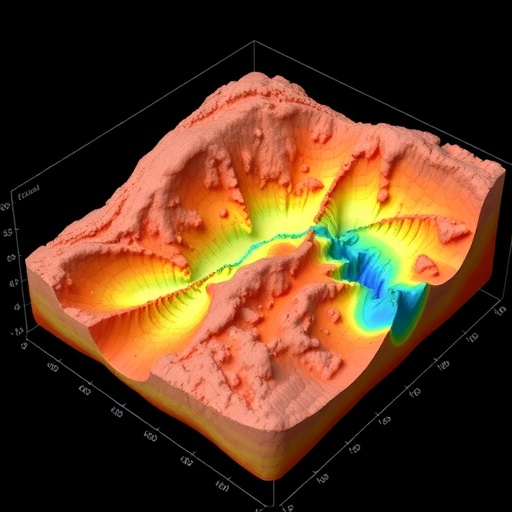
In the relentless quest to unravel Earth’s fiery past, scientists have now turned a groundbreaking page with the introduction of three-dimensional diffusion modeling to decode the complex histories embedded within magmatic crystals. The study, led by Mourey and Mutch and recently published in Nature Communications, pioneers a transformative approach that reconstructs the thermal and chemical evolution of magmatic systems with unprecedented depth and detail. This advancement promises to illuminate the intricate processes that shape volcanic activity, contributing pivotal insights into the dynamics of our planet’s inner workings.
Traditional methods of interpreting magmatic histories often rely on two-dimensional analyses of crystal zoning patterns—essentially reading chemical maps etched into minerals. While valuable, these approaches have inherent limitations in resolving the true complexity of crystal growth and diffusion. Magmatic systems are dynamic environments where temperature, pressure, and chemical gradients evolve in a three-dimensional space, leading to complex zoning patterns that two-dimensional slices cannot fully capture. Mourey and Mutch’s innovation capitalizes on recent computational advances to model diffusion processes in three dimensions, thereby unlocking a fuller narrative written in the crystal fabric.
Diffusion, a process where atoms move from regions of high concentration to low concentration, is pivotal in recording the evolving conditions inside magma chambers. As crystals grow and are subjected to changing temperatures and chemistries, elements diffuse within their structures, blurring initial zoning patterns over time. By accurately modeling this diffusion in a three-dimensional framework, the researchers can reverse-engineer these blurred signals to recover time-resolved records of magmatic evolution with remarkable fidelity. This opens the door to retracing the sequence, duration, and intensity of magmatic events that shape volcanic eruptions.
At the heart of this approach lies sophisticated numerical simulation, integrating physics-based diffusion equations with realistic crystal geometries reconstructed from advanced imaging techniques such as X-ray tomography. This allows for a precise 3D map of chemical distributions within crystals to inform the models. The novelty of incorporating complex crystal morphologies into the simulation enables a much more realistic representation of diffusion pathways, capturing subtle concentration gradients that would otherwise be misinterpreted in conventional 2D analyses. These simulations provide estimates of the time elapsed since specific zoning features formed, effectively creating a temporal map of magmatic processes frozen in crystal structures.
The implications of reconstructing magmatic histories in three dimensions are vast. Volcanologists gain a powerful new window into understanding pre-eruptive magma dynamics, including magma recharge rates, mixing events, and thermal histories. These processes critically control eruptive behaviors and hazards, and hence, such refined reconstructions have the potential to improve eruption forecasting. Furthermore, the method enhances our ability to interpret historic eruptions preserved in volcanic rock records, providing fundamental constraints on the lifespan and evolution of magma reservoirs that fuel explosive volcanism.
In particular, the study delineates how complex zoning in phenocrysts—large crystals grown in magma—can be deciphered with higher accuracy, revealing multi-stage magmatic episodes over timescales from years to millennia. These insights challenge previously held models that often treated magma chambers as homogenous or simplified entities and underscore the heterogeneous, dynamic nature of volcanic systems. By capturing the interplay of thermal and chemical gradients over time in three dimensions, this technique reshapes our understanding of magmatic evolution in a profoundly detailed manner.
The methodology requires high-resolution chemical and structural data to feed the models, achieved through cutting-edge microanalytical tools like electron microprobes and laser ablation ICP-MS (Inductively Coupled Plasma Mass Spectrometry), combined with non-destructive imaging modalities. These datasets form the backbone for precise model calibration and validation. Importantly, the computational framework is adaptable to a broad spectrum of crystal chemistries and geological settings, making it universally applicable across volcanoes worldwide.
Beyond its immediate volcanological applications, the advancement enriches broader geological and planetary sciences. Since crystal diffusion processes operate under universal physical principles, the three-dimensional modeling approach can be extended to interpret the history of magmatic systems on the Moon, Mars, and meteorites. This cross-disciplinary potential positions the method as a vital tool in comparative planetology, helping decode magmatic phenomena throughout the solar system and deepen our understanding of planetary differentiation processes.
This study also addresses the inherent challenges in disentangling overlapping diffusion profiles that represent multiple episodes of magmatic activity. Traditional techniques struggled to resolve closely spaced events because they were limited to planar slices of chemical zoning. The 3D model’s capacity to simulate diffusion through irregular crystal shapes allows clearer separation and temporal ordering of complex growth and alteration histories, thereby providing a more nuanced picture of how magmas evolve over time.
Crucial to the success of this approach is the integration of petrological theory with computational science. The researchers iteratively refined the model parameters by aligning simulated diffusion profiles with empirical data from natural samples. This iterative calibration ensures that the model accurately reflects physical realities rather than relying on oversimplified assumptions. The result is a robust, empirically grounded framework that can confidently reconstruct magmatic timelines and thermal histories across varied geological contexts.
Moreover, this innovation arrives at a time when volcanic risk mitigation is becoming increasingly critical. Many densely populated regions sit atop active volcanic systems whose internal magma dynamics are still poorly resolved. By enhancing our capability to interpret the evidence preserved in magmatic crystals, this 3D diffusion modeling approach could transform monitoring strategies and emergency preparedness, potentially allowing for earlier and more reliable prediction of volcanic unrest and eruption onset.
In terms of future directions, the researchers anticipate incorporating additional physical processes into their models, such as crystal dissolution and resorption, or fluid infiltration, which also impact chemical zoning signatures. These expansions would build increasingly comprehensive models of crystal growth and alteration, further refining reconstructions of magmatic evolution. Coupled with advances in machine learning and high-performance computing, these models may soon achieve real-time analysis capabilities for monitoring active volcanic systems in situ.
By marrying detailed petrological observations with state-of-the-art computational methodologies, Mourey and Mutch’s work exemplifies the new frontier in volcanic science. This synthesis not only deepens fundamental understanding but also enhances practical applications in hazard assessment and planetary exploration. As the method gains traction and evolves, it stands to fundamentally reshape how geoscientists decode the cryptic messages encrypted within the crystalline record of Earth’s fiery underworld.
In essence, this cutting-edge three-dimensional diffusion modeling technique transcends mere academic curiosity. It represents a transformative paradigm shift, equipping researchers with a powerful lens to observe the subtle, intricate evolution of magmatic systems through time and space. Such advancements forge a path toward more predictive models of volcanic activity, safeguarding lives and advancing knowledge about the dynamic processes that govern our planet and others in the cosmos.
Cite Scienmag News
Violet Maxwell. (May 3, 2026). 3D Diffusion Modeling Reveals Magmatic Histories. Scienmag. https://scienmag.com/3d-diffusion-modeling-reveals-magmatic-histories/
Violet Maxwell. "3D Diffusion Modeling Reveals Magmatic Histories." Scienmag, 3 May 2026, https://scienmag.com/3d-diffusion-modeling-reveals-magmatic-histories/. Accessed 5 September 2026.
Violet Maxwell. "3D Diffusion Modeling Reveals Magmatic Histories." Scienmag. May 3, 2026. https://scienmag.com/3d-diffusion-modeling-reveals-magmatic-histories/


