


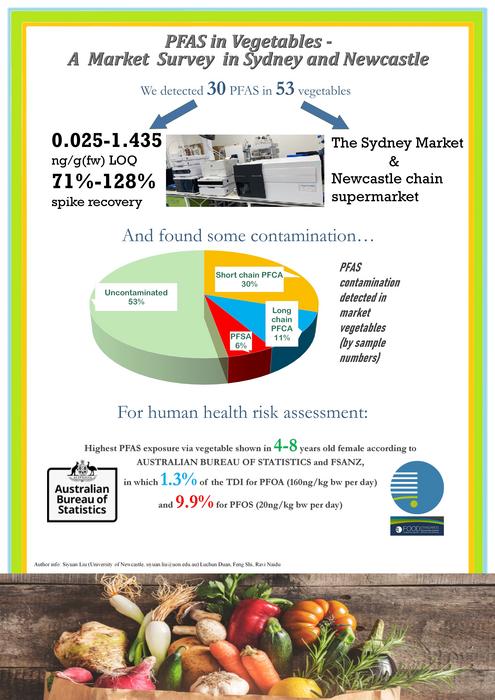
Researchers have revealed the presence of per- and polyfluoroalkyl substances (PFASs) in vegetables from Sydney and Newcastle in Australia. The research, published in SCI’s Journal of the Science of Food and Agriculture, addresses a critical gap in our understanding of PFAS contamination in vegetables and its potential implications for human health.

Credit: Global Centre for Environmental Remediation (GCER), University of Newcastle, Callaghan, New South Wales, Australia
Researchers have revealed the presence of per- and polyfluoroalkyl substances (PFASs) in vegetables from Sydney and Newcastle in Australia. The research, published in SCI’s Journal of the Science of Food and Agriculture, addresses a critical gap in our understanding of PFAS contamination in vegetables and its potential implications for human health.
PFASs are a group of synthetic chemicals which are widely used in industrial and agricultural production, from pesticide synthesis to textiles and food packaging. Often referred to as “forever chemicals”, they can persist in the environment for over 1,000 years. Environmental accumulation of PFASs is a concern as research has shown them to be highly toxic to both humans and wildlife, with increased cancer risks among health concerns.
Ravi Naidu, Director of the University of Newcastle’s Global Centre for Environmental Remediation and co-author of the study, explained the reasoning behind investigating PFAS exposure from vegetable consumption. ‘This research was conducted given the limited number of studies on the PFAS exposure pathway connecting food, in this case, vegetables, to humans. The study was initiated at least three years ago when the focus on PFAS contamination was primarily on water. It is now well-recognised that food, especially vegetables, could be another exposure pathway,’ he said.
The study analysed 53 fruit and vegetable samples sourced from local wholesale and retail markets in Sydney and a supermarket in Newcastle. Using solid phase extraction and liquid chromatography–tandem mass spectrometry techniques, the team measured the concentrations of 30 different PFASs, including perfluorooctanoic acid (PFOA), perfluorooctane sulfonate (PFOS) and perfluorohexanesulfonic acid (PFHxS).
Key Findings:
- PFOA Presence: Detected in 7 out of 53 samples, with concentrations ranging from 0.038 to 1.996 ng/g fresh weight.
- PFOS Presence: Detected in 2 samples, with concentrations ranging from 0.132 to 0.911 ng/g fresh weight.
- PFHxS: Not detected in any sample.
Discussing the impact to human health, the authors noted, ‘consumption of the vegetables from the study locations poses a marginal risk to human health’.
‘Based on data from the Australian Bureau of Statistics and Food Safety Australia New Zealand, current vegetable intake does not meet the risk threshold. Based solely on the per capita vegetable intake in Australia, the health risk from PFAS intake is probably no greater than the health risk from insufficient vegetable intake. That said, people who are vegetarians would be more exposed than those who ingest a mixture of meat/fish and vegetables,’ explained Naidu.
The study identified the demographic most sensitive to PFAS concentrations of the level identified in vegetables to be girls aged 4-8. Luchun Duan, a researcher at the University of Newcastle’s Global Centre for Environmental Remediation, explained, ‘vulnerability in this group is primarily due to lower body mass index and relatively higher intake. Even the 4-8 years age group girls take only 9.9% of the PFOS tolerable daily intake, which would not exceed the threshold value in recommended vegetable daily intake.’
Discussing the potential sources of PFAS contamination in vegetables, Duan identified plant uptake during cultivation – potentially from water, soil, or atmospheric deposition – as the most likely contributor. The team also analysed the vegetable packaging as a possible source but found little evidence to suggest that PFASs migrate from packaging to food.
The persistence and prevalence of PFASs means there is much more research to be done to ascertain their impact. Naidu and the team are now turning their attention to biosolids – a product of wastewater treatment processes which is added to soils as a fertiliser. The disposal of PFAS containing products on both an industrial and residential scale can cause the contamination of wastewater resulting in the presence of PFASs in biosolids.
‘In this study, we are focussing on different plant species and investigating both PFAS and mico-nanoplastic uptake to better understand PFAS dynamics and mitigation strategies,’ said Naidu.
Journal
Journal of the Science of Food and Agriculture
Article Title
Concentrations of per- and polyfluoroalkyl substances in vegetables from Sydney and Newcastle, Australia
COI Statement
The authors declare that there is no conflict of interest.
Cite Scienmag News
Bethany Barker. (May 23, 2024). Young girls most sensitive to PFAS “forever chemicals” found in Australian vegetables. Scienmag. https://scienmag.com/young-girls-most-sensitive-to-pfas-forever-chemicals-found-in-australian-vegetables/
Bethany Barker. "Young girls most sensitive to PFAS “forever chemicals” found in Australian vegetables." Scienmag, 23 May 2024, https://scienmag.com/young-girls-most-sensitive-to-pfas-forever-chemicals-found-in-australian-vegetables/. Accessed 5 September 2026.
Bethany Barker. "Young girls most sensitive to PFAS “forever chemicals” found in Australian vegetables." Scienmag. May 23, 2024. https://scienmag.com/young-girls-most-sensitive-to-pfas-forever-chemicals-found-in-australian-vegetables/

