Chemists and biotechnologists have long had to take a winding, three-step route to obtain acetylated sophorolipid esters, a class of glycolipids prized for both their surface-active and bioactive properties. First, microbes produce the sophorolipid lactone; then chemical transesterification attaches the desired alcohol; finally, an enzymatic re-acetylation restores the acetyl groups on the sugar head group. A new study now shows that this entire sequence can be collapsed into a single fermentation. By feeding glucose, oleic acid and a wide variety of alcohols simultaneously to the yeast Starmerella bombicola, researchers produced acetylated sophorolipid esters directly in the culture broth, avoiding the post-fermentation chemistry altogether.
The work, published in AMB Express by Eugen Banmann, Enes Medet Aksoy and Ulrich Schörken, systematically mapped how alcohol structure governs both toxicity and product formation. In shake-flask cultures, straight-chain primary alcohols with chain lengths from C3 to C12, such as propanol, butanol, hexanol, octanol, decanol and dodecanol, severely impaired sophorolipid production when added at 150 millimolar. In contrast, the toxicity of short-chain primary, secondary and branched-chain alcohols was significantly lower. Methanol and ethanol proved remarkably benign, and long-chain fatty alcohols of C16 and C18 were also well tolerated, with total sophorolipid production reaching around 60 grams per liter in the initial shake-flask screening, comparable to reference cultivations without alcohol supplementation.
The authors note that their toxicity measurements describe the impairment of metabolic activity in resting, sophorolipid-producing cells, because alcohol dosing began only at the onset of sophorolipid production. The pattern of inhibition appears tied to hydrophobicity: the bilayer-modifying potency of n-alcohols scales with their octanol/water partition coefficient up to a cut-off chain length, and branching or an internal hydroxyl group lowers that coefficient relative to the linear isomer. At equal carbon number, secondary and branched alcohols were less inhibitory than their linear counterparts. Isopropanol and the C4 alcohols were well tolerated, matching the reference titer of roughly 60 grams per liter, while toxicity still rose with chain length within the branched group, with 2-ethyl-1-hexanol showing the strongest inhibition. The lower toxicity of the longest alcohols is attributed to their limited solubility, which keeps them from reaching inhibitory concentrations.
Analysis of the fermentation broth by HPLC with evaporative light-scattering detection and by liquid chromatography–mass spectrometry revealed that, besides lactonic, acidic and bolaform sophorolipids, acetylated sophorolipid esters appeared in small quantities under initial conditions. To verify the ester structures, the team purified individual congeners by flash chromatography and characterized them by nuclear magnetic resonance spectroscopy. The spectra showed that the lactone ring had opened upon esterification: a signal corresponding to the 4″-hydroxyl group, absent only in the lactonic form, was present in the ester, and the ester linkage was localized by long-range correlations between the protons adjacent to the alcohol’s hydroxyl group and the first carbon of the fatty acid. Additional signals confirmed the alkyl head group of each ester.
Because the initial ester-to-lactone ratios were low, the researchers optimized the process. Raising the yeast extract concentration in the production medium from 1 to 3 grams per liter increased biomass and accelerated the production rate, with sophorolipid titers reaching 20 to 40 grams per liter after three days instead of the seven to ten days previously required. Alcohol feeding then became the key lever. With methanol feeding rates of up to 800 millimolar per day, ester fractions of 52 percent were achieved, and ethanol feeding at 500 millimolar per day yielded 47 percent. Higher feeding rates shifted the product spectrum toward esters but reduced total titers, from 109 down to 40 grams per liter for methanol and from 76 down to 62 grams per liter for ethanol, illustrating the trade-off between ester share and overall productivity.
Secondary and branched alcohols also entered the product spectrum. All secondary and branched-chain alcohols tested were incorporated into sophorolipid esters, whereas tertiary alcohols were not accepted as substrates, a selectivity the authors interpret as indirect evidence for the enzyme involved. The isobutyl ester was confirmed by NMR after purification, and optimization with isopropanol and isobutanol identified suitable feeding rates of 200 and 75 millimolar per day, respectively, balancing ester fraction against total titer. With isobutanol a maximum ester fraction of 45 percent was achieved, compared with 36 percent for isopropanol, although pushing feeding rates higher cut total sophorolipid formation dramatically, from about 68 to 12 grams per liter for isopropanol and from 94 to 17 grams per liter for isobutanol.
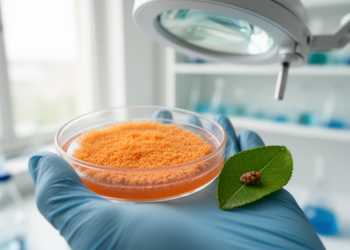
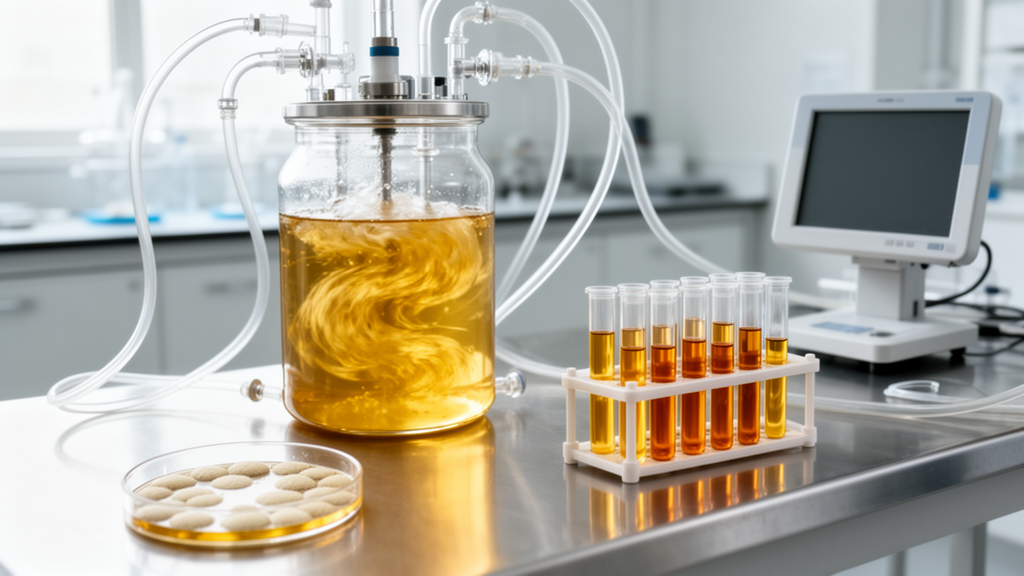
The process was then scaled up. In a 2-liter bioreactor operated for 14 days with isopropanol fed at 200 millimolar per day, the total sophorolipid titer reached nearly 100 grams per liter, a two-fold increase over the shake-flask cultures, and the isopropyl ester accounted for 30 percent of all sophorolipid species, corresponding to 47 percent when only lactonic sophorolipids and the isopropyl ester are considered. That equates to about 60 grams of sophorolipid isopropyl ester in the fermentation volume. The crude product formed a separate heavy phase that could be withdrawn gravimetrically, resembling the crude product of a conventional sophorolipid lactone fermentation, which suggests that established downstream procedures could be applied at industrial scale. After flash chromatography and crystallization from acetone and hexane, the individual esters were obtained as odorless white crystalline solids.
To determine whether ester formation is a general capability of the Starmerella clade, the team screened five additional species: S. batistae, S. caucasica, S. davenportii, S. riodocensis and S. kuoi. Sophorolipid synthesis was demonstrated for the first time in S. caucasica and S. davenportii, which had not been verified as sophorolipid producers before. All six species produced sophorolipid esters when fed methanol, ethanol, isopropanol or isobutanol, although with varying confidence: the methyl and ethyl ester assignments for S. riodocensis were close to baseline and regarded as tentative, S. batistae showed no signal above baseline for the isopropyl ester, and S. davenportii gave a clear peak only for the methyl ester. Notably, ester formation occurred even in S. kuoi and S. batistae, which produce open-chain sophorolipids via ω-hydroxylated fatty acids, indicating that lactone formation is not a prerequisite and that the ability for sophorolipid ester synthesis appears to be widespread among sophorolipid-producing Starmerella strains.
Sequence and structural analyses added mechanistic texture. Differences in chromatographic retention between species reflected the known ω versus ω-1 hydroxylation preferences, verified by NMR of esters from S. bombicola and S. kuoi. The authors consider it most probable that the lactone transesterase SBLE, which shares features with lipases and was recently shown to catalyze transesterification of bolaform sophorolipids, also catalyzes the reaction with alcohols, although a direct proof is still needed and a minor contribution of lactone alcoholysis cannot be excluded. Intriguingly, no close SBLE homolog could be identified in the genome of S. davenportii, and the finding that only its methyl ester was detected points to a different enzyme being responsible there. The feeding strategy also explains why earlier attempts using fatty acid esters such as biodiesel largely failed: supplying the alcohol as a separate feed component decouples it from the lipid substrate and makes it an independent process variable. Given that acetylated sophorolipid esters have shown promising surface-active properties and, in prior studies, anticancer activity against human pancreatic and breast cancer cells as well as antimicrobial activity against Bacillus cereus, direct microbial access to this compound class opens a practical route to a broader sophorolipid product portfolio.
Subject of Research: Direct microbial synthesis of short-chain acetylated sophorolipid esters by Starmerella yeasts using three-component feeding of glucose, oleic acid and alcohols.
Article Title: Microbial synthesis of short-chain sophorolipid esters using yeasts of the Starmerella clade
Article References: Banmann, E., Aksoy, E. M., & Schörken, U. (2026). Microbial synthesis of short-chain sophorolipid esters using yeasts of the Starmerella clade. AMB Express, 16(1), Article 103. https://doi.org/10.1186/s13568-026-02130-5
Image Credits: AI Generated
DOI: 10.1186/s13568-026-02130-5
Keywords: sophorolipids, biosurfactants, Starmerella bombicola, microbial fermentation, glycolipids, alcohol feeding, biotransformation, Starmerella clade, bioreactor scale-up, transesterification, yeast biotechnology, Microbial
Cite Scienmag News
Gregory Coleman. (October 27, 2026). Yeasts brew short-chain sophorolipid esters directly in one fermentation step. Scienmag. https://scienmag.com/yeasts-brew-short-chain-sophorolipid-esters-directly-in-one-fermentation-step/
Gregory Coleman. "Yeasts brew short-chain sophorolipid esters directly in one fermentation step." Scienmag, 27 October 2026, https://scienmag.com/yeasts-brew-short-chain-sophorolipid-esters-directly-in-one-fermentation-step/. Accessed 28 October 2026.
Gregory Coleman. "Yeasts brew short-chain sophorolipid esters directly in one fermentation step." Scienmag. October 27, 2026. https://scienmag.com/yeasts-brew-short-chain-sophorolipid-esters-directly-in-one-fermentation-step/