


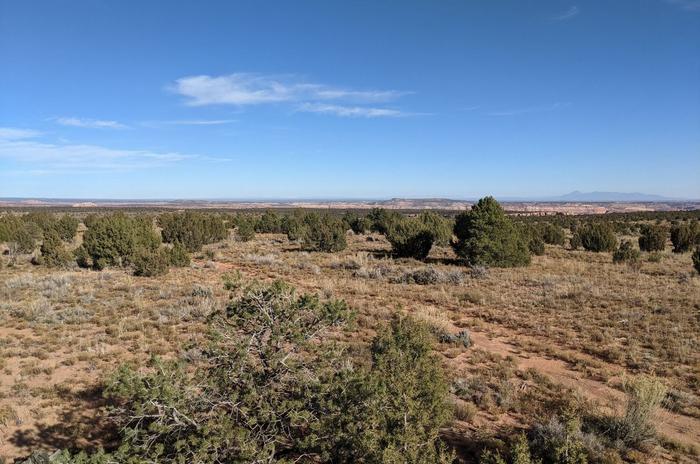
Drylands in the western United States are currently in the grips of a 23-year “megadrought,” and one West Virginia University researcher is working to gain a better understanding of this extreme climate event.

Credit: WVU Photo
Drylands in the western United States are currently in the grips of a 23-year “megadrought,” and one West Virginia University researcher is working to gain a better understanding of this extreme climate event.
Steve Kannenberg, assistant professor of biology at the WVU Eberly College of Arts and Sciences, is using observations from existing networks of scientific instrument stations across the region to inch toward that goal.
The megadrought is an ongoing climate crisis for natural ecosystems, agricultural systems and human water resources, but researchers have a limited understanding of the phenomenon.
With joint National Science Foundation funding from Ecosystem Science Cluster and the Established Program to Stimulate Competitive Research, commonly known as EPSCoR, Kannenberg is seeking to identify where this drought has been most severe.
Data should reveal where the conditions have depleted groundwater and soil moisture and identify which dryland plants have been most affected.
The term “drylands” refers to areas where water availability limits the health of ecosystems.
“In West Virginia, we have plenty of water,” he said. “But, if you go out to Utah, for example, it’s very hot, very dry. And the health of the vegetation is determined by how much water is in the soil and how much water is in the air.”
Data on the west’s climatological history can be obtained by studying tree growth rings in drylands. Using tree rings, researchers have found the current 23-year drought period is the most severe over the last 1,200 years. Kannenberg will pair tree ring data with measurements of soil moisture, groundwater and ecosystem fluxes via eddy covariance flux towers.
“These are, essentially, fancy weather stations that can sense the ecosystem breathing,” he said. “It can quantify how much carbon is going into the vegetation from the atmosphere as plants photosynthesize during the day, and likewise, how much carbon is breathed out back into the atmosphere at night, because ecosystems respire like we do.”
The towers can also measure how much water is coming in via rain, how much goes out through plants to the atmosphere and how much evaporates from the soil surface.
Globally, megadroughts are projected to increase in frequency and severity in the coming decades, and Kannenberg’s synthesized data may help inform researchers about other dryland and non-dryland biomes.
He’s also focused on carbon capture. The photosynthetic rate of the vegetation across drylands affects their ability to store carbon, but trees can only photosynthesize when there’s sufficient water available. This process is fairly consistent in eastern forests, but difficult to predict in drylands.
“If you think of a forest here in West Virginia, there’s obviously a lot of carbon stored in the vegetation,” he said. “This makes it a very important carbon sink, globally. It’s easy for scientists to predict how much carbon gets taken up by these trees every year because we know that the environment during the spring, summer and fall is pretty conducive to photosynthesis.”
However, with far less vegetation in western landscapes, less carbon is stored in drylands. Water availability is inconsistent and unpredictable, and the amount of carbon western vegetation can take up each year varies significantly. In drought years, little carbon may be absorbed at all.
“Studies show dryland ecosystems in particular are really important for determining how much carbon gets taken up by the whole Earth’s surface globally,” Kannenberg said. “Not because they take up a ton of carbon, but because they’re so inconsistent over time. Understanding photosynthesis and carbon storage in these dryland ecosystems is important, even though it might not look like there’s a ton of carbon stored in the vegetation on the landscape.”
Kannenberg said there are various management actions available to help mitigate some of the current impacts and prepare for those to come, because as the planet gets hotter, the atmosphere gets drier. In many regions, like the southwestern U.S., which are already very dry, feedback loops warm the air and dry the atmosphere, which in turn will accelerate future drought events.
“Historically, megadroughts are a rare, rare thing,” he said. “But there have been a number of them throughout time, and they’re going to get more frequent and more severe in the future.”
Cite Scienmag News
Bethany Barker. (April 17, 2024). WVU researcher studying worst western US megadrought in 1,200 years. Scienmag. https://scienmag.com/wvu-researcher-studying-worst-western-us-megadrought-in-1200-years/
Bethany Barker. "WVU researcher studying worst western US megadrought in 1,200 years." Scienmag, 17 April 2024, https://scienmag.com/wvu-researcher-studying-worst-western-us-megadrought-in-1200-years/. Accessed 5 September 2026.
Bethany Barker. "WVU researcher studying worst western US megadrought in 1,200 years." Scienmag. April 17, 2024. https://scienmag.com/wvu-researcher-studying-worst-western-us-megadrought-in-1200-years/

