


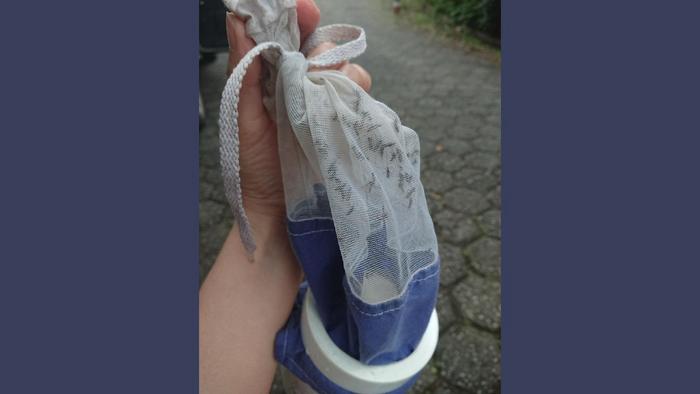
The technology used to sequence SARS-CoV-2 at record speed early in the COVID-19 pandemic has been successfully tested as a technique to monitor arboviruses and diseases transmitted mainly by mosquitoes.

Credit: Lilian de Oliveira Guimarães/Instituto Pasteur
The technology used to sequence SARS-CoV-2 at record speed early in the COVID-19 pandemic has been successfully tested as a technique to monitor arboviruses and diseases transmitted mainly by mosquitoes.
In an article published in the journal Microbiology Society, researchers affiliated with Pasteur Institute in São Paulo, Brazil, and the University of São Paulo (USP), in collaboration with colleagues at the University of Birmingham in the United Kingdom, describe the use of the technology to sequence viral RNA and DNA from blood-engorged mosquitoes collected in São Paulo city with the aim of finding out how arboviruses circulate as a basis for predicting future outbreaks of dengue, zika, chikungunya and yellow fever, among other diseases.
“The study proved the concept that it’s possible to use metagenomics [sequencing the genetic material of all organisms in an environment at the same time without isolating them] to analyze samples from invertebrates. Previously, it was used to analyze samples from vertebrates [such as humans and other primates]. Our protocol can reveal viral diversity and identify mosquito species while also analyzing their feeding habits, and has the potential to extend our understanding of insect genetic diversity and the dynamics of arbovirus transmission,” said Karin Kirchgatter, a researcher at Pasteur Institute (São Paulo) who coordinated the study jointly with Nicholas J. Loman, Professor of Microbial Genomics and Bioinformatics at the University of Birmingham.
The protocol was developed by researchers affiliated with the Brazil-UK Center for Arbovirus Discovery, Diagnosis, Genomics and Epidemiology (CADDE), which is supported by FAPESP. Arbovirus tracking was made possible by adaptation of a rapid metagenomics technique developed during the PhD research of Ingra Morales Claro, who was supported by a scholarship from FAPESP.
Another key member of the research team was Ester Sabino, a professor at USP. Sabino led the first sequencing of SARS-CoV-2 in Brazil (in March 2020) and genomic analysis of the first cases of infection by the gamma variant in Manaus, the capital of Amazonas state, about a year later (read more at: agencia.fapesp.br/35414).
“The success of the tracking test was important. It showed that the technology can also be used to investigate arboviruses rapidly and efficiently. The test wasn’t surveillance but the technique will be an important part of it. We also added information of various kinds, such as epidemiological data, as a basis for predicting new outbreaks of disease,” Sabino said.
How it works
Nanopore sequencing allows for real-time analysis of long DNA or RNA fragments. It works on the principle of minute changes in electric current when the nucleotides of a single-stranded DNA molecule are pulled through a nanopore, a tiny hole (on the order of 1 nanometer in internal diameter) that is made up of certain transmembrane cellular proteins. The amount of change in current is characteristic for each nucleotide. The change in the current is directly read, and the sequence is determined by detecting changes in the current specific to the base in question. The results can be compared to genetic sequencing databases to determine the details of interest, such as the species from which the sample was taken.
“The technique is still expensive. No genetic sequencing technology can be considered low-cost to date. With time and expanding use, the cost will come down,” said Jeremy Mirza, a researcher at the University of Birmingham and first author of the article. He is also affiliated with CADDE.
Real-time metagenomics can be used to detect emerging viruses and unknown pathogens in samples taken from patients, without requiring reagents developed specifically for certain microorganisms, as do conventional tests.
The protocol described in the article identifies vectors, viruses and hosts by means of a portable device that can be used in future to look for pathogens in remote areas. For the first time, it has now been used to identify not just the virus and mosquito species in a sample, but also the contents of the mosquito’s blood meal.
“We tested the technology on samples collected at the São Paulo zoo, a biodiversity hotspot and hence an interesting area for this type of study. The diversity of vectors and blood meal sources is huge. Large numbers of people are continuously on the move there, it’s a stopover for many migratory birds, and it’s also a controlled location with a known number of animals and species. The mosquitoes can be tracked as they move through the zoo on the basis of the blood on which they feed,” Kirchgatter explained.
The samples analyzed in the study came from engorged mosquitoes collected at the zoo in 2015 and had already been analyzed using traditional techniques. “This enabled us to compare the results and the time taken in each stage of the process,” said Lilian de Oliveira Guimarães, second author of the article and a researcher at Pasteur Institute. At the time, she had a postdoctoral scholarship from FAPESP.
“In 2015, we analyzed each mosquito individually, identifying the species by classical taxonomy, sequencing specific regions of each specimen and comparing the sequences manually. This took weeks. With the new methodology, molecular identification is feasible in real time. It identifies and correlate species and feeding preferences, as well as the viruses present in the insect.”
According to the authors, the positive results of the arbovirus tracking test open the door to further research and discoveries. Combining information about mosquito genetic diversity and the transmission dynamics of mosquito-borne viruses presents an opportunity to link novel arboviruses to the mosquito vectors of these pathogens.
“Further, it can be used to identify animals that may be infected by these viruses and point to risks of spillover into human populations,” the researchers note. “The portability of the technology permits discovery of novel arboviruses in remote environments, and the method can form the basis of an early warning detection system by identifying arboviruses before they spread into human populations, providing a system for preempting future arboviral epidemics”.
About São Paulo Research Foundation (FAPESP)
The São Paulo Research Foundation (FAPESP) is a public institution with the mission of supporting scientific research in all fields of knowledge by awarding scholarships, fellowships and grants to investigators linked with higher education and research institutions in the State of São Paulo, Brazil. FAPESP is aware that the very best research can only be done by working with the best researchers internationally. Therefore, it has established partnerships with funding agencies, higher education, private companies, and research organizations in other countries known for the quality of their research and has been encouraging scientists funded by its grants to further develop their international collaboration. You can learn more about FAPESP at www.fapesp.br/en and visit FAPESP news agency at www.agencia.fapesp.br/en to keep updated with the latest scientific breakthroughs FAPESP helps achieve through its many programs, awards and research centers. You may also subscribe to FAPESP news agency at http://agencia.fapesp.br/subscribe.
Journal
Microbial Genomics
Article Title
Tracking arboviruses, their transmission vectors and potential hosts by nanopore sequencing of mosquitoes
Article Publication Date
19-Jan-2024
Cite Scienmag News
Denise Maddox. (April 17, 2024). Arboviruses, mosquitoes and potential hosts tracked in real time in São Paulo city. Scienmag. https://scienmag.com/arboviruses-mosquitoes-and-potential-hosts-tracked-in-real-time-in-sao-paulo-city/
Denise Maddox. "Arboviruses, mosquitoes and potential hosts tracked in real time in São Paulo city." Scienmag, 17 April 2024, https://scienmag.com/arboviruses-mosquitoes-and-potential-hosts-tracked-in-real-time-in-sao-paulo-city/. Accessed 6 September 2026.
Denise Maddox. "Arboviruses, mosquitoes and potential hosts tracked in real time in São Paulo city." Scienmag. April 17, 2024. https://scienmag.com/arboviruses-mosquitoes-and-potential-hosts-tracked-in-real-time-in-sao-paulo-city/

